
A civic open-data InfiniBand pod wants fabric health in the city observability stack. What should operators do?
Select an answer to reveal the explanation.
Short Explanation
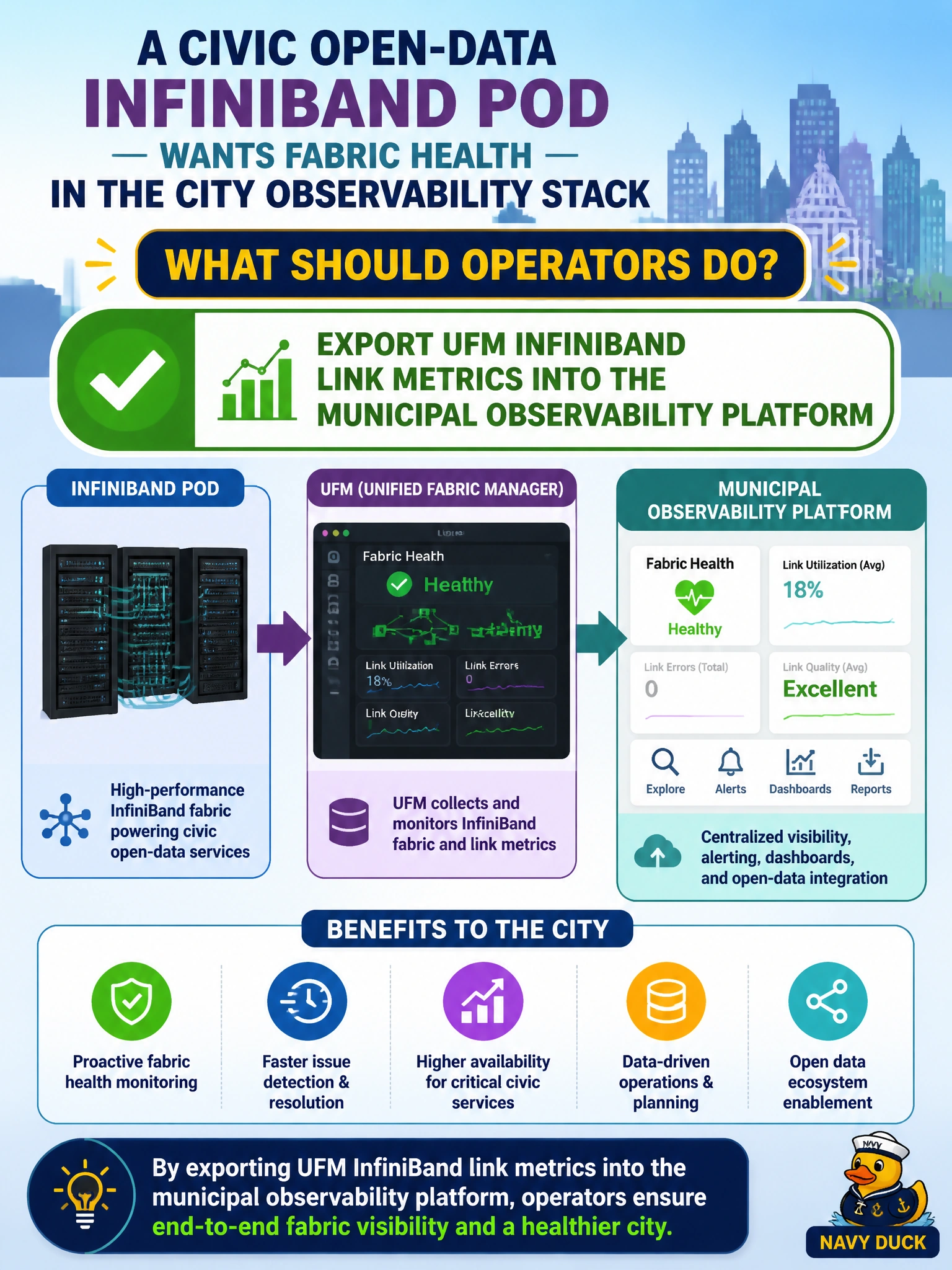
Host HCA counters or switch-side SNMP can't stand in for real InfiniBand fabric telemetry. Export UFM's link metrics into the city's observability platform so you get IB health showing up where operators already look.
Full Explanation
A civic open-data InfiniBand pod that needs fabric health in the city observability stack should export UFM InfiniBand link metrics into the municipal observability platform. Exporting machine-readable link status, error counters, and bandwidth series lets city operators see InfiniBand health beside the same dashboards and paging rules used for other civic services. That integration operationalizes fabric monitoring: anomalies become tickets and SLOs instead of tribal knowledge trapped inside a siloed UFM console.
Scraping host HCA port counters into the city dashboard as a proxy for fabric link state fails because host-level counters do not capture InfiniBand fabric link state, topology, or switch-level errors, so they cannot substitute for UFM IB-aware telemetry. Replacing UFM entirely with random SNMP polls of unrelated Ethernet gear fails conceptually: Ethernet SNMP does not represent InfiniBand link state or RDMA fabric topology, so it cannot substitute for UFM IB-aware telemetry. Streaming UFM trap events to archival object storage for quarterly compliance audits fails as an observability practice—archived traps are not queryable, alertable, or correlatable with open-data job metrics.
Exam caveat: Exporting UFM metrics does not mean discarding UFM. Keep UFM as the authoritative InfiniBand management source and treat the municipal platform as the aggregation and alerting layer. Validate metric cardinality and retention so IB export does not overwhelm city TSDB quotas.
Operational check: Configure UFM metric export (or scrape) into the city observability stack, map InfiniBand link series to civic dashboards for the open-data pod, create at least one alert on link-down or error-rate thresholds, and verify a test flap appears both in UFM and in the municipal platform within the expected latency.