
311 and SOC AI tenants accidentally share a default InfiniBand PKey. What should operators do?
Select an answer to reveal the explanation.
Short Explanation
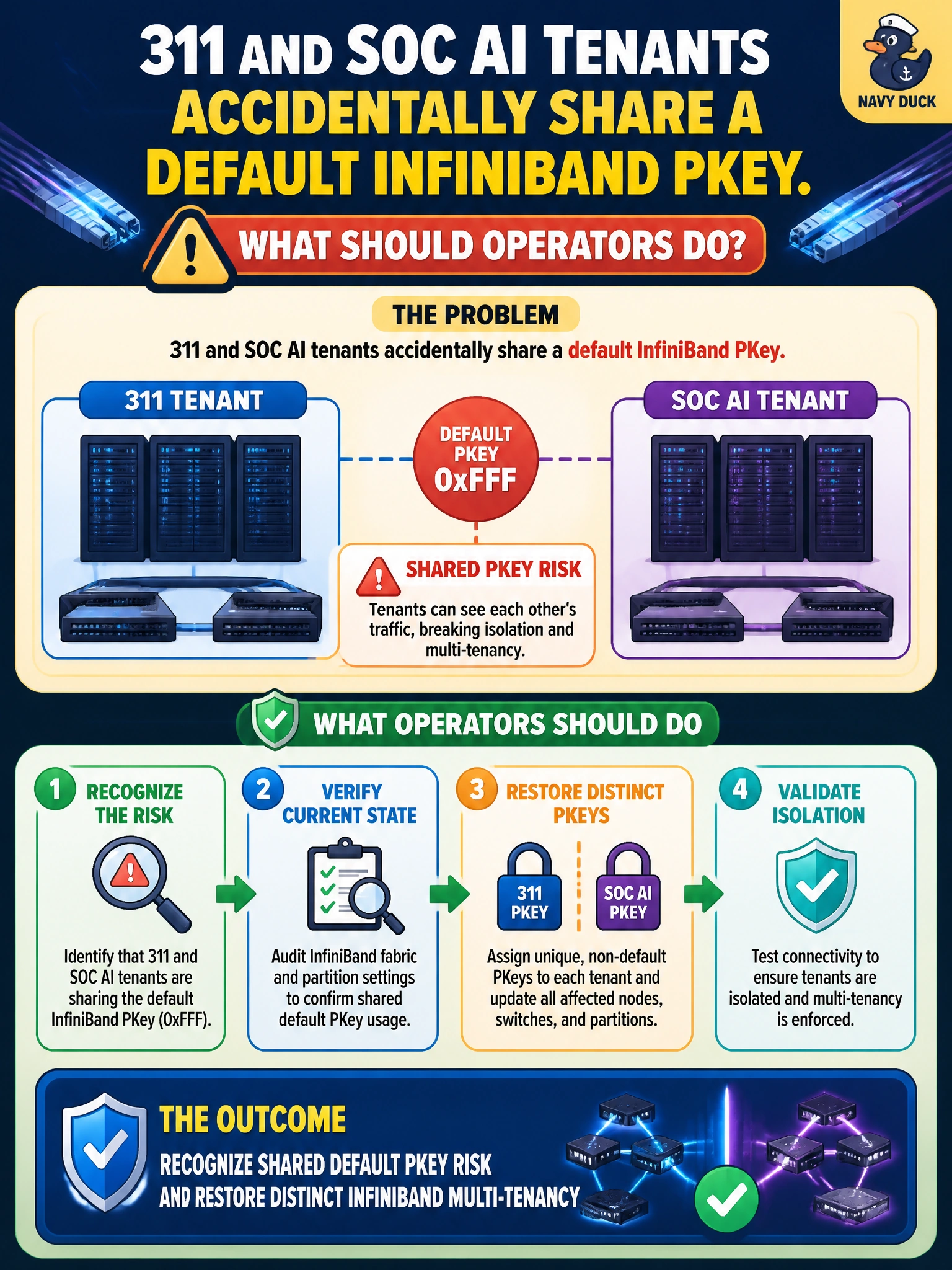
Default PKeys are the IB version of an unlocked lobby. Spot the shared-default risk and put 311 and SOC back on distinct InfiniBand partitions.
Full Explanation
If 311 and SOC AI tenants accidentally share a default InfiniBand PKey, operators must recognize shared-default PKey risk and restore distinct InfiniBand multi-tenancy. The default or broadly shared partition undermines isolation: agencies that should be separate can communicate over IB as if on one tenant. Corrective action assigns separate PKeys (and memberships) so 311 and SOC return to isolated partitions on the shared fabric. Assigning both tenant HCAs full membership in the shared default partition fails because it grants both tenants unrestricted access to the same partition, defeating isolation instead of restoring it. Rebalancing subnet manager priority while retaining the shared default PKey fails because it changes fabric management priority without fixing the underlying tenancy isolation problem; the shared PKey remains. Configuring adaptive routing and congestion control while retaining shared PKey settings fails because traffic engineering cannot substitute for partition isolation; the shared PKey still lets the tenants communicate as one fabric. Exam caveat: shared default PKey is a classic IB multi-tenancy finding; remediation is distinct partitions, not shared-default full membership, SM priority changes, or traffic tuning. Operational check: identify members of the shared default PKey, migrate 311 and SOC GUIDs to distinct tenant PKeys, remove them from the unsafe shared default for data traffic, and retest that cross-tenant RDMA fails.