
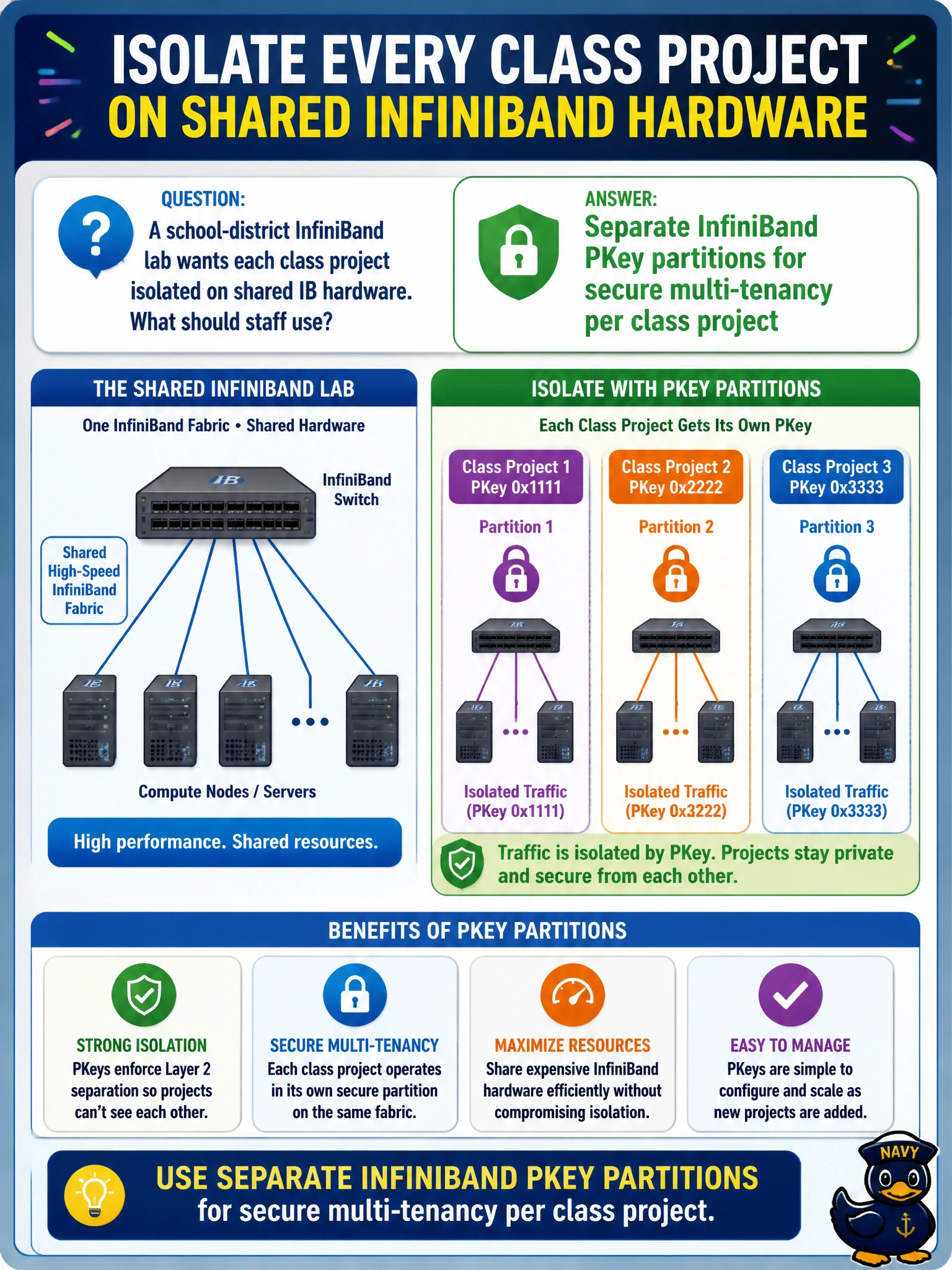
A school-district InfiniBand lab wants each class project isolated on shared IB hardware. What should staff use?
Select an answer to reveal the explanation.
Short Explanation
IP subnets and subnet-manager routing won't keep class projects off each other's RDMA traffic. Give each project its own InfiniBand PKey partition so you get real multi-tenant isolation on that shared teaching fabric.
Full Explanation
A school-district InfiniBand lab that isolates each class project on shared IB hardware should use separate InfiniBand PKey partitions for secure multi-tenancy per project. Distinct PKeys keep student or research projects from freely RDMA-peering across classes while still sharing physical GPUs and switches under district budgets. That preserves academic integrity and dataset boundaries without buying a dedicated fabric per classroom. Separate IPoIB IP subnets per class project fail by concept: IP subnet separation lives above the InfiniBand fabric and does not set PKey partition membership for RDMA paths, so it cannot provide the required project isolation on shared IB hardware. Ethernet ACLs alone without InfiniBand partition configuration fail because Ethernet ACL policy does not set IB partition membership for RDMA paths on InfiniBand. Relying on InfiniBand subnet manager routing for project traffic isolation fails: subnet manager routing does not enforce PKey partition membership, and teaching environments still host credentials, datasets, and cross-class integrity concerns that routing alone cannot address; labeling a fabric “lab” does not exempt it from IB multi-tenancy design. Exam caveat: educational civic fabrics use the same PKey isolation model as production municipal tenants; Ethernet ACLs are not an IB substitute. Operational check: map each class project to its own PKey, assign only that project’s HCA GUIDs, verify intra-project RDMA succeeds, confirm cross-project RDMA fails, and file the PKey map with school-district IT before the shared lab opens.