
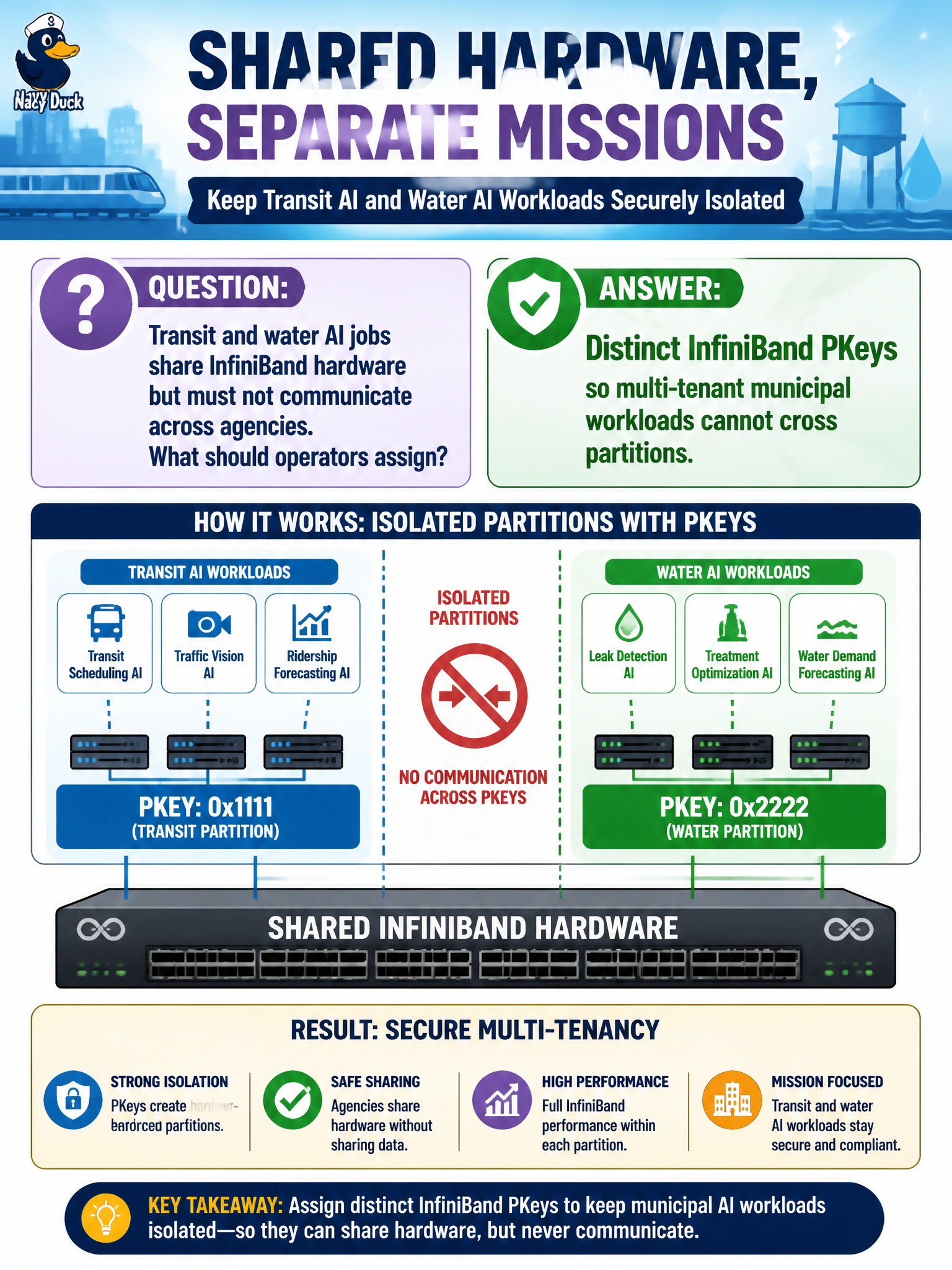
Transit and water AI jobs share InfiniBand hardware but must not communicate across agencies. What should operators assign?
Select an answer to reveal the explanation.
Short Explanation
Sharing switches is fine; sharing partitions is not. Give transit and water distinct InfiniBand PKeys so their AI jobs cannot talk across agency lines.
Full Explanation
When transit and water AI jobs share InfiniBand hardware but must not communicate across agencies, operators assign distinct InfiniBand PKeys so multi-tenant municipal workloads cannot cross partitions. Different partition memberships prevent unauthorized RDMA between transit and water while still allowing shared physical IB infrastructure under civic cost constraints. A shared InfiniBand PKey with limited membership for transit and water queues still places both agencies in the same partition, so queue misconfiguration or stale membership can let traffic cross the agency boundary; hard isolation requires distinct PKeys. Separate GUID-indexed LIDs under a shared subnet manager do not enforce agency isolation because LIDs address endpoints within a subnet and do not restrict cross-tenant RDMA the way PKey partition membership does. A common InfiniBand PKey plus distinct service levels for transit and water priority traffic only prioritizes traffic; it does not partition the fabric, so both agencies remain in one communication domain and can still reach each other. Exam caveat: isolation on shared IB is a PKey design problem, not a GUID-indexed LID workaround or a common partition with service-level differentiation. Operational check: place transit HCAs in PKey T and water HCAs in PKey W, verify intra-agency RDMA succeeds, attempt cross-agency RDMA and confirm it fails, and record the PKey map in the municipal tenancy doc.