
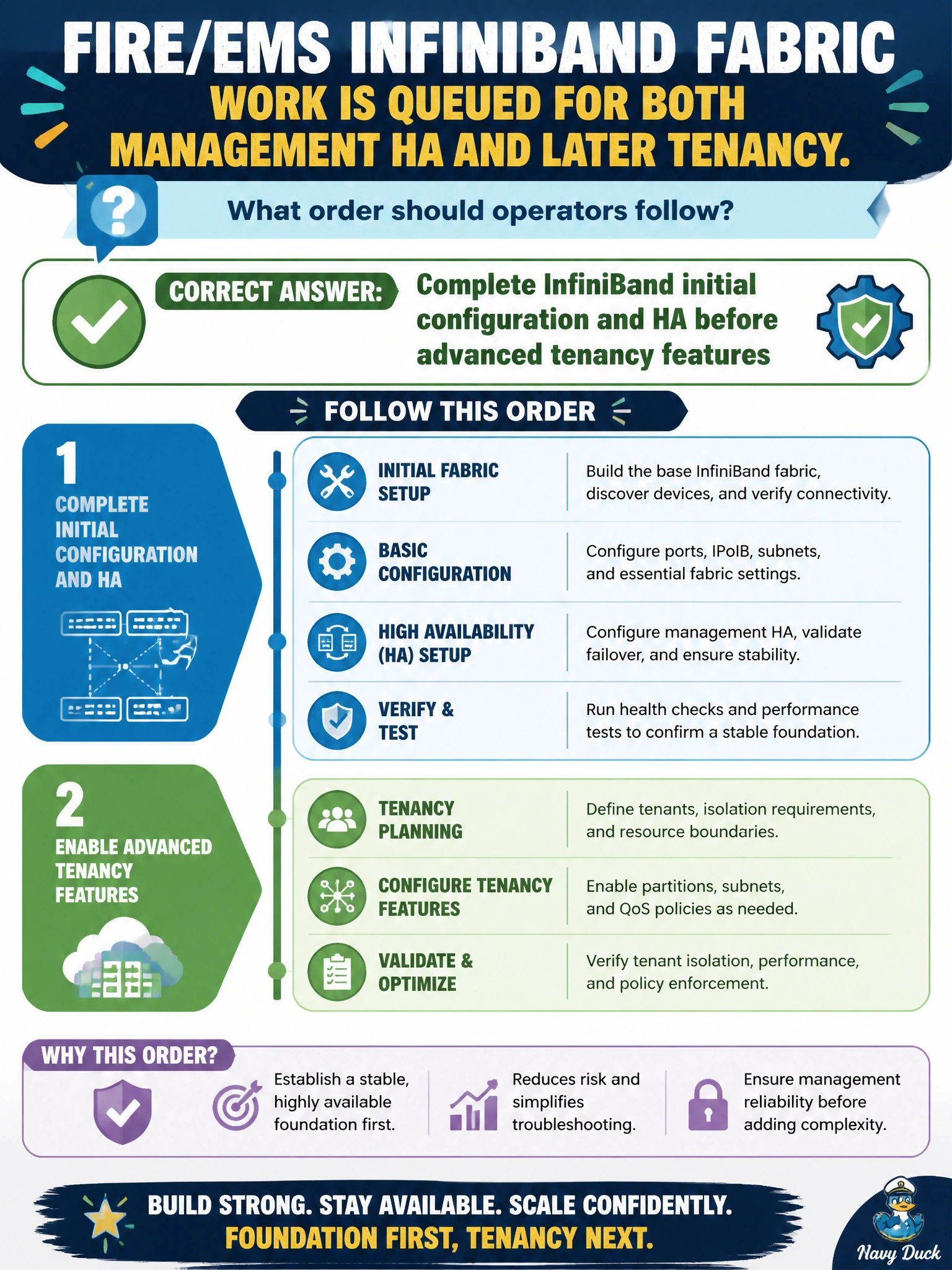
Fire/EMS InfiniBand fabric work is queued for both management HA and later tenancy. What order should operators follow?
Select an answer to reveal the explanation.
Short Explanation
Do not paint the guest rooms before the foundation cures. Finish InfiniBand initial config and HA for Fire/EMS, then layer PKey tenancy and other advanced features.
Full Explanation
For Fire/EMS InfiniBand work that includes both management HA and later tenancy, operators should complete InfiniBand initial configuration and HA before advanced tenancy features such as detailed PKey design. A stable SM, management network, firmware/OS baseline, and HA pair form the foundation; partition tenancy and other advanced features layer on a fabric that can already be managed and failed over. Configuring partition keys for tenant isolation and then deploying Subnet Manager redundancy fails by order: partitions depend on a managed fabric with an HA SM, and tenant isolation set up before SM redundancy leaves Fire/EMS isolation on an unstable control plane. Enabling adaptive routing policies and then synchronizing Subnet Managers for failover readiness fails by order: adaptive routing assumes a working SM-managed topology, and syncing SMs for failover cannot substitute for completing initial IB configuration and HA first. Deploying Unified Fabric Manager telemetry and then building core Subnet Manager services reverses priorities: UFM telemetry observes a fabric that must first be provisioned, and telemetry cannot replace initial IB configuration and core SM bring-up. Exam caveat: sequencing questions reward foundation-before-features—initial config and SM HA before PKeys, AR, and tool-only workflows. Operational check: finish Fire/EMS IB initial config, prove SM HA failover, then introduce PKey tenancy changes against the stable HA fabric and re-validate management endpoints.