
A housing authority expands InfiniBand by adding switches into an existing HA subnet-manager domain. What must operators preserve?
Select an answer to reveal the explanation.
Short Explanation
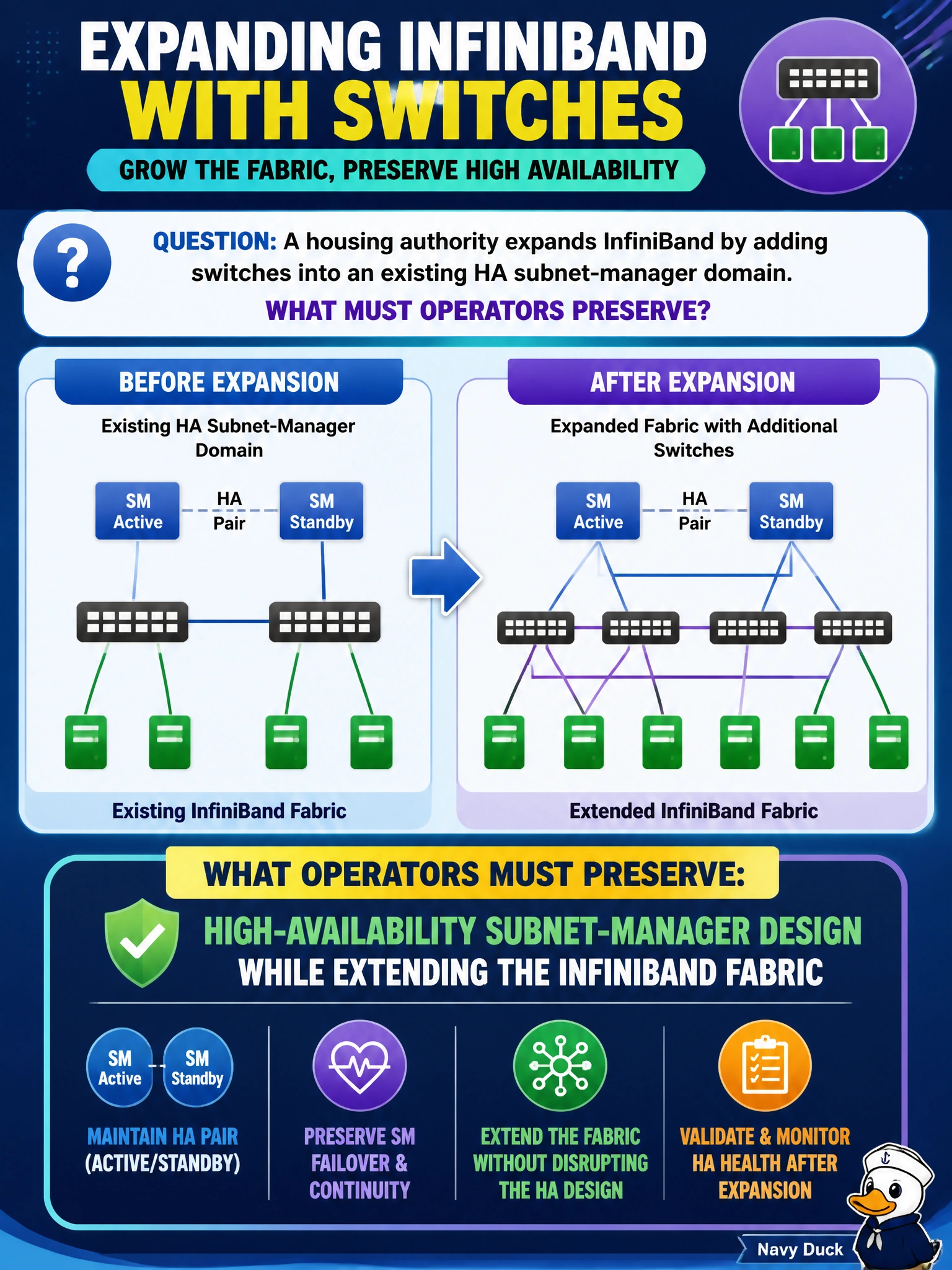
You can't promote the standby SM and assign a revised fabric identifier just to add switches. Add the housing-authority switches while keeping the existing dual subnet-manager design intact.
Full Explanation
When a housing authority adds InfiniBand switches into an existing HA subnet-manager domain, operators must preserve the high-availability SM design while extending the fabric. Expansion should enlarge the managed topology under the same dual-SM (master/standby) model so new switches inherit stable fabric management rather than promoting a standby SM with a revised fabric identifier, which would create an inconsistent management domain and a single point of failure during growth. Promoting the standby SM with a revised fabric identifier fails by concept: changing the fabric identifier during growth creates an outage window and abandons the civic HA contract just when topology change risk is highest. Unified Ethernet VLAN bridging across new switches fails because VLAN bridging does not preserve IB SM HA and discards the InfiniBand fabric the authority is extending. Default partition-key restoration on existing switches before fabric discovery fails because PKey resets are a tenancy change, not a prerequisite for switch addition, and they can break existing municipal isolation during expansion. Exam caveat: fabric growth questions often tempt candidates to “simplify” by promoting a standby with a revised fabric identifier or restoring default partition keys; correct practice keeps SM HA intact while integrating new switches. Operational check: before and after adding switches, confirm master and standby SMs remain in role, new switches appear under the existing SM domain, and no unintended partition-key restoration or fabric-identifier change occurred for housing-authority tenants.