
Water-utility engineers finish InfiniBand management IP assignment. What should they verify next for HA?
Select an answer to reveal the explanation.
Short Explanation
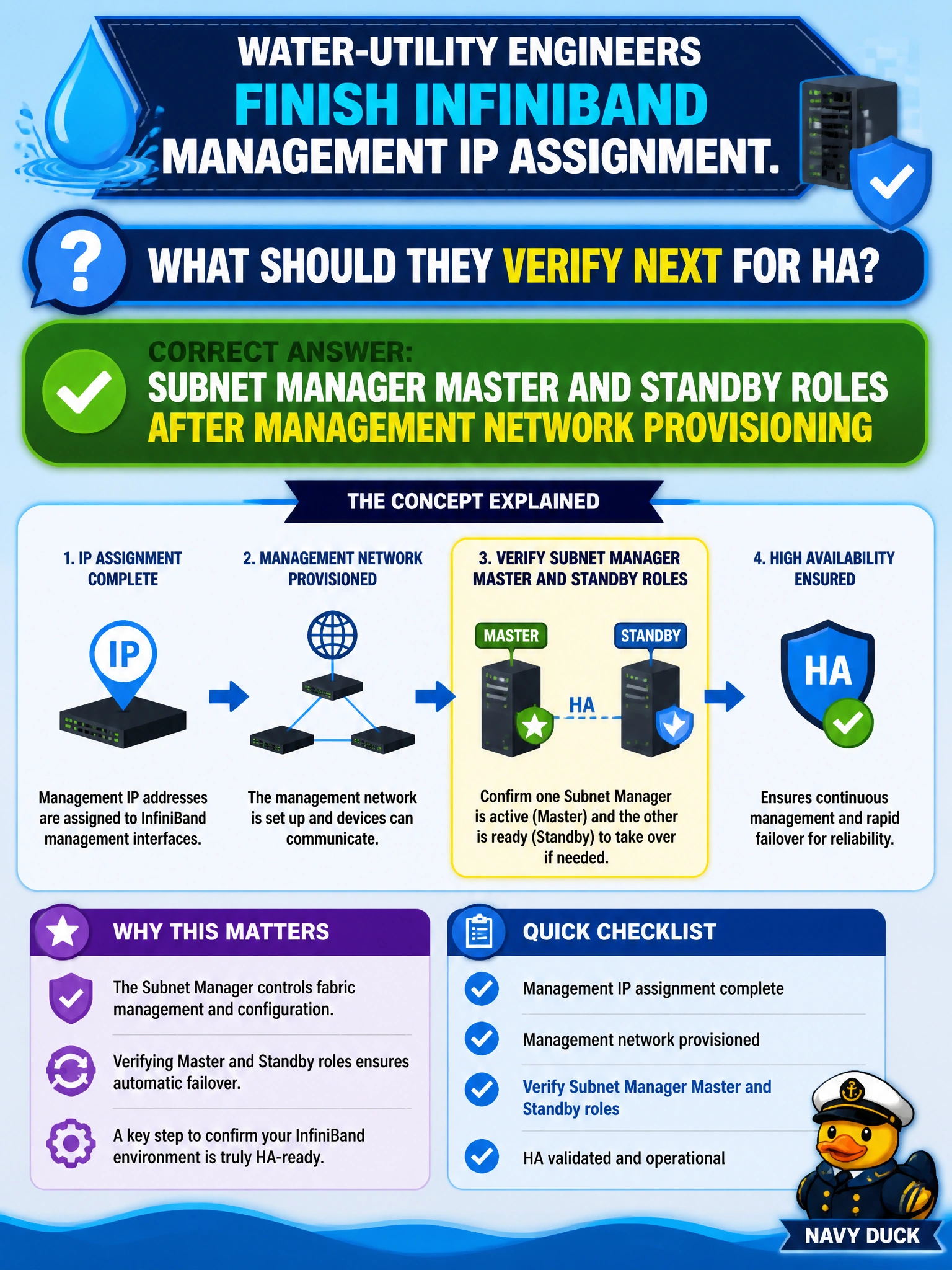
Management IPs alone do not prove HA. Check which InfiniBand SM is master and which is standby so the water-utility fabric can fail over cleanly.
Full Explanation
After water-utility engineers assign InfiniBand management IPs, the next HA validation is confirming subnet manager master and standby roles on the management network. Management addressing only proves reachability; it does not prove that dual SMs are elected, synchronized in role, and ready to fail over. Civic fabrics that run OpenSM or equivalent HA pairs must show a clear master and a living standby so a utility outage on one SM node does not strand the InfiniBand subnet. Partition key assignments on compute nodes after management network provisioning fails by concept: PKeys segment fabric traffic and do not validate subnet manager HA, so changing them does not confirm a master and standby are elected and ready to fail over for the water-utility fabric. OpenSM routing engine tuning on spine switches after management network provisioning fails because spine-switch routing tuning does not elect or confirm SM master and standby roles, and it does not prove the management HA pair can fail over without stranding the InfiniBand subnet. Adjusting UFM telemetry polling intervals for fabric health after management network provisioning fails because telemetry polling only observes fabric health; it does not perform InfiniBand subnet manager duties such as LID assignment, path computation, or SM HA failover. Exam caveat: candidates often stop at “IPs are up” and skip SM role verification, or assume changing UFM telemetry polling intervals can stand in for verifying IB SM master and standby roles. Operational check: from the management network, identify which SM is master and which is standby, confirm both are reachable on their management endpoints, and document the failover expectation for the water-utility runbook before production jobs start.