
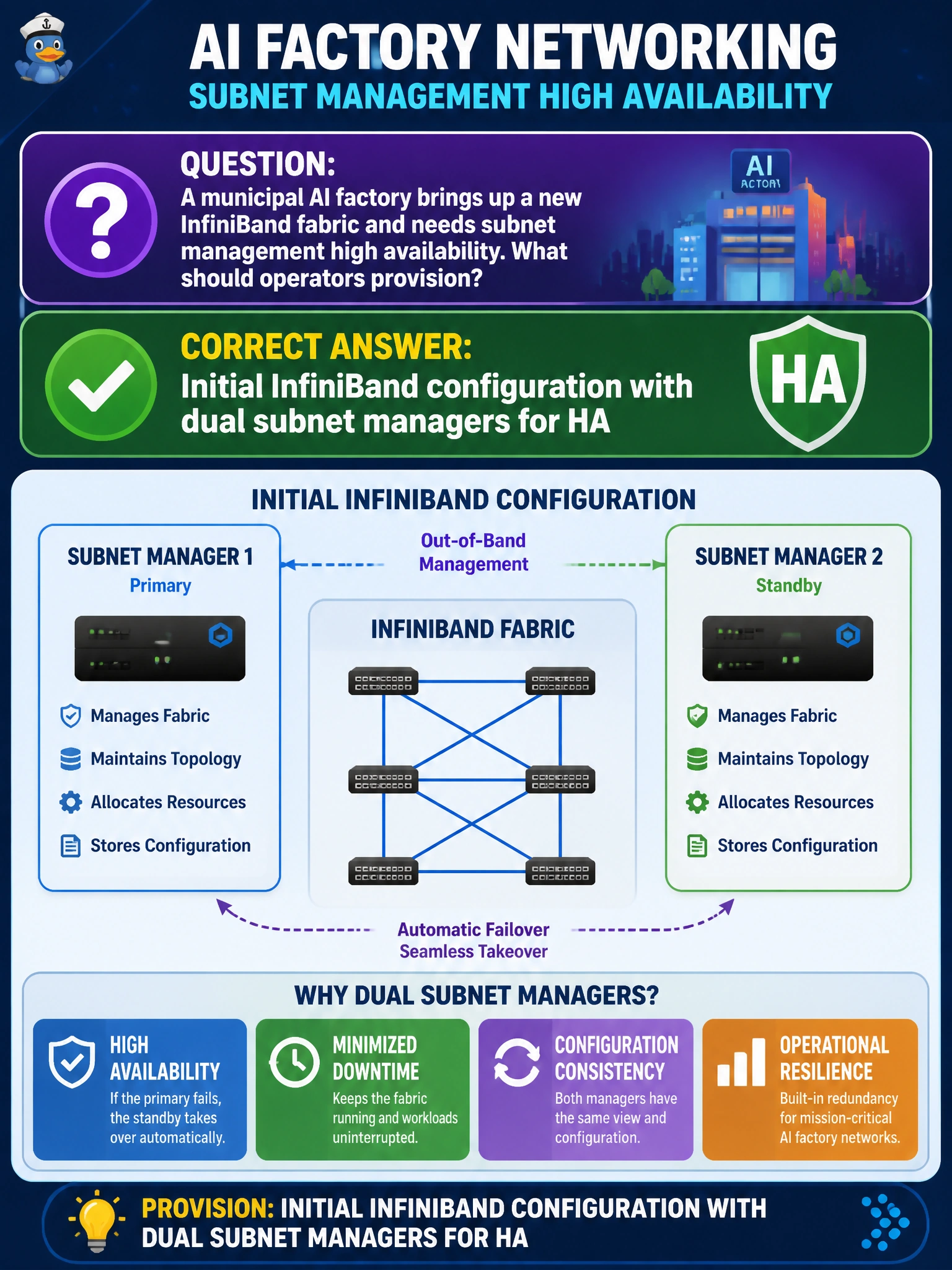
A municipal AI factory brings up a new InfiniBand fabric and needs subnet management high availability. What should operators provision?
Select an answer to reveal the explanation.
Short Explanation
Dual OpenSM instances on the same switch chassis still share one failure domain—if the chassis dies, both SMs go down and you lose HA. Provision the new InfiniBand fabric with dual subnet managers so municipal AI stays up if one SM fails.
Full Explanation
A municipal AI factory bringing up a new InfiniBand fabric that needs subnet management high availability should provision initial InfiniBand configuration with dual subnet managers for HA. Dual SMs provide active/standby (or HA pair) subnet management so a single SM failure does not freeze LID assignment, path records, or fabric management for city GPU workloads.
Dual OpenSM instances hosted on the same management switch chassis fail by concept: they share a single chassis failure domain, so one hardware failure takes out both instances—unacceptable for municipal AI factory uptime. Unified Fabric Manager telemetry for fabric performance monitoring fails as a substitute because telemetry only observes the fabric; it does not perform IB subnet management or provide HA subnet control. OpenSM daemons across GPU worker nodes for distributed mastership fails: worker nodes are not the right HA placement for subnet managers; putting SM daemons on compute workers without dedicated fabric management nodes leaves the IB fabric fragile and couples control to workloads.
Exam caveat: InfiniBand HA begins with dual subnet managers in the initial configuration; Unified Fabric Manager telemetry cannot replace IB SMs, and dual OpenSM instances on the same chassis are not HA.
Operational check: deploy two SM nodes per municipal IB design, configure HA roles and priorities, verify both are visible to the fabric, fail over in a maintenance window, and document that city GPU jobs continue with subnet management intact.