
Water-utility SuperNICs must work with Spectrum-X lossless and ECN policy. How should congestion control be set?
Select an answer to reveal the explanation.
Short Explanation
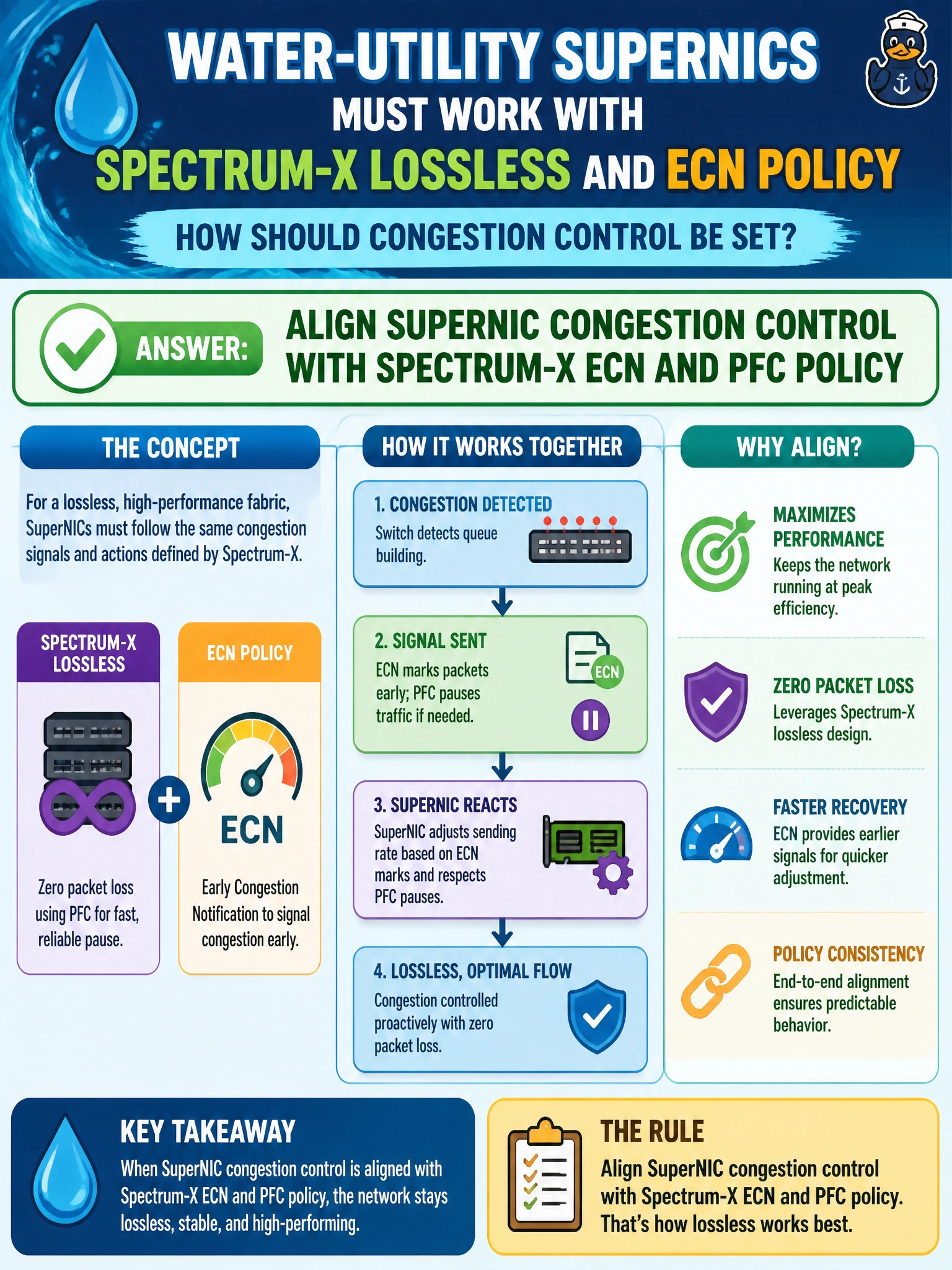
Host and leaf have to sing the same congestion song. Align SuperNIC congestion control with Spectrum-X ECN and PFC so water-utility RoCE does not fight itself end to end.
Full Explanation
Water-utility SuperNICs must work with Spectrum-X lossless and ECN policy by aligning SuperNIC congestion control with Spectrum-X ECN and PFC policy. End-to-end RoCE stability on a civic Spectrum-X fabric requires the host SuperNIC and the leaf/spine policy to agree on congestion signaling and lossless behavior; misalignment causes unnecessary pauses, marks, or drops that hurt utility analytics jobs.
Tuning SuperNIC DCQCN thresholds independently of Spectrum-X switch ECN markings fails by concept: RoCE/AI Ethernet congestion is not solved by host-only thresholds, and DCQCN thresholds set without fabric ECN alignment break the Spectrum-X lossless design by causing mismatched congestion signals. Enabling SuperNIC PFC with switch ECN thresholds tuned for standard TCP traffic fails because PFC with TCP-tuned ECN thresholds risks pause-storm behavior and incomplete congestion management for RoCE. Mapping SuperNIC queues to a Spectrum-X priority class using default QoS values fails: default QoS values strip RoCE traffic of the guaranteed lossless treatment Spectrum-X expects.
Exam caveat: SuperNIC congestion control must align with Spectrum-X ECN and PFC; independently tuned DCQCN thresholds, PFC with standard-TCP ECN thresholds, or priority-class mapping with default QoS values are incorrect for lossless municipal AI Ethernet.
Operational check: document Spectrum-X ECN/PFC classes for water-utility RoCE, mirror matching SuperNIC congestion and queue settings, validate with congestion views under load, and confirm no systemic pause storms or lossless treatment gaps from default QoS on the civic fabric.