
A city GPU fabric must distinguish SuperNIC roles from plain ConnectX NIC baselines. What should architects recognize?
Select an answer to reveal the explanation.
Short Explanation
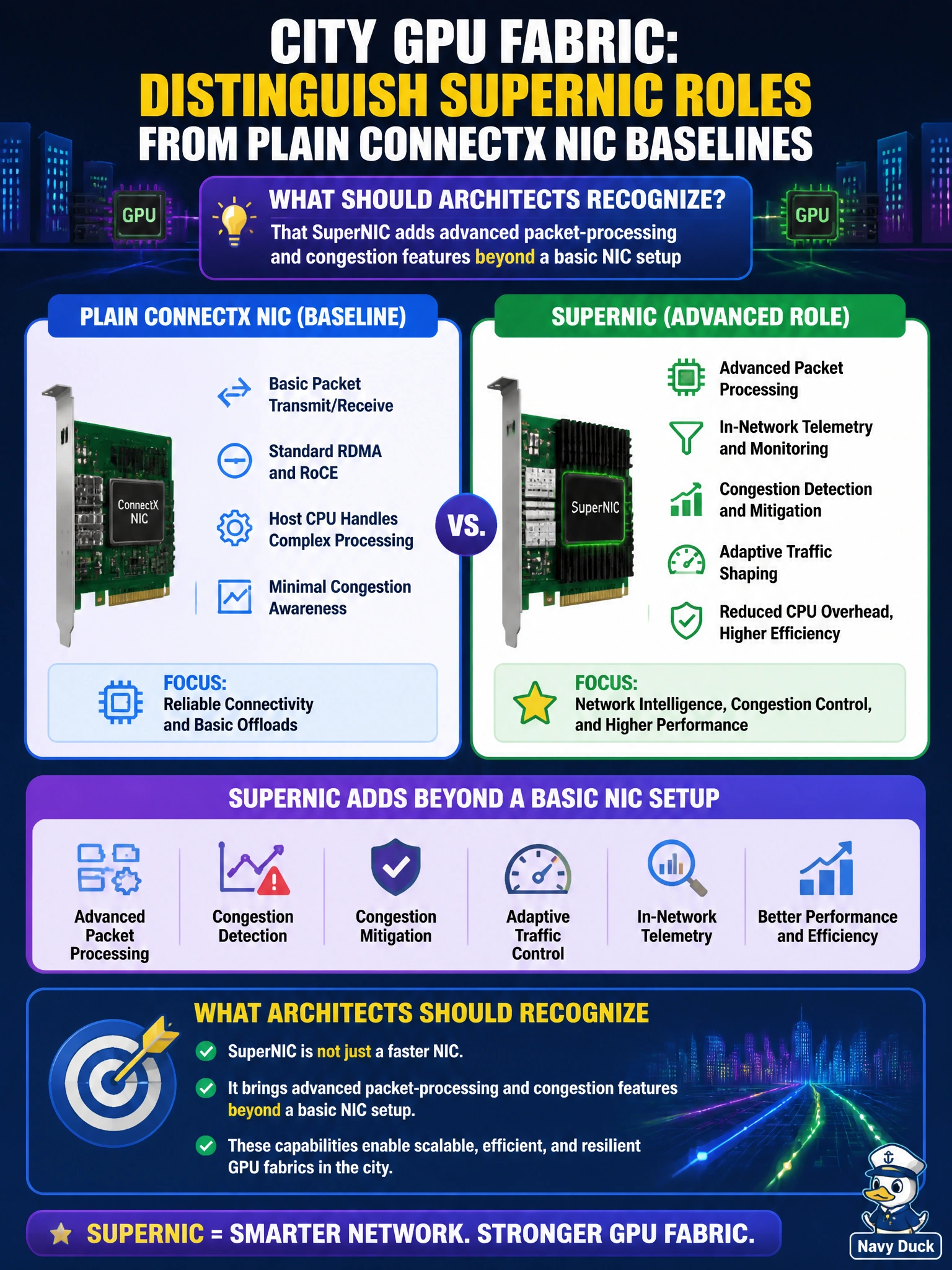
A plain ConnectX NIC is the bicycle; SuperNIC is the e-bike with packet smarts. Architects should treat SuperNIC as the advanced packet-processing and congestion option—not just another baseline Ethernet NIC.
Full Explanation
A city GPU fabric must distinguish SuperNIC roles from plain ConnectX NIC baselines by recognizing that SuperNIC adds advanced packet-processing and congestion features beyond a basic NIC setup. Architects sizing municipal AI Ethernet should treat SuperNIC as the enhanced host path for offload and congestion assists, not as interchangeable with a minimal ConnectX baseline that lacks those advanced capabilities.
Claiming SuperNIC functions as a Top-of-Rack switch aggregating east-west GPU traffic flows fails because SuperNIC is a host adapter role that offloads packet processing and congestion control, not a rack-layer switching device.
Claiming SuperNIC provides InfiniBand subnet management from the compute endpoint adapter fails because SuperNIC is positioned for advanced Ethernet/AI host networking, not IB subnet management functions on the endpoint.
Claiming ConnectX baselines integrate BlueField programmability for AI fabric congestion control fails because baseline ConnectX is a standard NIC without SuperNIC offloads or BlueField programmability by default.
Exam caveat: SuperNIC = advanced packet-processing and congestion features beyond a basic NIC; do not treat it as a Top-of-Rack switch, an endpoint IB subnet manager, or assume ConnectX baselines include BlueField congestion-control programmability.
Operational check: in the city GPU BOM and runbooks, label which hosts are SuperNIC versus baseline ConnectX, document enabled advanced features, and verify with software inventory that SuperNIC capabilities are actually present before promising civic AI offload SLOs.