
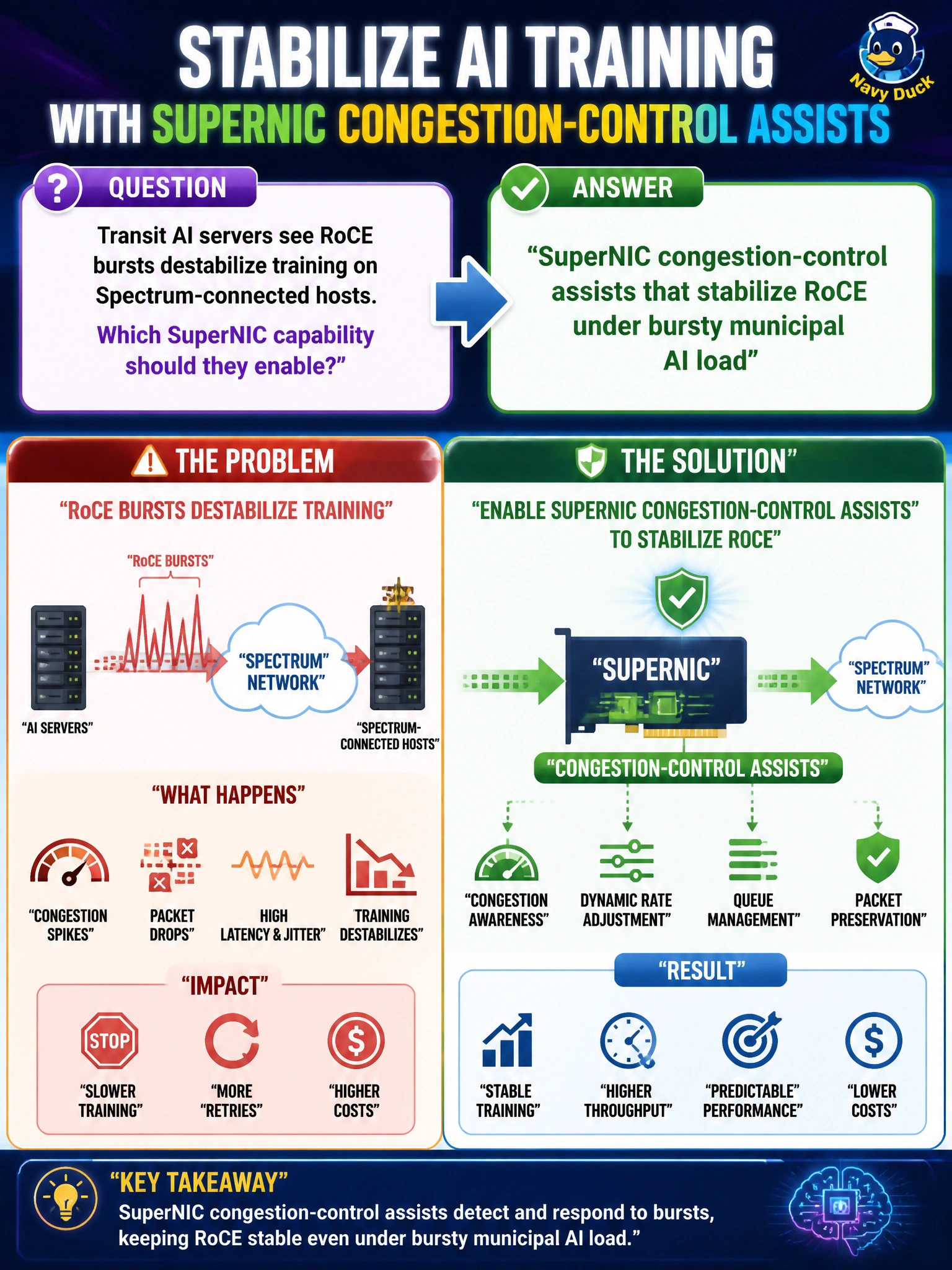
Transit AI servers see RoCE bursts destabilize training on Spectrum-connected hosts. Which SuperNIC capability should they enable?
Select an answer to reveal the explanation.
Short Explanation
RoCE bursts on transit training are like rush-hour spikes—you want congestion assists at the curb, not SR-IOV tenant-queue slicing. Enable SuperNIC congestion-control features so Spectrum-connected hosts stay stable under load.
Full Explanation
Transit ML operators seeing RoCE bursts on Spectrum-connected hosts should enable SuperNIC congestion-control assists that stabilize RoCE under bursty municipal AI load. Those assists help the host participate correctly in congestion signaling and pacing so Spectrum Ethernet RoCE flows degrade gracefully instead of collapsing during rush-hour-like training spikes on the transit fabric.
SuperNIC SR-IOV partitioning for isolated tenant queues on training nodes fails by concept: SR-IOV splits hardware queues for tenant isolation and does nothing to stabilize RoCE bursts or provide congestion signaling and pacing on Spectrum-connected hosts. SuperNIC RDMA connection scaling with Spectrum ECMP hashing for distributed job placement fails because ECMP hashing and connection scaling spread traffic across paths but do not provide the congestion signaling and pacing needed to stabilize bursty RoCE flows on the data path. SuperNIC MACsec encryption offload for secure east-west RoCE traffic between municipal sites fails: MACsec encrypts traffic but adds no congestion-control assists, so it cannot stabilize RoCE bursts under load.
Exam caveat: under bursty municipal RoCE load, enable SuperNIC congestion-control assists; do not rely on SR-IOV partitioning, RDMA/ECMP scaling, or MACsec offload to stabilize bursts.
Operational check: confirm DOCA/SuperNIC software is present on transit GPU hosts, enable congestion-control assists aligned to Spectrum ECN/PFC, generate or wait for a bursty training window, and verify RoCE stability metrics and civic job completion improve versus the pre-change baseline.