
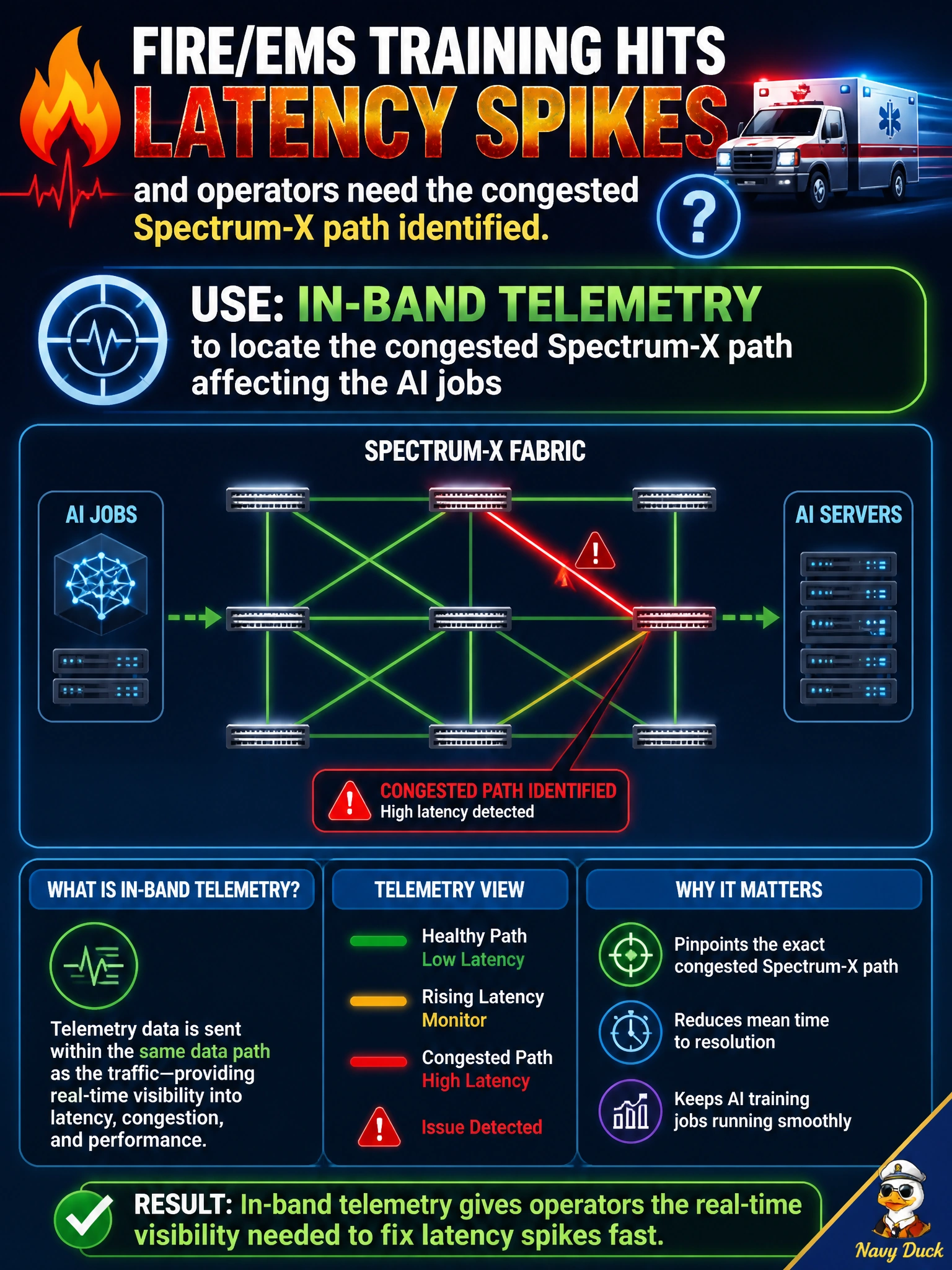
Fire/EMS training hits latency spikes and operators need the congested Spectrum-X path identified. What should they use?
Select an answer to reveal the explanation.
Short Explanation
Fire/EMS latency spikes need a fabric heat map, not SNMP polling of Spectrum-X interface counters. In-band telemetry shows which Spectrum-X path is congested so you fix the right link instead of guessing.
Full Explanation
When Fire/EMS training hits latency spikes and operators need the congested Spectrum-X path identified, they should use in-band telemetry to locate the congested Spectrum-X path affecting the AI jobs. In-band telemetry provides path- and hop-aware visibility into where queues build and latency accumulates, which is what emergency-services AI training needs when spikes appear. Identifying the congested path lets municipal operators remediate the right uplink, leaf, or ECMP member instead of guessing.
SNMP polling of Spectrum-X interface counters to track uplink utilization trends fails by concept: it provides only periodic snapshots and cannot pinpoint the exact congested hop or path causing latency spikes in real time. sFlow sampling on Spectrum-X switches to profile traffic flows for bottleneck analysis fails because it samples packets without providing the per-flow latency and congestion visibility that in-band telemetry delivers. GPU-based NCCL bandwidth tests to validate collective performance across nodes fail because they measure application-level throughput, not network path congestion, and cannot identify the congested Spectrum-X link causing latency spikes.
Exam caveat: in-band telemetry locates the congested path; it does not by itself choose between adding capacity, retuning ECN/PFC, or moving jobs—that remains an engineering decision. Operational check: during a Fire/EMS training spike, pull in-band telemetry for the job’s flows, identify the hot Spectrum-X path, confirm with WJH or interface counters, remediate that path, and verify training latency returns to baseline with telemetry still enabled.