
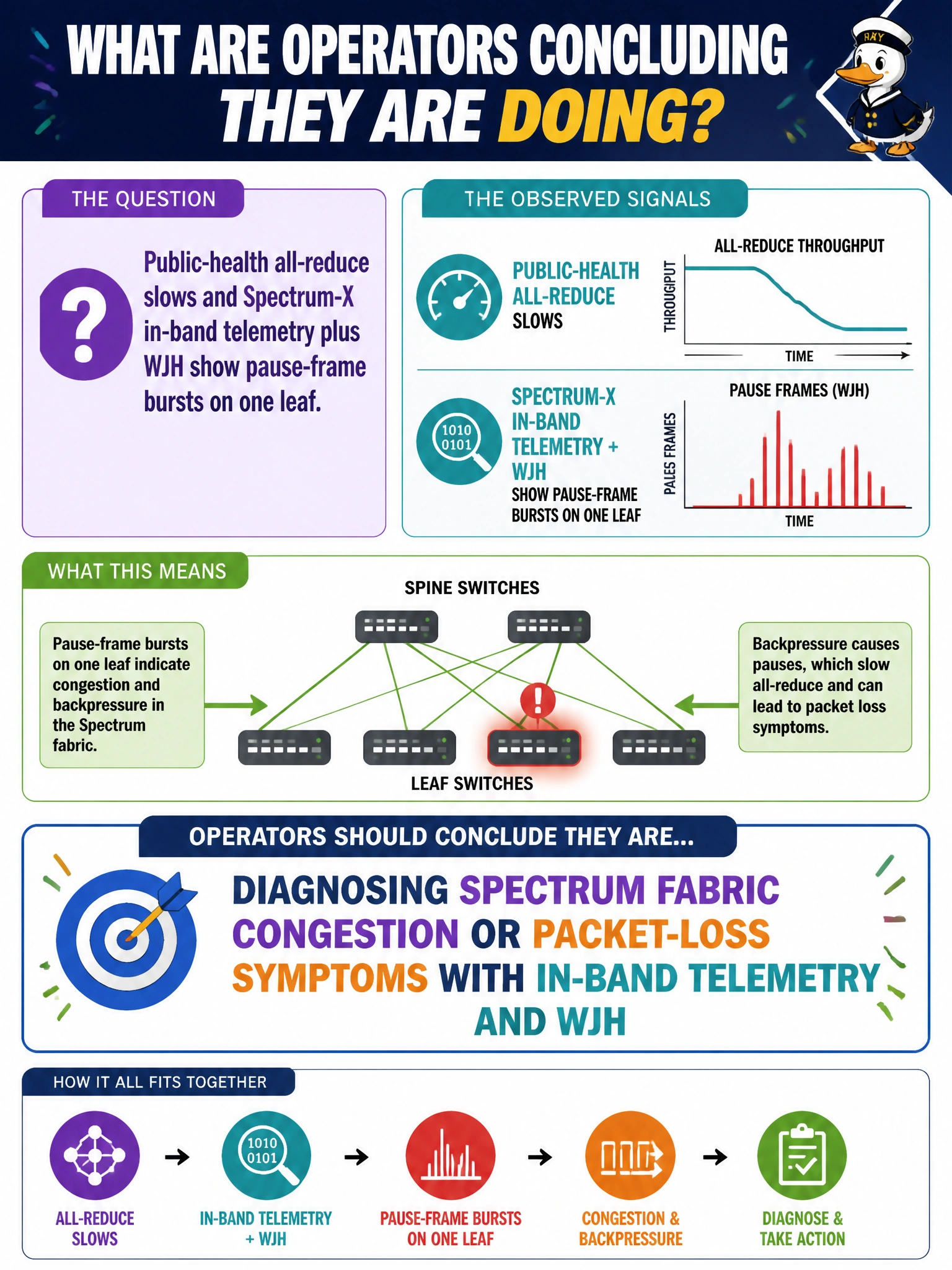
Public-health all-reduce slows and Spectrum-X in-band telemetry plus WJH show pause-frame bursts on one leaf. What should operators conclude they are doing?
Select an answer to reveal the explanation.
Short Explanation
When public-health all-reduce crawls and WJH lights up pause-frame bursts, the fabric is waving a flag—listen to it. In-band telemetry plus What Just Happened are how you diagnose Spectrum congestion instead of blindly restarting jobs.
Full Explanation
When public-health all-reduce slows and Spectrum-X in-band telemetry plus What Just Happened (WJH) show pause-frame bursts on one leaf, operators should conclude they are diagnosing Spectrum fabric congestion or packet-loss symptoms with in-band telemetry and WJH. Those Spectrum observability tools surface queue pressure, pause behavior, and discard-related events that explain why collective communication stalls. For a civic public-health fabric, listening to fabric signals is the disciplined first response—not restarting training frameworks in the dark.
Profiling NCCL collective algorithm selection using host-side CUDA traces for all-reduce fails by concept: it inspects how the collective is implemented on the GPU side, not why pause frames are bursting on the Spectrum fabric underneath it, so it leaves the actual congestion unexamined. Tuning Spectrum-X adaptive routing and ECN marking thresholds to relieve leaf congestion jumps to a remediation before the diagnosis is confirmed; changing routing and marking without first reading what the in-band telemetry and WJH say about the specific leaf risks masking the symptom or disturbing paths that are not actually congested. Correlating NetQ fabric validation events with BGP session flaps on the affected leaf chases a routing-protocol explanation for a pause-frame and congestion symptom—RoCE pause bursts are a PFC and queue phenomenon, not evidence of BGP instability, so this correlation points at the wrong layer.
Exam caveat: pause-frame bursts on one leaf point to congestion or PFC activity on that path; they do not automatically identify whether the root cause is oversubscription, mis-tuned PFC/ECN, a bad NIC, or a elephant-flow placement issue—those need follow-on correlation. Operational check: note the leaf and timestamps from in-band telemetry/WJH, correlate with the public-health job's all-reduce phase, inspect PFC/ECN and buffer counters on the implicated interfaces, remediate, and confirm pause bursts and job runtime improve together.