
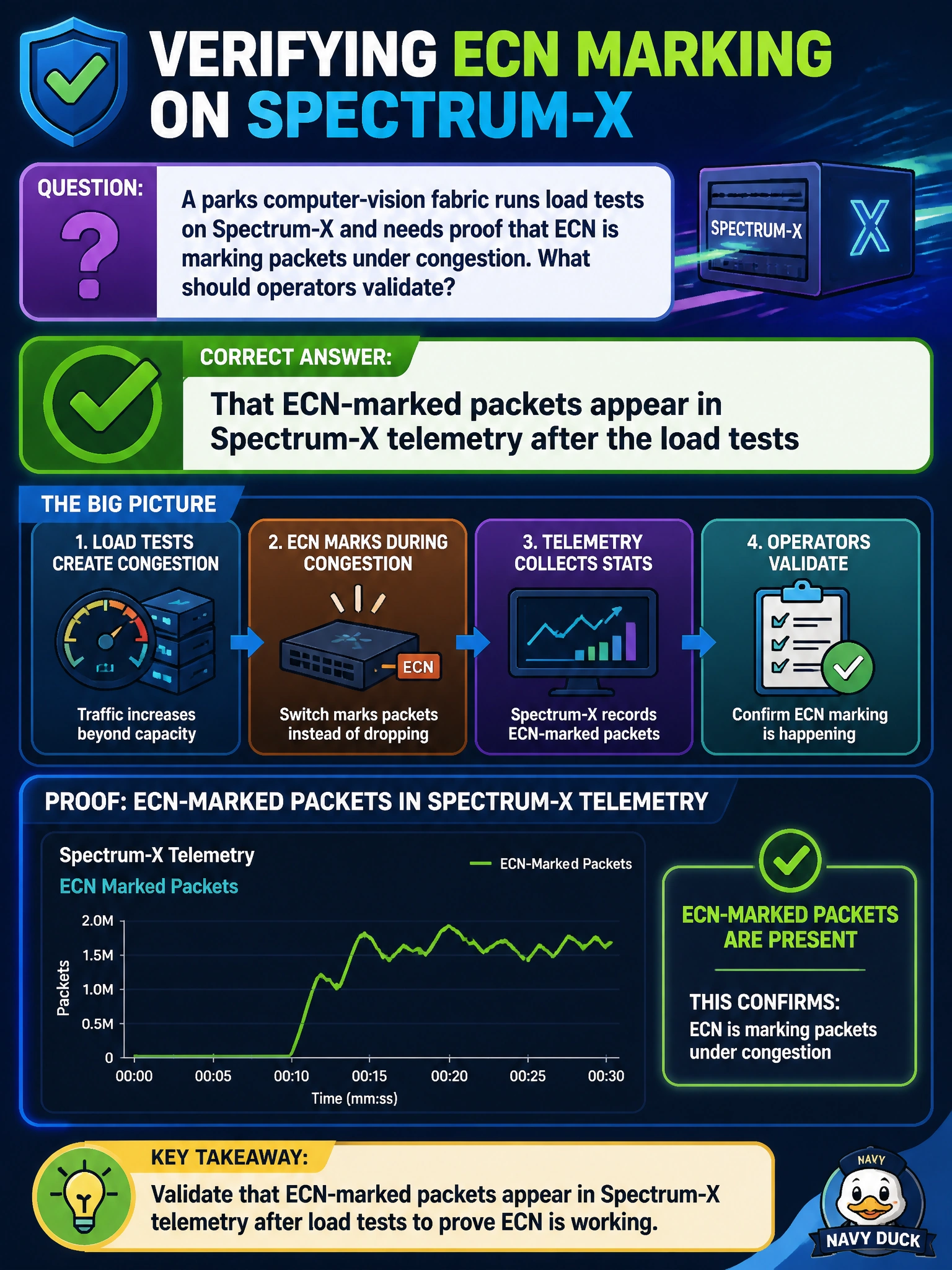
A parks computer-vision fabric runs load tests on Spectrum-X and needs proof that ECN is marking packets under congestion. What should operators validate?
Select an answer to reveal the explanation.
Short Explanation
ECN without telemetry is like painting yellow lines on a park path and never checking if bikes actually see them. After load tests, look in Spectrum-X telemetry for ECN-marked packets so you know congestion signaling is really working.
Full Explanation
In a parks computer-vision Spectrum-X fabric, proving that Explicit Congestion Notification (ECN) works under load is an evidence problem, not a configuration checkbox. Operators enable ECN so switches can mark packets when queues approach congestion thresholds, allowing RoCE endpoints to throttle before buffers overflow. The correct validation is that ECN-marked packets appear in Spectrum-X telemetry after the parks CV load tests. Telemetry that shows Congestion Experienced markings confirms the marking path from queue depth through the data plane into counters operators can read. Without that observation, enablement could be incomplete, mismatched on leaves versus hosts, or masked by counter filters.
PFC pause frame counters incrementing in Spectrum-X telemetry during the load tests does not prove ECN marking, because pause frames are link-level flow-control signals distinct from ECN packet marks. PFC and ECN are complementary congestion tools in many AI Ethernet designs; seeing pause-frame counters rise tells you about pause behavior, not whether ECN is marking packets for the parks workload. ECN threshold configuration showing in Spectrum-X telemetry after the load tests does not prove ECN marking, because a configured threshold is only a setting and does not show that packets were actually marked when queues congested. Packet drop counters increasing in Spectrum-X telemetry during the load tests does not prove ECN marking, because drops indicate packet loss rather than ECN's Congestion Experienced marks and may mean marking did not happen before buffers overflowed.
Exam caveat: seeing ECN marks after a load test proves marking and telemetry export under that synthetic stress; it does not by itself prove that end-to-end RoCE congestion control is optimally tuned, that PFC thresholds are correct, or that every tenant path behaves identically. Operational check: during a scheduled parks CV load window, capture Spectrum-X ECN-related counters or streaming telemetry before and after, confirm marked-packet increments on the congested leaves serving the CV racks, and retain the evidence with the change record so municipal operators can show auditors and peers that congestion signaling is live—not assumed.