
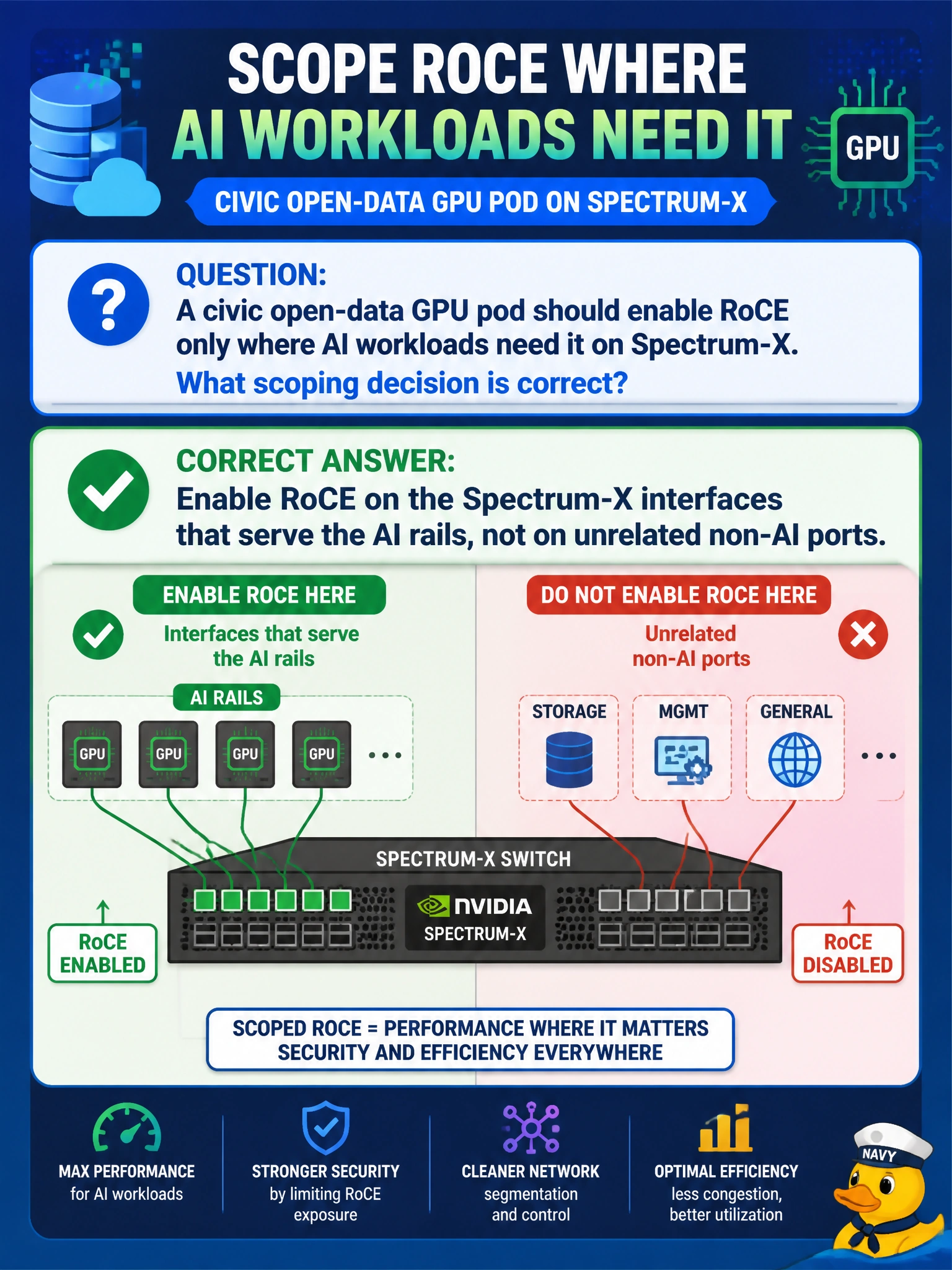
A civic open-data GPU pod should enable RoCE only where AI workloads need it on Spectrum-X. What scoping decision is correct?
Select an answer to reveal the explanation.
Short Explanation
RoCE belongs on the AI rails—the lanes where open-data GPUs actually train and serve—not on printers, badge VLANs, or guest Wi-Fi. Scope Spectrum-X RoCE to the interfaces that carry those workloads and leave the rest alone.
Full Explanation
A civic open-data GPU pod should enable RoCE on the Spectrum-X interfaces that serve the AI rails, not on unrelated non-AI ports. Scoping RoCE to where open-data training and serving actually run keeps lossless configuration, PFC/ECN, and operational attention on the rails that need RDMA, while printers, badges, and guest networks keep ordinary Ethernet behavior. That selective enablement matches Spectrum-X AI Ethernet practice and reduces blast radius.
Enabling RoCE on every printer and badge VLAN in the city spreads lossless complexity where AI workloads do not run and creates unnecessary operational risk. Disabling RoCE on all AI rails while enabling it only on guest Wi-Fi inverts the requirement: guests do not need RoCE, and the open-data GPUs do. Enabling RoCE solely on out-of-band serial consoles is meaningless for tensor traffic; consoles are not the AI data path.
Exam caveat: RoCE scoping follows the AI workload attachment points (rails), not citywide VLANs or OOB consoles. Operational check: inventory Spectrum-X ports on the open-data pod’s AI rails, enable RoCE only there with matched host settings, and explicitly leave printer, badge, guest Wi-Fi, and serial-console interfaces on non-RoCE policy; re-check after changes that no one “helpfully” enabled RoCE citywide.