
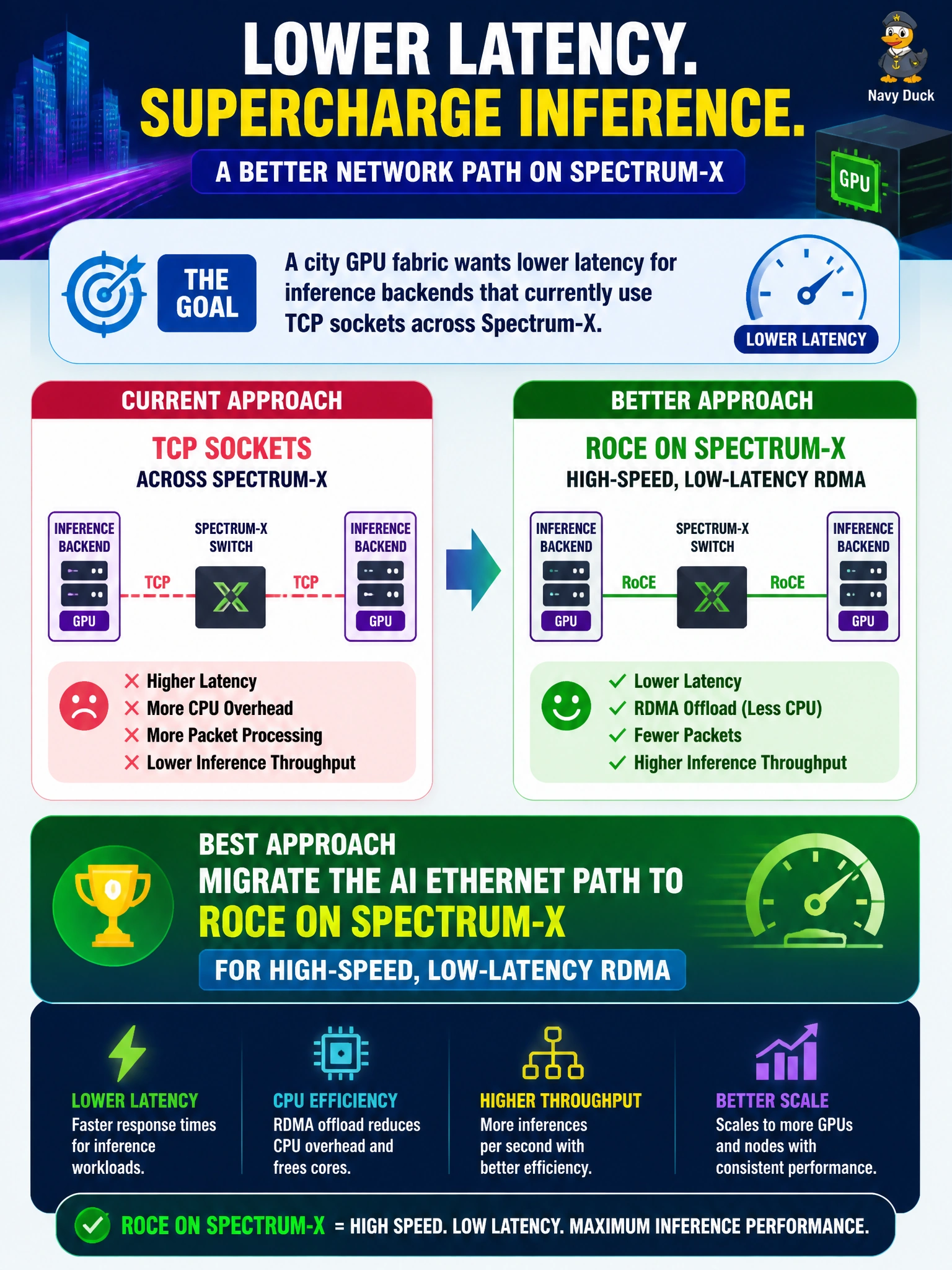
A city GPU fabric wants lower latency for inference backends that currently use TCP sockets across Spectrum-X. Which approach best meets that networking goal?
Select an answer to reveal the explanation.
Short Explanation
TCP sockets on the AI fabric are the scenic bus route; RoCE on Spectrum-X is the subway for inference backends that need lower latency. Migrating those city GPU paths to RDMA over Converged Ethernet is the networking move that matches the goal.
Full Explanation
A city GPU fabric seeking lower latency for inference backends that currently use TCP sockets across Spectrum-X should migrate the AI Ethernet path to RoCE for high-speed, low-latency RDMA. RoCE replaces bulk of the socket copy path with RDMA operations over the same Ethernet underlay Spectrum-X provides, cutting latency and host overhead for municipal inference backends that chat frequently across leafs. That migration is the networking approach aligned with Spectrum AI Ethernet designs.
Tuning TCP socket buffers and congestion control for Spectrum-X AI Ethernet flows end to end does not remove the socket copy path; it still leaves TCP overhead and cannot match RDMA latency for frequent inference messages. Enabling jumbo frames across Spectrum-X to raise throughput for large checkpoint transfers helps bulk moves but can increase head-of-line blocking and does not reduce latency for small inference exchanges. Raising Spectrum-X telemetry sampling to track inference queue depth in detail gives visibility into queues but does not by itself lower latency; it observes the problem instead of fixing the data path.
Exam caveat: the improvement lever is RoCE/RDMA on Spectrum-X, not TCP buffer tuning, jumbo frames, or extra telemetry sampling. Operational check: baseline TCP inference latency, enable RoCE with matched host/switch QoS, re-measure p50/p99 across the city GPU path, and keep Spectrum-X telemetry on to prove the gain; reject fixes that merely tune TCP buffers, enable jumbo frames, or raise telemetry sampling instead of moving to RDMA.