
A public-health inference network needs clinic models to exchange tensors across Spectrum-X leaf switches with high speed and low latency. Which configuration goal should engineers pursue?
Select an answer to reveal the explanation.
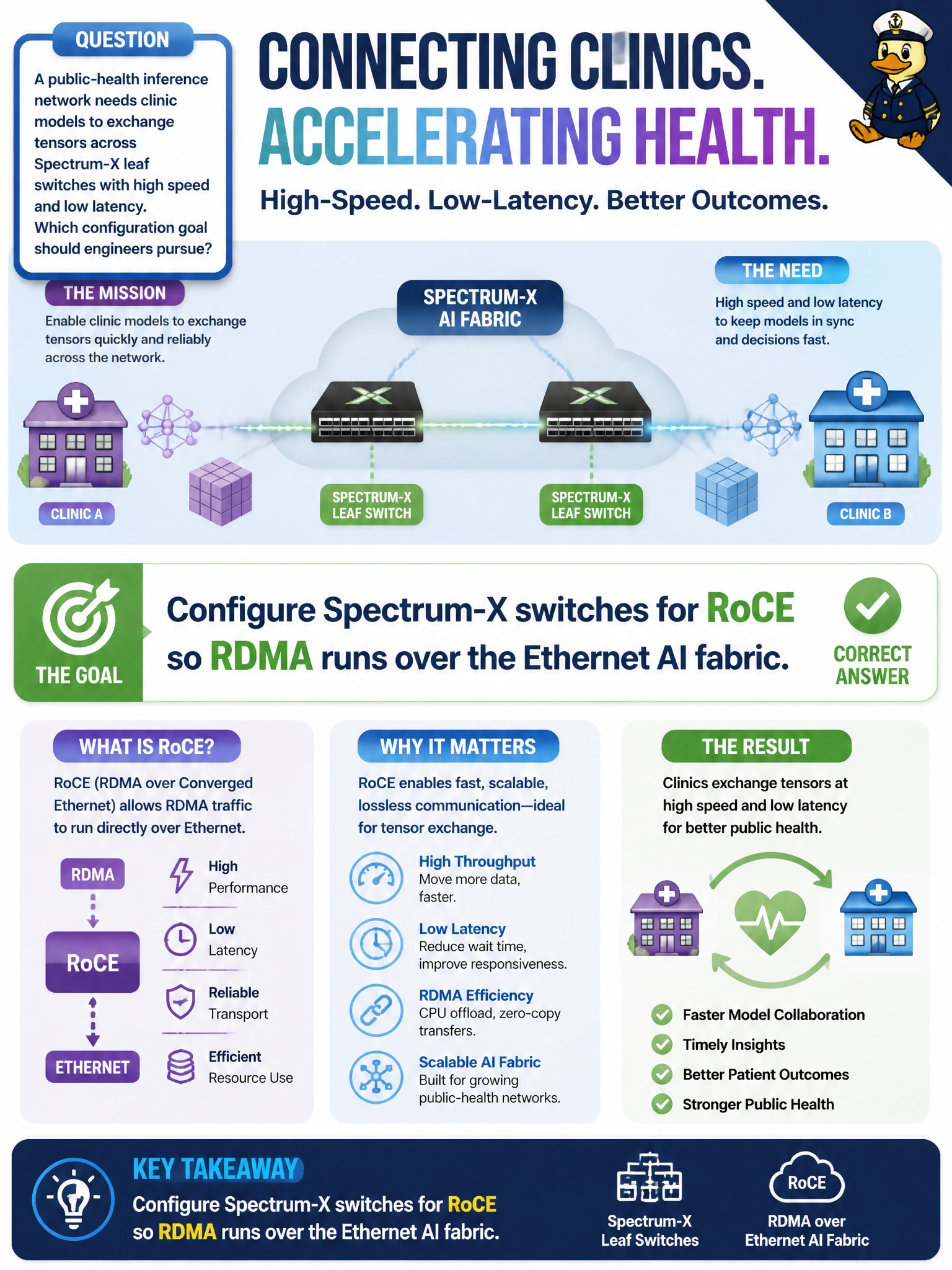
Short Explanation
RoCE is like giving the clinic models a reserved express lane on the city Ethernet streets—RDMA without building a separate InfiniBand neighborhood. Configure Spectrum-X for RoCE so those tensor exchanges stay fast and low-latency across the leafs.
Full Explanation
A public-health inference network that must exchange tensors across Spectrum-X leaf switches at high speed and low latency should configure those switches for RoCE so RDMA runs over the Ethernet AI fabric. RoCE (RDMA over Converged Ethernet) lets clinic models move tensors with kernel-bypass, low CPU overhead, and fabric-friendly latency on Spectrum-X without requiring a separate InfiniBand fabric for every pod. That configuration goal matches municipal Ethernet AI designs that still need RDMA-class collectives and inference traffic.
Running RDMA verbs over Spectrum-X without enabling lossless PFC/ECN settings exposes RoCE traffic to drops and retransmits that erase the latency benefit RDMA is supposed to deliver; RoCE needs a properly configured lossless fabric underneath it, not just RDMA verbs layered on top of best-effort Ethernet. Configuring Spectrum-X leaf ports for standard TCP transport carrying GPU collective traffic reintroduces CPU cost and higher latency that RoCE is meant to avoid, because TCP copies lack the kernel-bypass efficiency of RDMA for tensor collectives. Enabling Spectrum-X adaptive routing with standard ECMP hashing for lossy Ethernet forwarding undermines the predictable, lossless delivery that tensor collectives require, because lossy forwarding can drop or reorder inference packets and erase the latency gains RoCE is meant to provide.
Exam caveat: on Spectrum-X Ethernet AI fabrics, RoCE is the RDMA mechanism—a lossy best-effort transport, standard TCP transport carrying GPU collective traffic, and lossy ECMP forwarding are anti-patterns. Operational check: enable and validate RoCE on the Spectrum-X leaf interfaces serving public-health GPU rails, align host PFC/priority/MTU, and run a tensor/collective latency test across leafs; confirm traffic is not left on a lossy best-effort path, carried over standard TCP transport for GPU collectives as the design goal, or forwarded with lossy ECMP hashing.