
A housing authority installs a replacement GPU after a failure. What closeout steps are required?
Select an answer to reveal the explanation.
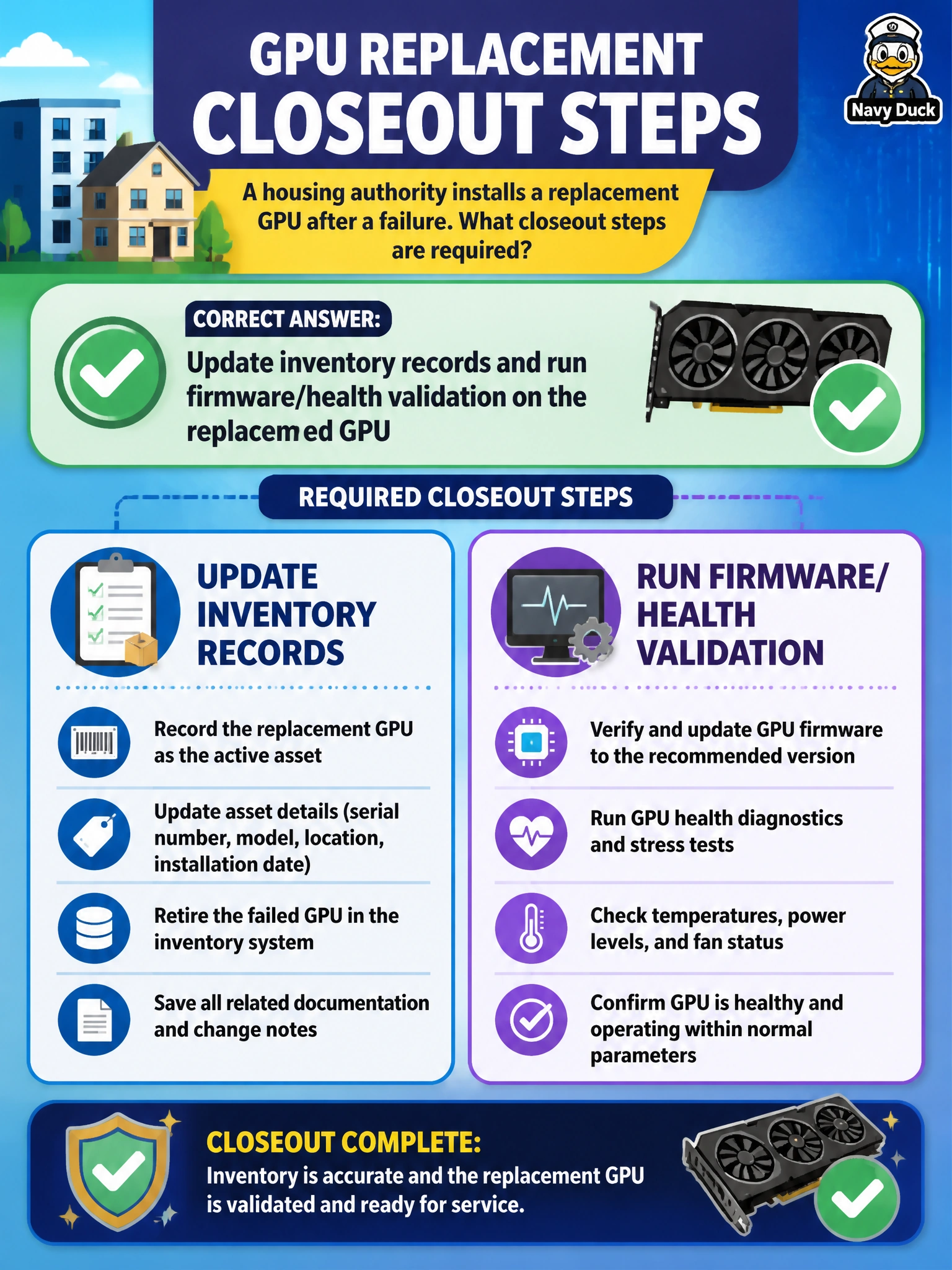
Short Explanation
Power-on isn't a graduation ceremony—update the inventory and prove firmware/health on the new GPU. Housing authority closeout needs both the paperwork and the checks.
Full Explanation
When a housing authority installs a replacement GPU after a failure, closeout requires updating inventory records and running firmware and health validation on the new GPU. Domain 5 post-replacement completeness makes civic asset truth and device readiness match what is physically in the chassis so later troubleshooting and capacity reports stay accurate. A powered chassis with a stale CMDB entry is an audit and operations failure waiting to happen. Leaving CMDB stale and skipping firmware checks creates phantom capacity and version skew that later incidents will misread. Closing the ticket solely because the chassis powered on proves AC path, not that the replacement GPU enumerates, passes health, or matches firmware policy. Wiping all cluster logs to hide the prior fault destroys forensic value and violates operational transparency without validating the new FRU. Exam caveat: firmware validation may include a controlled update if the spare arrives at an older level—document the version before returning the node to housing analytics jobs. Operational check: update CMDB serial and location for the housing authority GPU, run health and firmware checks, attach results to the ticket, then release the node to the pool.