
Transit ops builds a single-node NCCL acceptance suite for new multi-GPU servers. What should the suite include?
Select an answer to reveal the explanation.
Short Explanation
Bake NVLink topology checks into the single-node NCCL suite—transit wants proof the map matches the metal, not just a happy bandwidth number.
Full Explanation
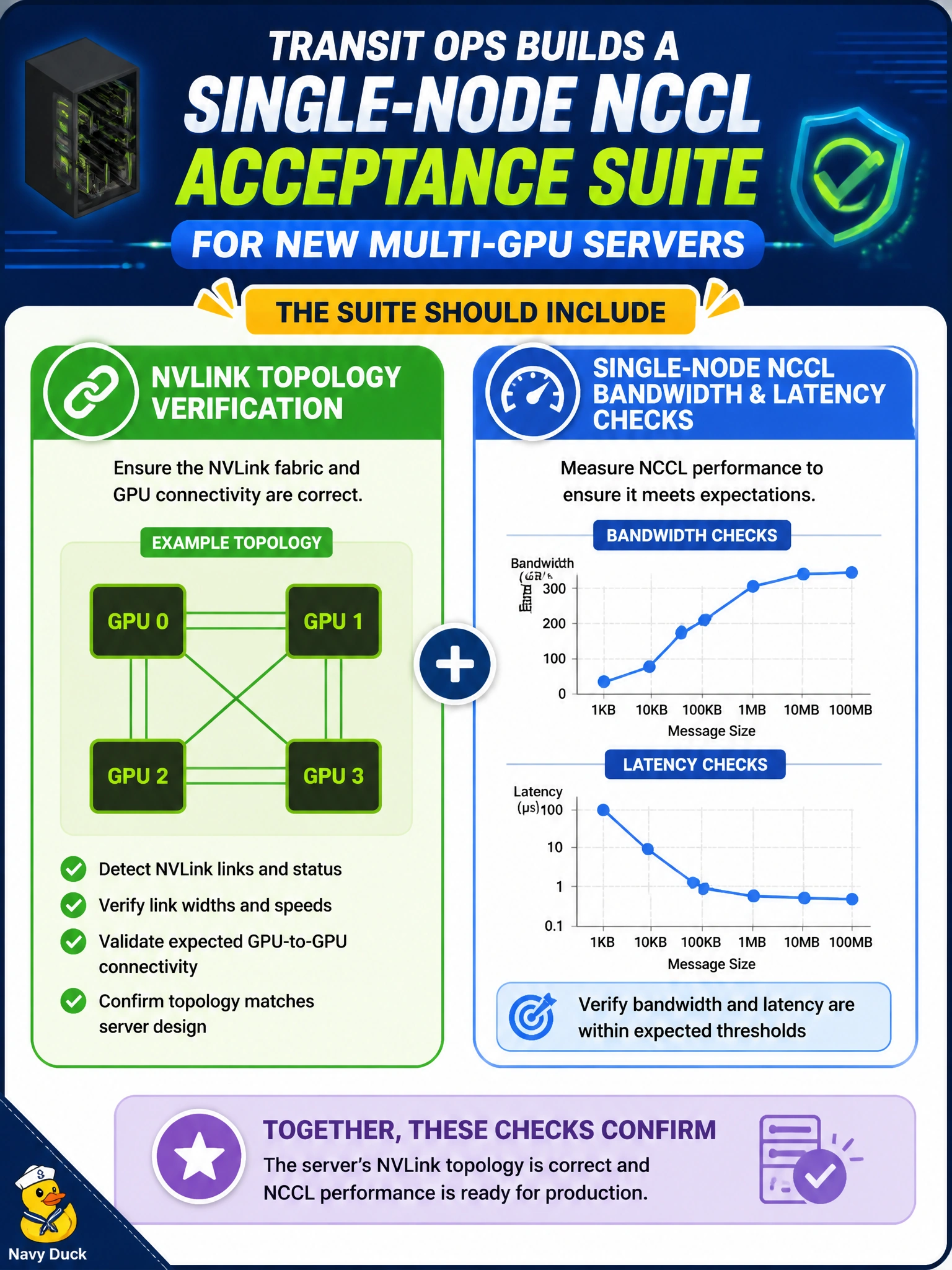
Transit’s single-node NCCL acceptance suite for new multi-GPU servers should include NVLink topology verification alongside single-node NCCL bandwidth and latency checks. Topology confirms the map matches the metal; bandwidth and latency confirm the paths perform. Together they form a complete node-local interconnect gate before any rack-level fabric work begins.
Only disk SMART short tests fail by concept because storage SMART does not validate GPU collectives or NVLink Switch paths that transit training servers depend on. Omitting NVLink topology checks to save time fails because miswired or degraded NVLink Switch configurations can still produce misleading partial bandwidth results that look acceptable without proving correct topology. Fabric east-west tests exclusively with no node-local NCCL fail sequencing—fabric tests are not a substitute for intra-node acceptance and can mis-attribute local faults to the network.
Exam caveat: Domain 4 acceptance suites explicitly combine topology verification with NCCL performance measurements on the node; time-saving omissions and disk-only distractors are common wrong answers.
Operational check: automate topology dump plus single-node NCCL bandwidth and latency into the transit acceptance job, store artifacts with the server serial and firmware versions, and block rack induction on topology mismatch or out-of-band performance.