
Transit ops must rebuild a corrupted GPU node OS while keeping shared fabric settings intact for the rack. What approach is appropriate?
Select an answer to reveal the explanation.
Short Explanation
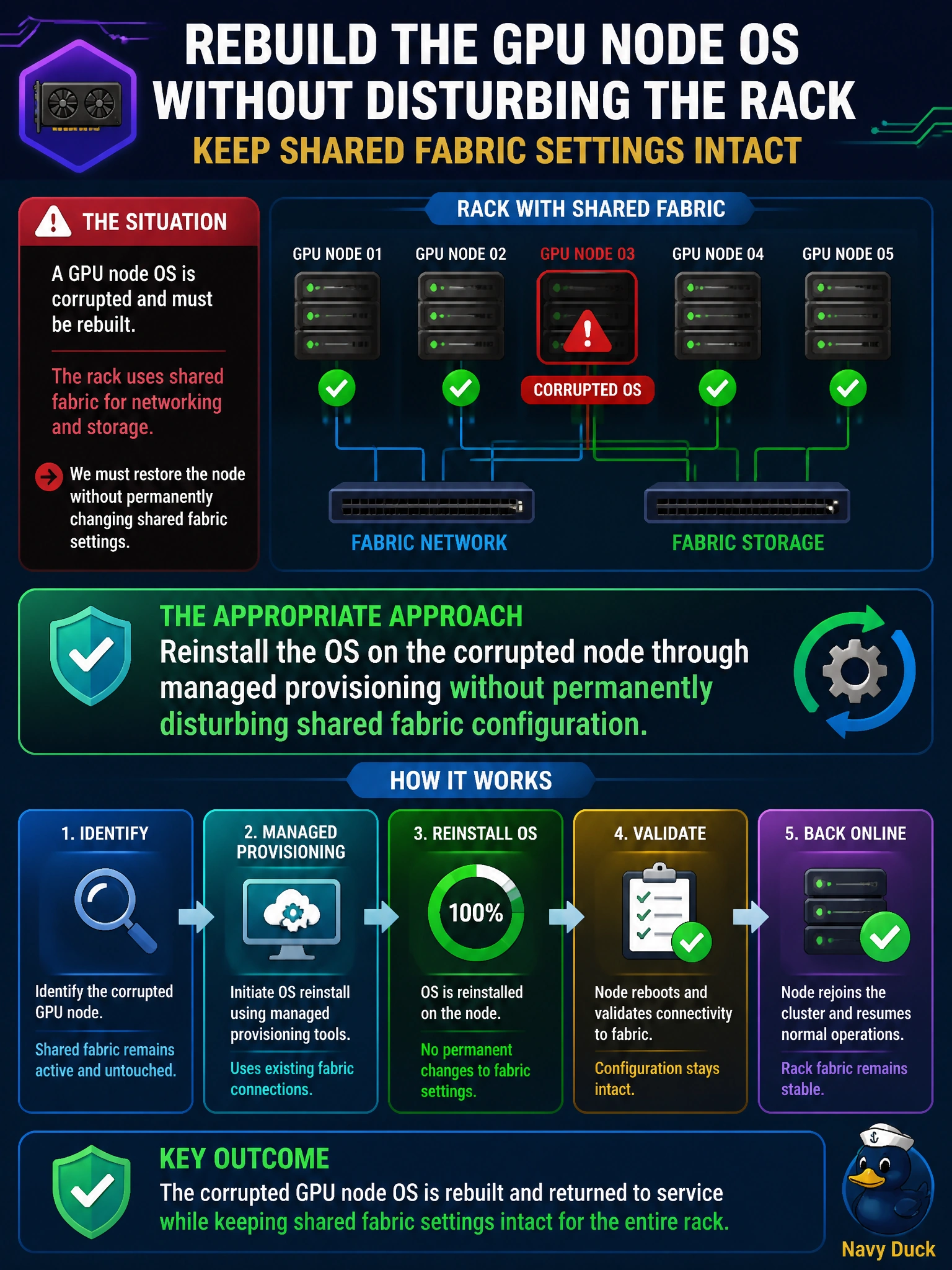
Rebuild the bad node’s OS with BCM-style provisioning and leave the shared fabric alone—like replacing one bus’s computer without rewiring the whole depot. Site-wide fabric wipes are overkill.
Full Explanation
When transit ops rebuilds a corrupted GPU node OS, the appropriate approach is managed provisioning of that node while leaving shared fabric configuration intact for the rack. The failure domain is the node’s root/OS state, not the east-west or storage fabric other buses still use. BCM-style reinstall restores the host image and software profile without permanently destroying switch configs that the rest of the depot depends on.
Wiping every switch config in the hall so the node can reinstall faster expands blast radius from one root filesystem to the entire networking plane and is not required for OS rebuild. Replacing the entire east-west fabric each time one node’s root filesystem fails confuses host OS recovery with fabric replacement and is operationally absurd. Disabling all NICs site-wide until the single node finishes imaging takes healthy nodes offline unnecessarily and does not improve imaging correctness.
Exam caveat: OS reinstall is node-scoped through managed provisioning; answers that permanently disturb shared fabric or site-wide NICs are over-scoped distractors.
Operational check: quarantine or drain the bad node, reprovision OS via BCM without saving destructive fabric changes, verify the node rejoins with correct interfaces, and confirm neighboring transit nodes retained their fabric configs throughout.