
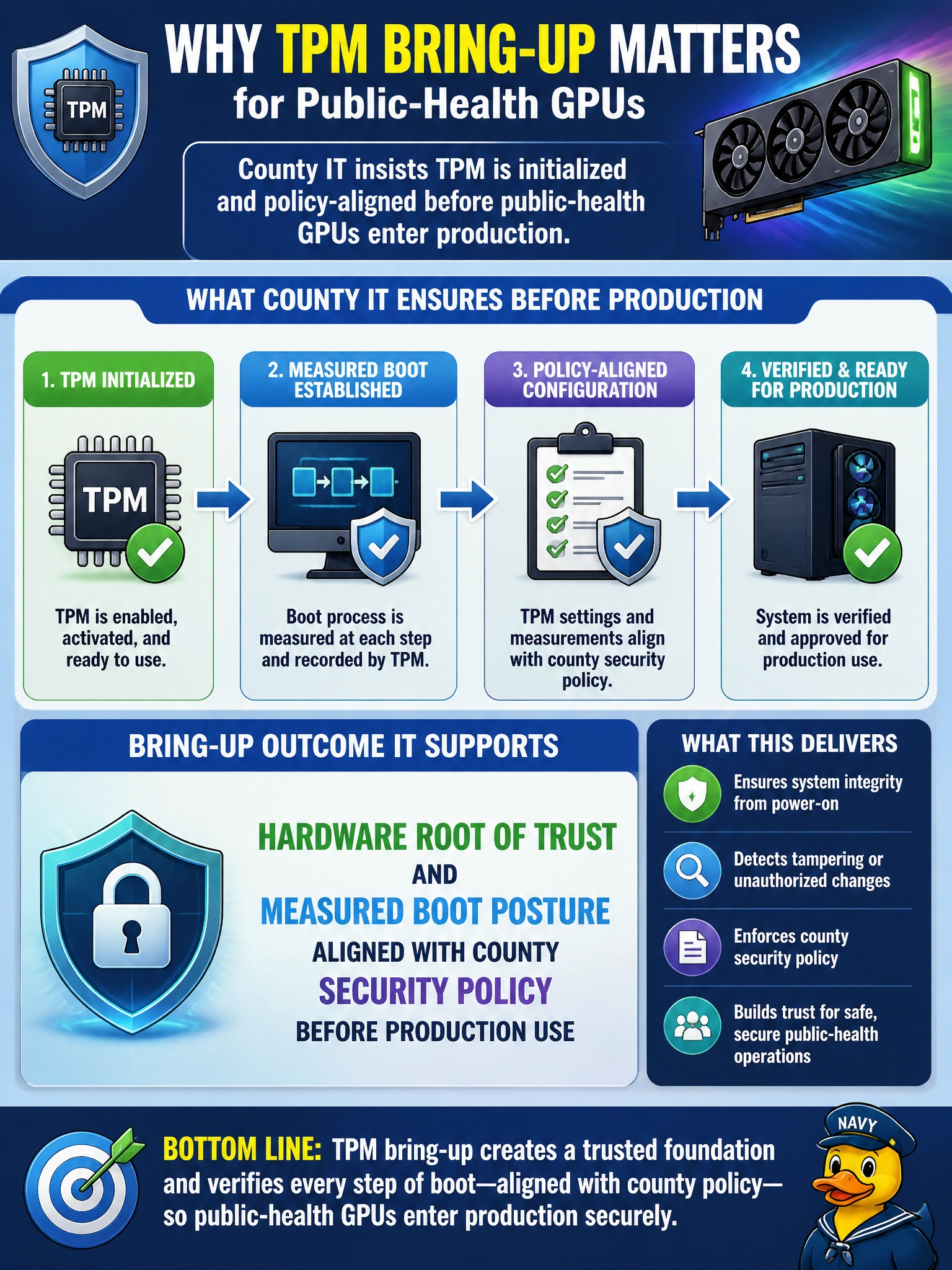
County IT insists TPM is initialized and policy-aligned before public-health GPUs enter production. What bring-up outcome does that support?
Select an answer to reveal the explanation.
Short Explanation
TPM is the county’s sealed notary stamp for the server’s boot story—not a magic GPU tuner. Initialize and align it to policy so public-health nodes join production with a trustworthy hardware root, not so you can skip power checks or drivers.
Full Explanation
Initializing TPM and aligning it to county security policy before public-health GPUs enter production establishes a hardware root of trust and measured-boot posture that later attestations and boot integrity checks can rely on. TPM enrollment binds platform identity and policy expectations to the chassis so unauthorized firmware or boot-chain changes are harder to hide once the node joins production. TPM does not replace the need for GPU drivers on the host; drivers remain mandatory for compute, while TPM addresses trust and integrity. TPM initialization also does not remove PDU power validation—facility power checks stay a separate day-0 gate. TPM enrollment does not automatically tune NCCL for all-reduce performance; collective performance comes from fabric, libraries, and job configuration, not TPM. Exam caveat: TPM readiness is necessary for policy-aligned production acceptance but not sufficient alone; firmware, drivers, and health validation still apply. Operational check: before marking a public-health GPU node production-ready, verify TPM is initialized, policy state matches the county baseline (via BMC or host tooling), and measured-boot or attestation status is recorded in the acceptance ticket.