
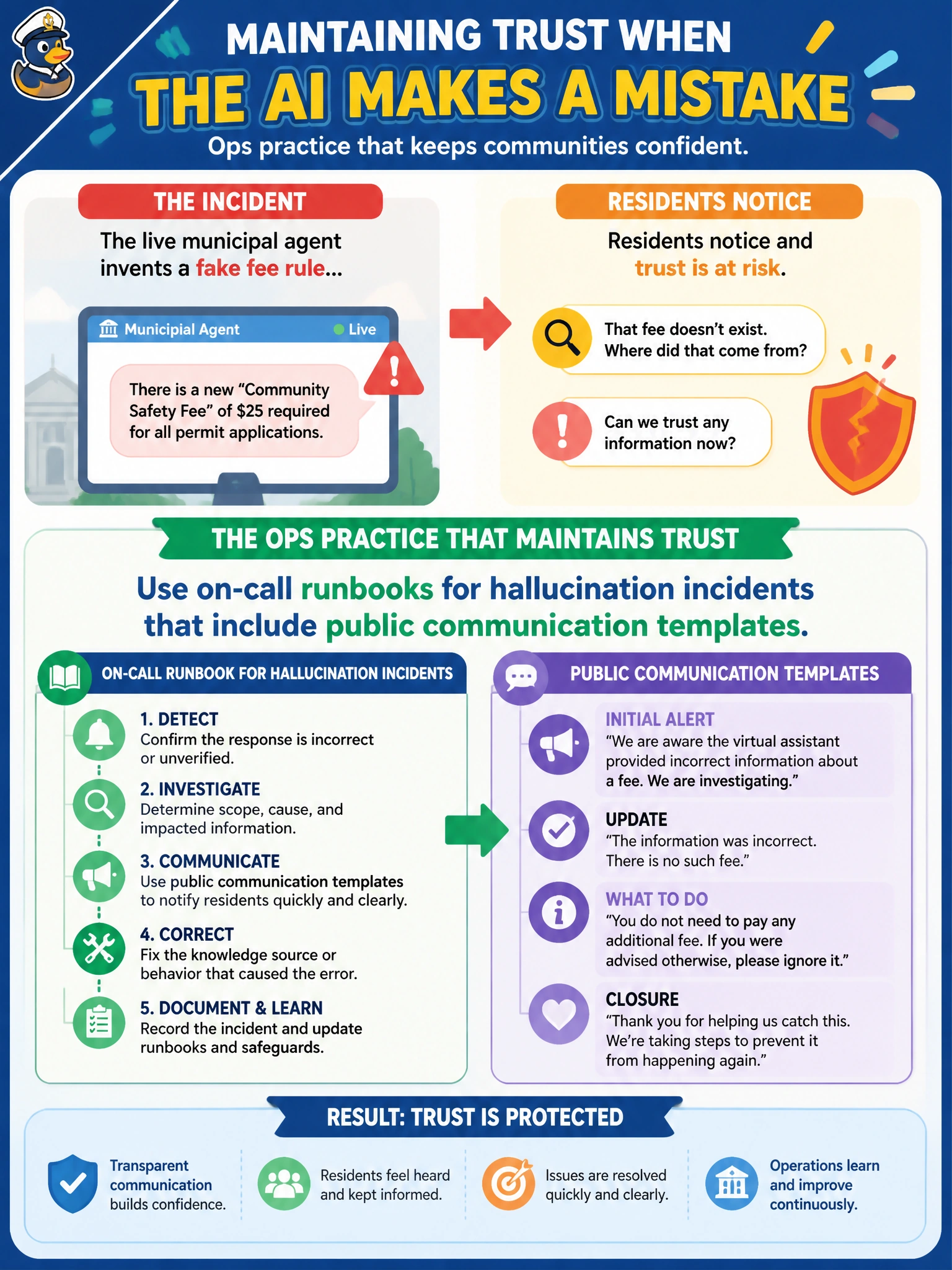
The live municipal agent invents a fake fee rule and residents notice. What ops practice maintains trust during the incident?
Select an answer to reveal the explanation.
Short Explanation
A fake fee rule is an incident, not a shrug. On-call runbooks with public communication templates keep the city transparent while the hallucination gets fixed.
Full Explanation
A live municipal agent inventing a fake fee rule is an operational incident with public impact, not a quirky model quirk. Maintaining trust requires on-call runbooks for hallucination incidents that include public communication templates: who is paged, how the bad answer is retracted or corrected, what interim guidance clerks give residents, and how the city acknowledges the error without amplifying incorrect fee amounts. Runbooks turn a chaotic discovery into a repeatable response that pairs technical remediation (prompt, retrieval, or guardrail fix) with transparent resident communication.
Deleting social posts about the error and never acknowledging it publicly fails by concept because suppression without acknowledgment looks like a cover-up and leaves residents who already saw the fake fee without an authoritative correction. Leaving on-call with no runbook because “hallucinations are normal” fails because normalizing ungoverned false civic rules abandons incident management; frequency does not remove the need for response procedures. Blaming GIS for every invented fee without a communication plan fails because scapegoating an unrelated system neither stops the hallucination path nor informs residents what the correct fee rule is.
Exam caveat: NCP-AAI ops/trust items expect structured incident response for harmful model outputs. Prefer runbooks that combine remediation steps with public communication artifacts over denial, fatalism, or misdirected blame.
Operational check: maintain a hallucination-incident runbook with paging tree, kill-switch or model rollback steps, corrected fee statement, and approved public/status templates; after a fake fee surfaces, execute the runbook, publish the correction, capture the failing prompt/retrieval trace, and add a regression test that blocks reintroducing the invented rule.