
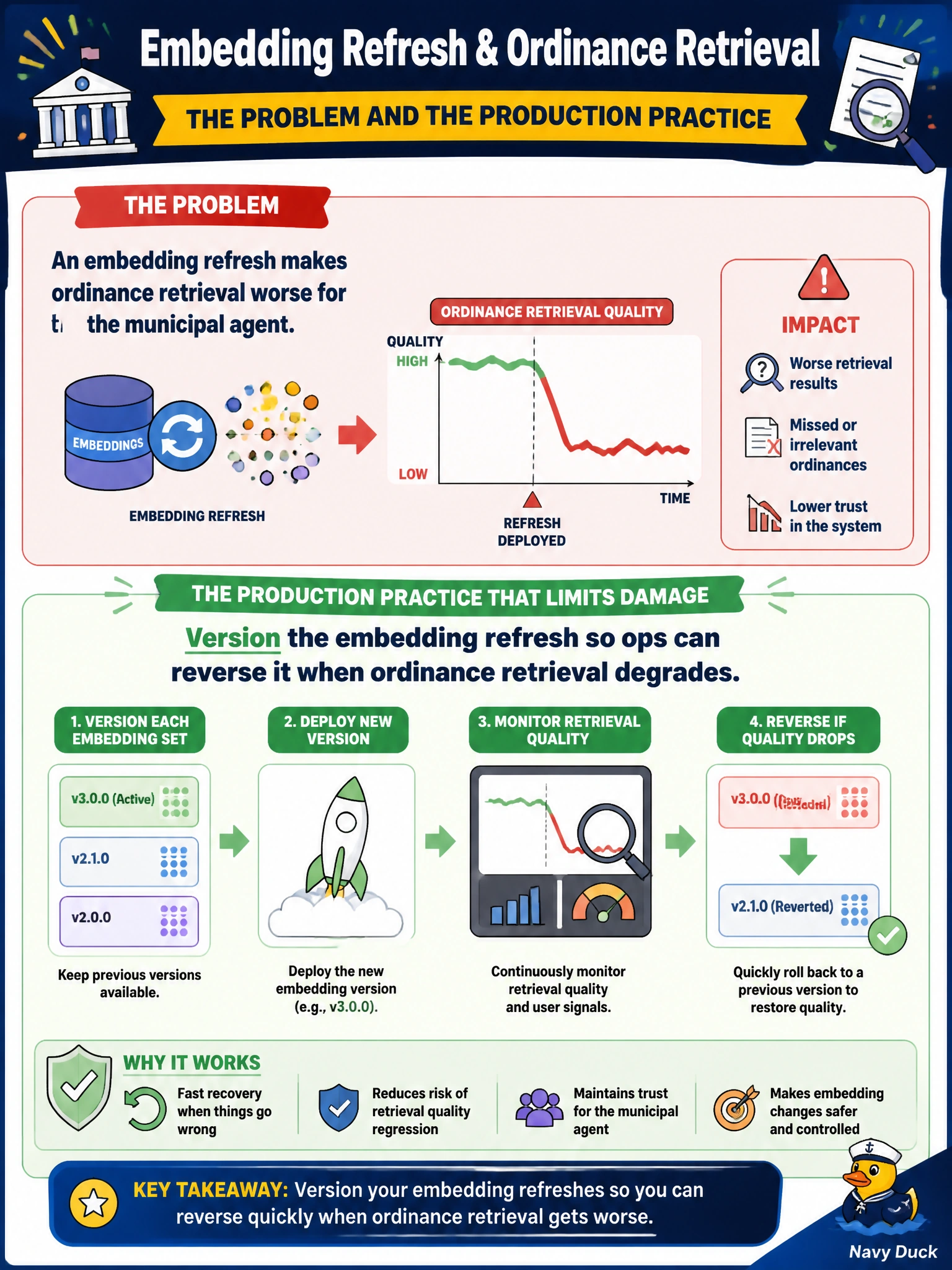
An embedding refresh makes ordinance retrieval worse for the municipal agent. What production practice limits damage?
Select an answer to reveal the explanation.
Short Explanation
New embeddings can quietly break ordinance search. Version the refresh so when retrieval tanks, ops can reverse it instead of living with a one-way overwrite.
Full Explanation
Embedding refreshes change how a municipal agent retrieves ordinance text. When a refresh degrades ordinance retrieval, the production practice that limits damage is to version the embedding corpus (or index build) so operations can reverse to the last known-good version instead of living with a one-way overwrite. Versioned refreshes treat embeddings as reversible infrastructure: each refresh is a named artifact with provenance, enabling compare-before-promote, canary retrieval checks, and fast rollback when citation hit-rate or ordinance match quality drops for resident questions.
Overwriting old embeddings permanently with no rollback path fails by concept because a destructive replace removes the recovery baseline the moment retrieval quality tanks. Treating embedding refreshes as unlogged experiments with no versions fails because unlogged changes break change control, incident analysis, and any ability to correlate retrieval failures with a specific refresh. Forcing residents to memorize ordinance numbers instead of fixing retrieval fails because it shifts operational failure onto the public and abandons the agent’s retrieval mission rather than restoring a working index.
Exam caveat: NCP-AAI production-ops items often pair retrieval quality with rollback readiness. Prefer answers that version and reverse embedding refreshes over irreversible overwrites, informal experiments, or resident workarounds that paper over broken search.
Operational check: before cutting over a municipal embedding refresh, snapshot or version the prior index; run ordinance retrieval evals (top-k hit rate, citation correctness) on a canary; promote only if gates pass; if live ordinance retrieval degrades, reverse the production pointer to the prior embedding version and confirm recovery with the same eval queries.