
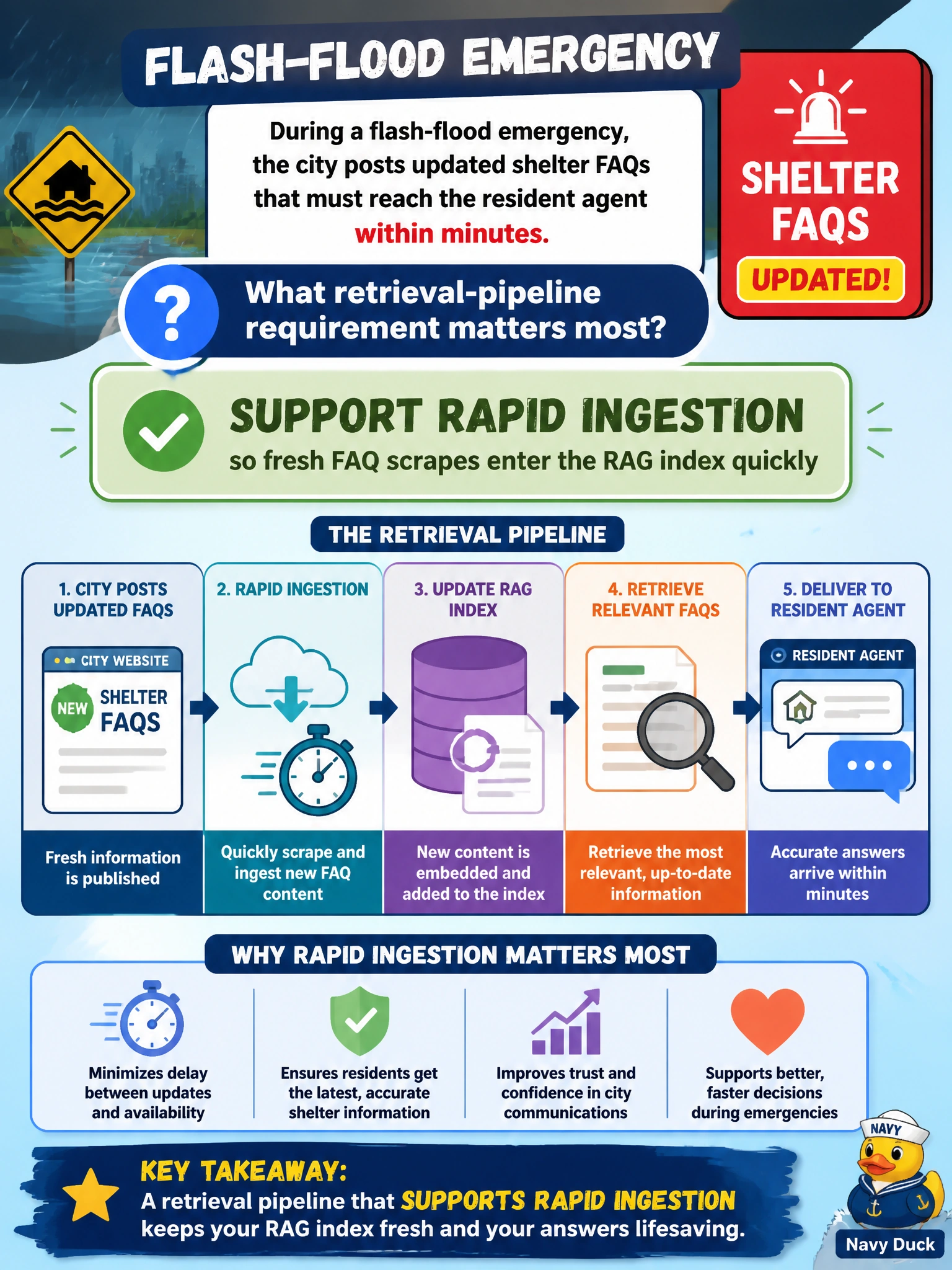
During a flash-flood emergency, the city posts updated shelter FAQs that must reach the resident agent within minutes. What retrieval-pipeline requirement matters most?
Select an answer to reveal the explanation.
Short Explanation
When shelters change mid-storm, yesterday’s FAQ is dangerous. The pipeline needs rapid ingestion so fresh emergency scrapes hit the RAG index in minutes, not next quarter.
Full Explanation
During a flash-flood emergency, updated shelter FAQs must reach the resident agent within minutes. The RAG system therefore needs rapid ingestion so fresh FAQ scrapes enter the index quickly—near-real-time (or very frequent) embedding and upsert of changed documents, not slow batch-only refresh. Emergency municipal content is time-critical; stale shelter directions are an operational hazard.
Freezing the index for thirty days to preserve historical FAQ wording prioritizes nostalgia over resident safety. Preferring quarterly batch embeds over near-real-time ingestion institutionalizes unacceptable lag. Serving only pretraining knowledge until an annual fine-tune ignores the city’s published updates entirely.
Exam caveat: rapid ingestion must include validation and provenance so malicious or unverified scrapes do not silently overwrite official FAQs. Operational check: publish a test shelter FAQ change, measure time-to-retrievability in the agent index, and confirm emergency SLOs (minutes, not days) are met with rollback if a bad ingest is detected. Prefer incremental upserts of changed FAQ documents rather than full reindexes during the emergency window. Page on-call city IT when emergency FAQ ingest lag exceeds the published minute-level SLO during declared flood operations.