
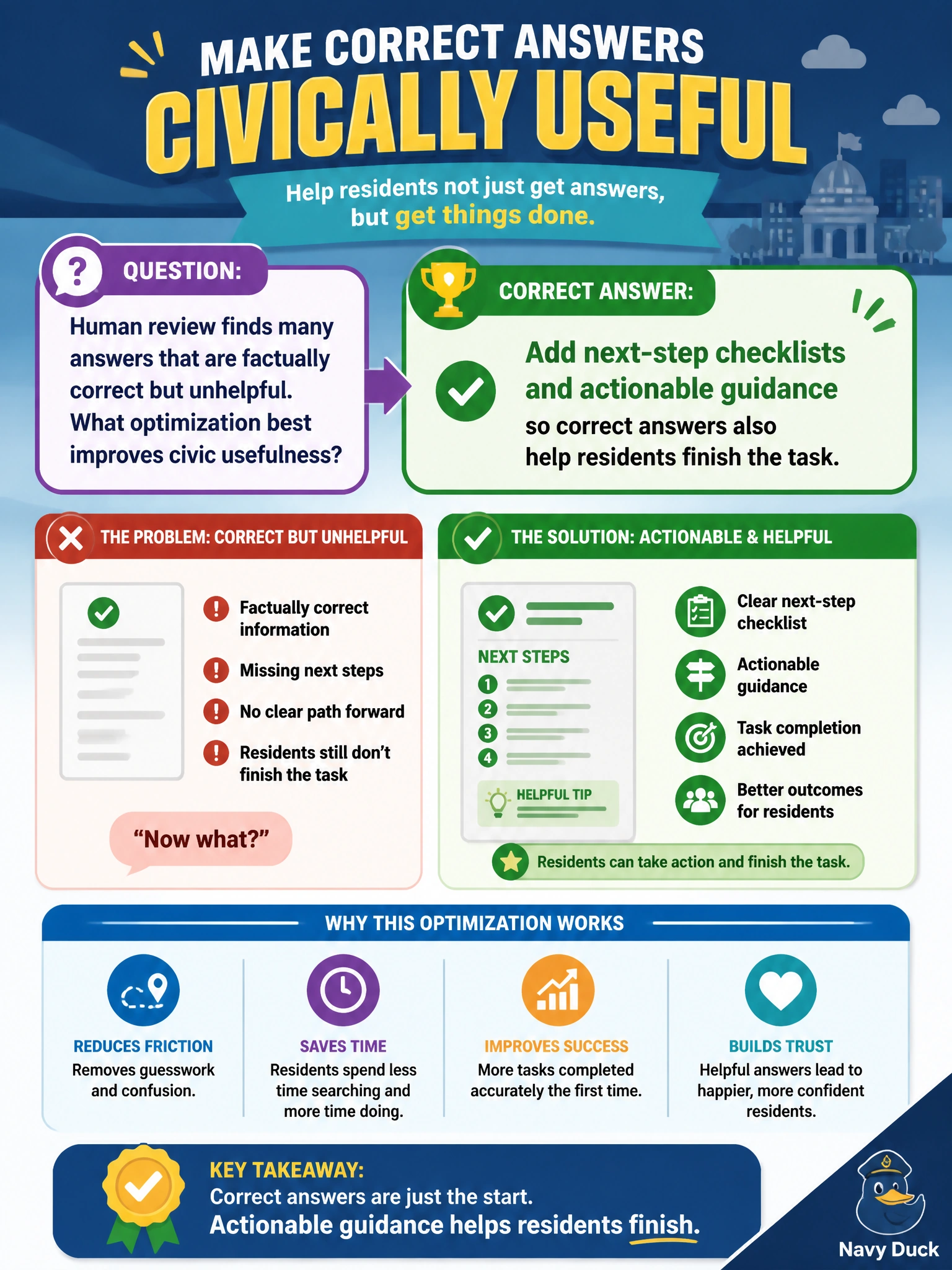
Human review finds many answers that are factually correct but unhelpful. What optimization best improves civic usefulness?
Select an answer to reveal the explanation.
Short Explanation
Correct but stuck is like getting the right street name with no turn-by-turn. Add next-step checklists so residents can finish the errand. One-word answers or statute-title matching alone still leave people stranded.
Full Explanation
Civic agent optimization must go beyond factual accuracy to usefulness. When human review finds many answers that are factually correct but unhelpful, the best improvement is adding next-step checklists and actionable guidance so residents can finish the task—what form to file, which office to contact, what documents to bring, and what happens next. Correct-but-stuck answers still fail municipal service outcomes even when every statute cite is right.
Shortening every reply to a single yes or no with no next steps removes the guidance residents need to complete civic workflows. Optimizing only for exact string match against statute titles rewards brittle lexical overlap over task completion and ignores how people actually use the answer. Removing human review because usefulness cannot be measured abandons a necessary qualitative signal; usefulness can be rubric-scored even when it is not a pure automatic metric.
Exam caveat: accuracy is necessary but not sufficient for civic agents—optimize for actionable completeness when reviews show correct-but-unhelpful answers. Operational check: define a usefulness rubric (next steps present, channel named, deadline noted), score a sample before and after checklist-style prompt changes, track task-completion proxies such as successful form starts after the answer, and keep human review in the loop for high-stakes domains.