
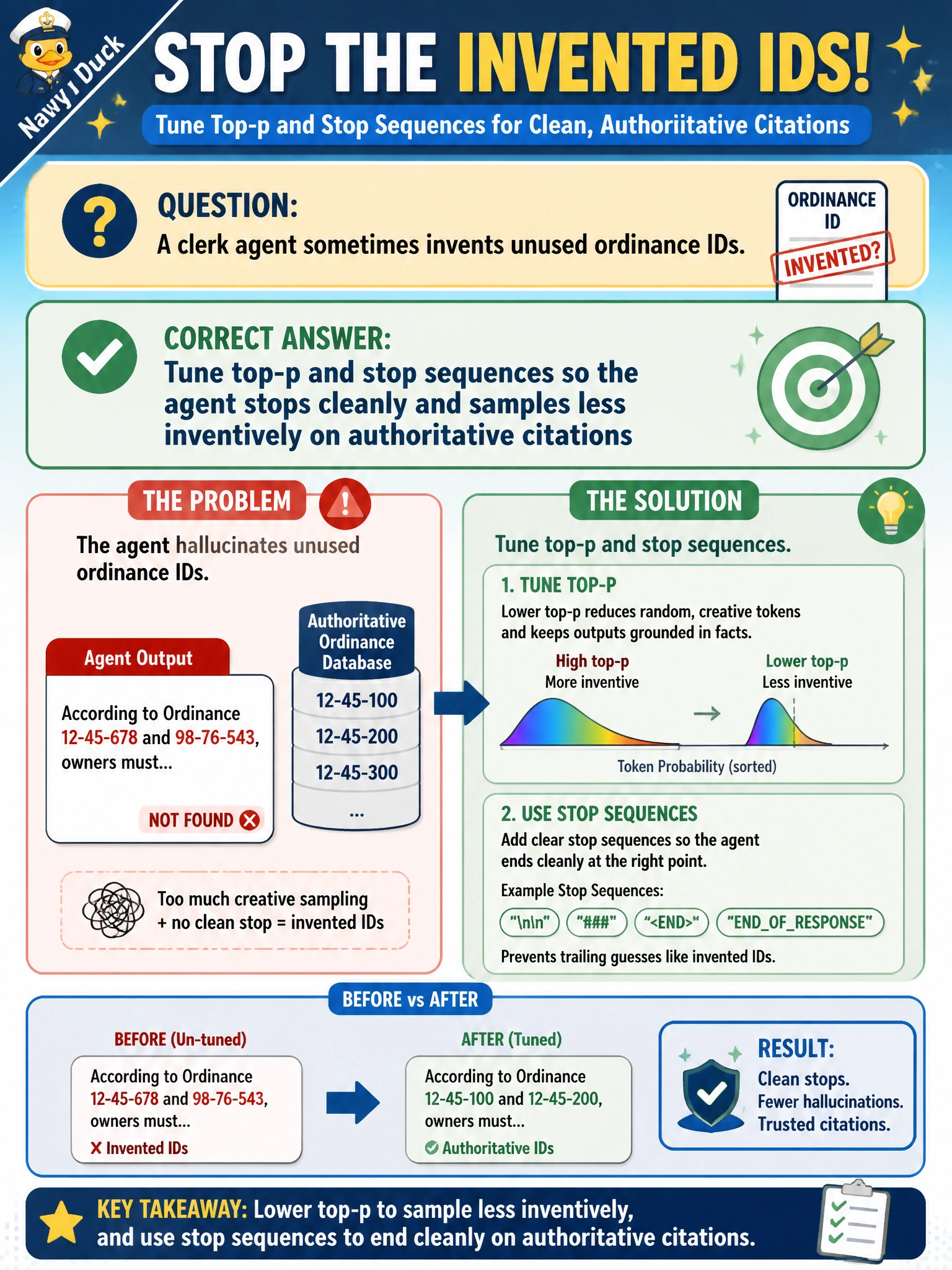
A clerk agent sometimes invents unused ordinance IDs. Which tuning move best reduces that hallucination pattern?
Select an answer to reveal the explanation.
Short Explanation
Fake ordinance IDs are like making up aisle numbers in a grocery store. Tighten top-p and use stop sequences so the model wraps up without free-associating statute codes. Cranking creativity or banning all citations either invents more junk or leaves clerks without real law.
Full Explanation
Decoding-parameter tuning such as top-p and stop sequences constrains inventive sampling and overlong generation that produces nonexistent ordinance identifiers. When a clerk agent invents unused ordinance IDs, tightening nucleus sampling and enforcing clean stops—ideally alongside retrieval-backed citation—reduces hallucination on authoritative legal references. Civic answers that cite local law need decoding controls aligned to grounded, bounded generation rather than open-ended invention.
Raising temperature so the agent invents even more creative ordinance codes worsens the exact failure mode under review. Removing all stop sequences so generation never ends on legal answers increases rambling and inventiveness instead of discipline. Banning every ordinance citation so the agent never references local law removes necessary legal grounding residents and clerks rely on; the fix is controlled citation, not citation abstinence.
Exam caveat: hallucination on authoritative civic citations is addressed with tighter decoding (and grounding), not with more randomness or by deleting the citation requirement. Operational check: build an eval set of ordinance-citation prompts with known valid IDs; measure invented-ID rate before and after top-p/stop changes; confirm valid citations still appear when retrieval returns them; gate promotion on the invented-ID metric.