
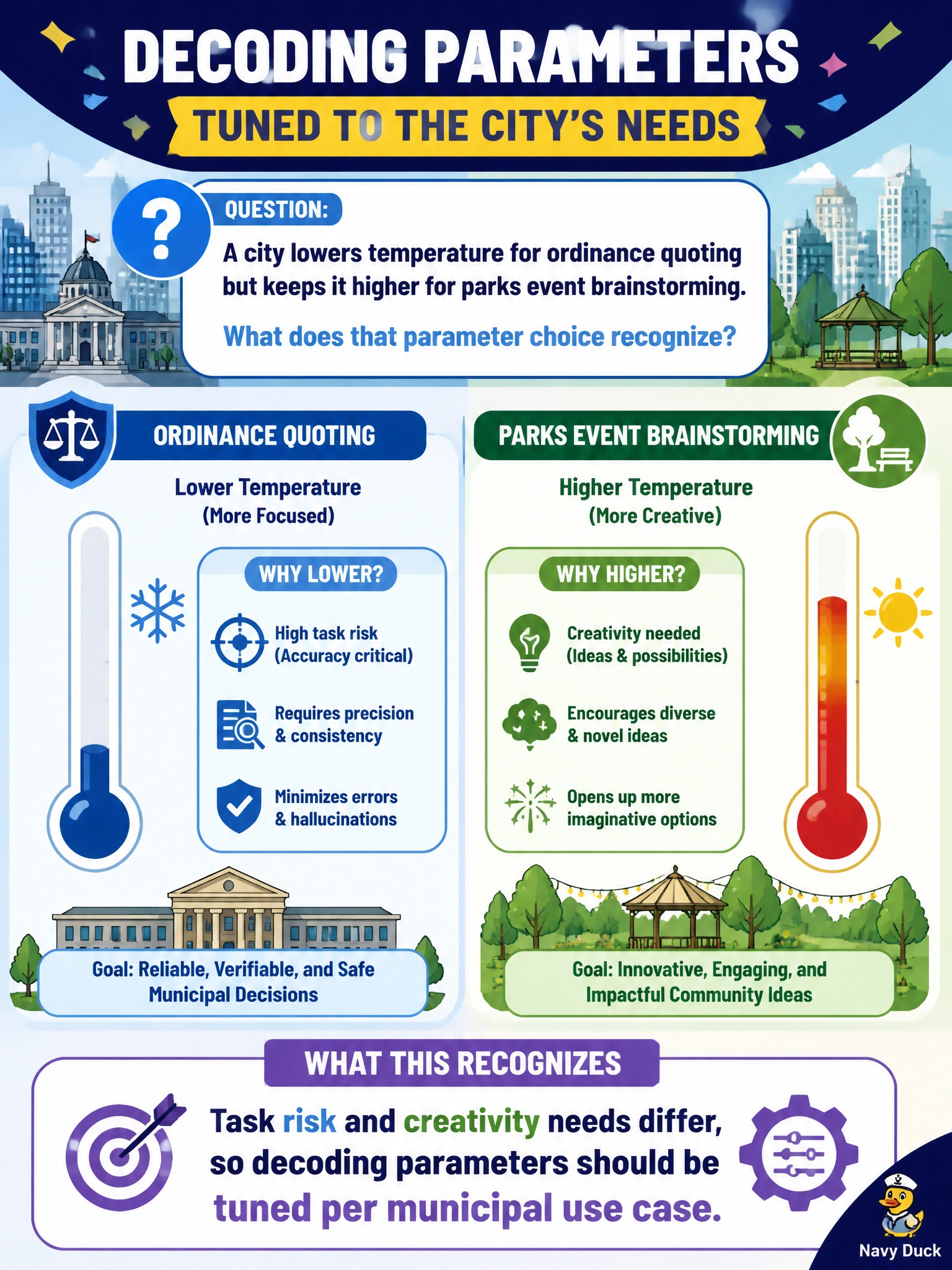
A city lowers temperature for ordinance quoting but keeps it higher for parks event brainstorming. What does that parameter choice recognize?
Select an answer to reveal the explanation.
Short Explanation
Quoting an ordinance is reading the recipe; brainstorming a parks festival is inventing toppings. Low temperature keeps legal text tight; higher temperature lets ideas breathe. One dial for every job is how you get creative law and boring festivals.
Full Explanation
Differentiated parameter tuning matches decoding settings to municipal task risk and creativity needs. Lowering temperature for ordinance quoting recognizes that legal and policy text must stay faithful and low-variance, while keeping temperature higher for parks event brainstorming allows exploratory ideation where novelty is desirable. The parameter choice recognizes that one civic platform hosts heterogeneous workloads with different failure costs.
Mandating one global temperature for every city workload forces either unsafe creativity on legal answers or sterile outputs on creative tasks. Using maximum temperature for ordinance quoting invites invented citations and wording drift on authoritative law. Forcing zero temperature on parks brainstorming does not legitimately “invent fake event dates”—and inventing false dates would be a data-integrity failure, not a creativity feature.
Exam caveat: decoding parameters should be tuned per municipal use case according to risk and creativity needs—do not assume a single global temperature is always correct. Operational check: run the same ordinance-citation prompts at low and high temperature and confirm low temperature reduces invented IDs; run parks ideation prompts at both settings and confirm higher temperature increases useful variety without fabricating closed facilities or false dates; document per-route parameter profiles in platform config.