
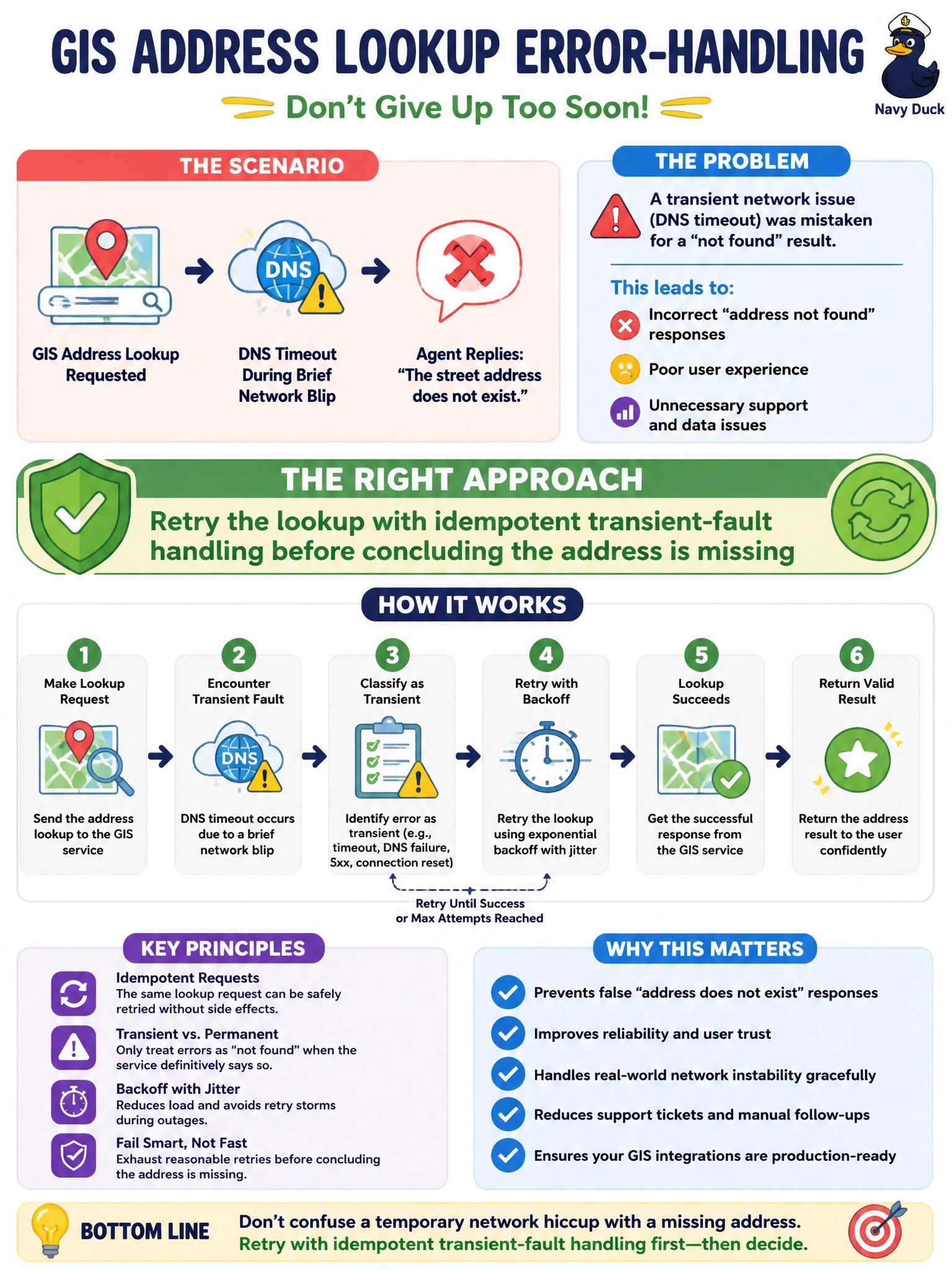
A GIS address lookup fails with a DNS timeout during a brief network blip, and the agent replies that the street address does not exist. What error-handling approach should developers apply?
Select an answer to reveal the explanation.
Short Explanation
A DNS hiccup is a dropped call, not proof the house vanished. You can retry the lookup safely when the fault is transient, then decide; reporting the address missing, disabling GIS after one timeout, or inventing a parcel ID only creates new problems.
Full Explanation
A brief DNS timeout during a GIS address lookup is a transient infrastructure fault, not an authoritative municipal result that the address does not exist. Apply idempotent transient-fault handling: classify the error as retryable, retry the same GIS query with backoff or a short retry budget, and conclude the address is missing only after the lookup succeeds or returns a durable civic response. Idempotency matters because repeating the address query must not create duplicate tickets, duplicate parcels, or conflicting side effects in the resident workflow. Treating any lookup error as confirmation that the civic record is absent confuses a transport failure with missing data and can falsely deny services for an address that exists. Disabling GIS tools after the first timeout turns a brief network blip into a continuing loss of authoritative location data. Inventing a nearby parcel ID fabricates municipal identity and can misroute inspections or notices, violating source-of-truth discipline. Exam caveat: distinguish transient faults such as timeouts, DNS blips, and 5xx responses from authoritative not-found or validation errors; only an authoritative negative justifies concluding the address is missing. Practical check: inject a short DNS or timeout fault in a staging GIS call, then confirm the agent retries without inventing parcel data, logs the fault class and final GIS status, and tells the resident the address was not found only when GIS returns a durable negative.