
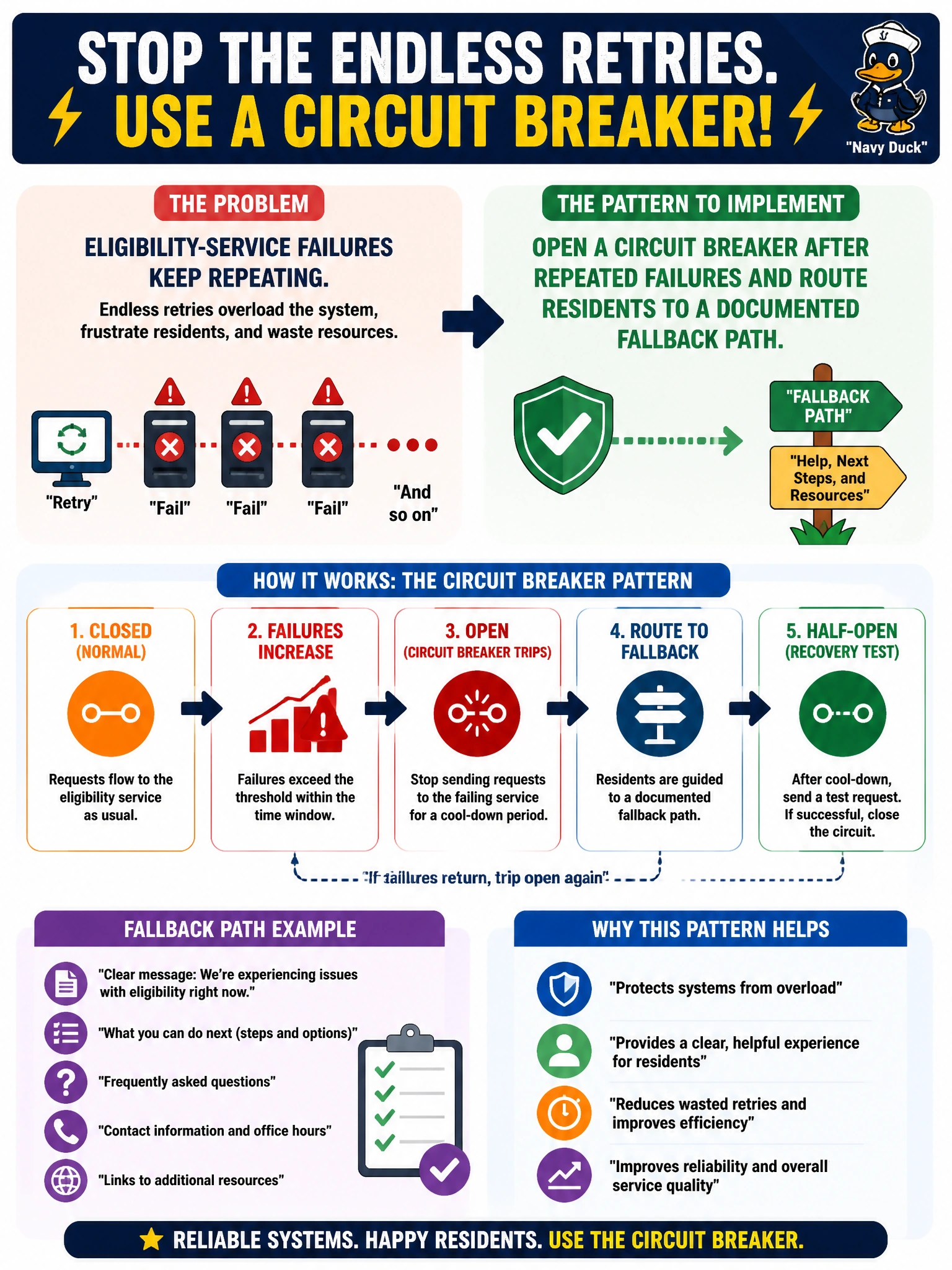
Eligibility-service failures keep repeating, so residents need a clear fallback instead of endless retries. Which pattern should the benefits agent implement?
Select an answer to reveal the explanation.
Short Explanation
When eligibility keeps falling over, stop pounding it—open the circuit and point people to the fallback. That might be a callback queue or staff line, not inventing yes/no decisions. Endless retries just multiply pain.
Full Explanation
When eligibility-service failures keep repeating, unlimited retries punish both the dependency and waiting residents. A circuit breaker that opens after repeated failures and routes residents to a documented fallback path—callback queue, staff line, or offline application instructions—stops cascading load and provides a clear next step. Inventing eligibility decisions without policy data, endlessly increasing retries, or restarting the entire data center after each failed call are unsafe or disproportionate patterns for benefits agents.
Increasing retry count without limit until the dependency recovers fails by concept: it amplifies outages and leaves residents stuck in silent wait loops. Hiding errors and inventing eligibility decisions locally without policy data produces unlawful or incorrect benefit determinations. Restarting the entire city data center after each failed eligibility call is an absurd blast-radius response to a single service fault.
Exam caveat: circuit breakers need half-open probes and monitored recovery criteria so traffic resumes when eligibility stabilizes; fallbacks must not silently become permanent shadow eligibility engines. Log open/close events for operations after-action review.
Operational check: induce repeated eligibility failures in staging, confirm the breaker opens after the configured threshold, verify residents see the documented fallback path, and ensure no fabricated approval/denial is emitted while the circuit is open.