
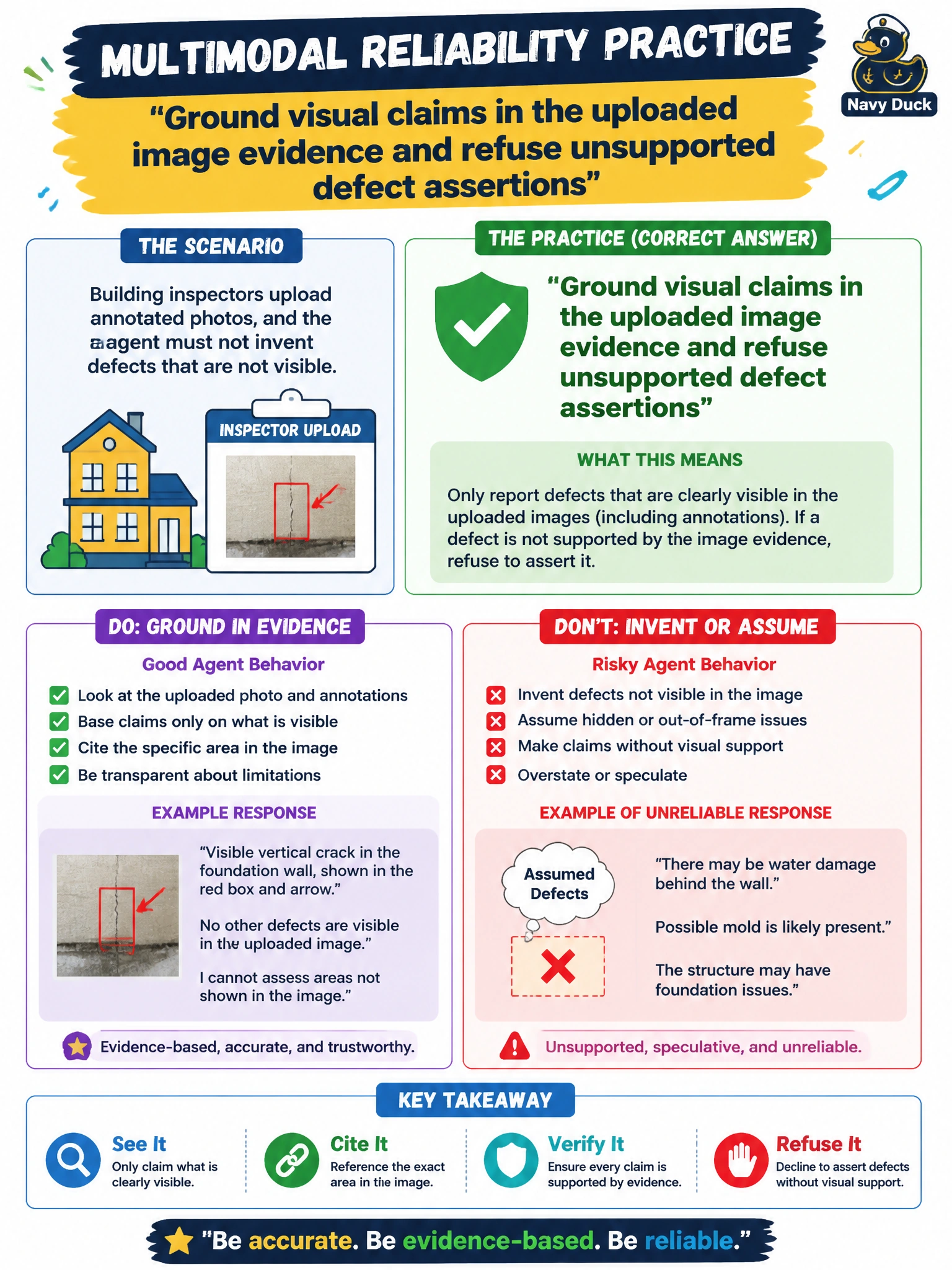
Building inspectors upload annotated photos, and the agent must not invent defects that are not visible. Which multimodal reliability practice should developers enforce?
Select an answer to reveal the explanation.
Short Explanation
Inspection photos are evidence photos—say what you see, not what you assume. Ground every defect claim in the image, and refuse the ones that aren’t there. Inventing cracks from an address alone fails the field audit.
Full Explanation
Building-inspection agents that consume annotated photos must ground every defect claim in visible image evidence and refuse unsupported assertions. That multimodal reliability practice prevents the model from “completing” inspections with common defect types that are not shown, inventing findings from addresses alone, or treating watermarks as structural failures. Inspectors and property owners rely on accurate visual claims; ungrounded additions create legal and remediation risk for the city.
Allowing the model to add common defect types even when the image does not show them fails by concept: it prioritizes completeness theater over evidence and contaminates inspection records. Disabling image inputs and inventing findings from the parcel address alone discards the multimodal evidence path and fabricates conditions. Treating decorative watermarks as confirmed structural failures confuses overlay artifacts with building pathology.
Exam caveat: grounding includes acknowledging uncertainty and image limitations (occlusion, blur, distance). Annotated regions from inspectors should be preferred cues, but the agent must still not extrapolate beyond what annotations and pixels support.
Operational check: feed images with and without visible defects (and with watermarks only), require the agent to list only supported findings, and score false-positive invented defects to zero before any production inspection assist goes live.