
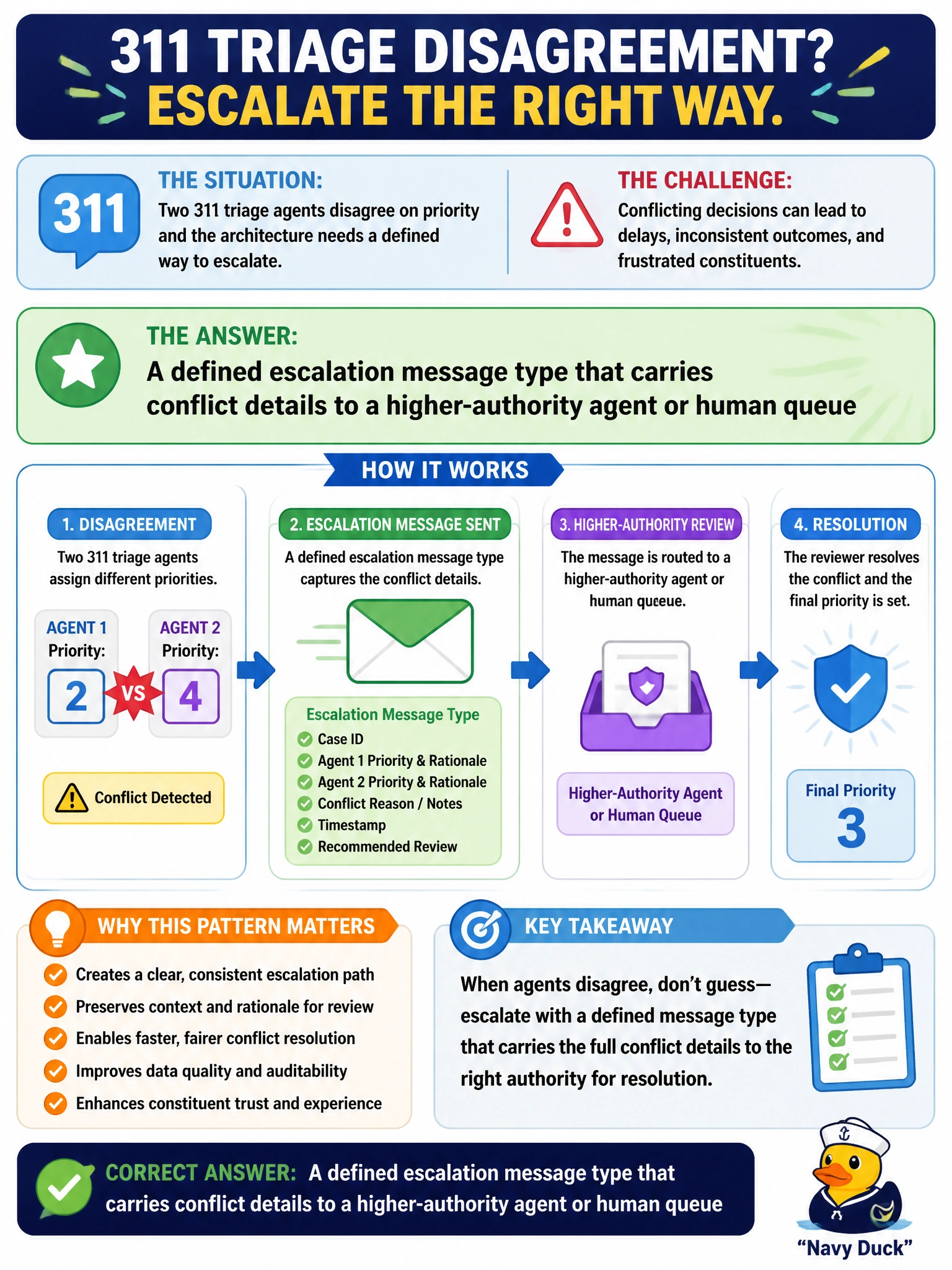
Two 311 triage agents disagree on priority and the architecture needs a defined way to escalate. Which collaboration pattern element is most important to add?
Select an answer to reveal the explanation.
Short Explanation
When two triage bots dig in, you need a formal "we're stuck—please take this" envelope, not more hallway chatter. Escalation message types give the fight a destination and a payload.
Full Explanation
When two 311 triage agents disagree on priority, collaboration architecture needs a defined escalation message type that carries conflict details to a higher-authority agent or human queue. Typed escalation makes disagreement a first-class protocol event—with payload for competing priorities, evidence, and ownership—rather than an unbounded chat argument. That element is what turns multi-agent triage into an operable municipal workflow.
A shared joke channel fails because social bonding channels are not conflict-resolution protocol. Silent random selection with no message type fails by concept: it hides the dispute and prevents audit or learning from conflicts. Unlimited retries of unstructured chat until one agent gives up fails as deadlock-prone non-determinism without escalation ownership.
Exam caveat: escalation patterns are about governed conflict handling. Distractors that sound collaborative but lack typed messages, authority routing, or termination criteria are incorrect.
Operational check: force two triage agents to emit conflicting priorities on a synthetic ticket; verify an escalation message is emitted with both priorities and reasons; confirm a supervisor queue or agent receives it and that the ticket does not remain stuck in peer retry loops.