
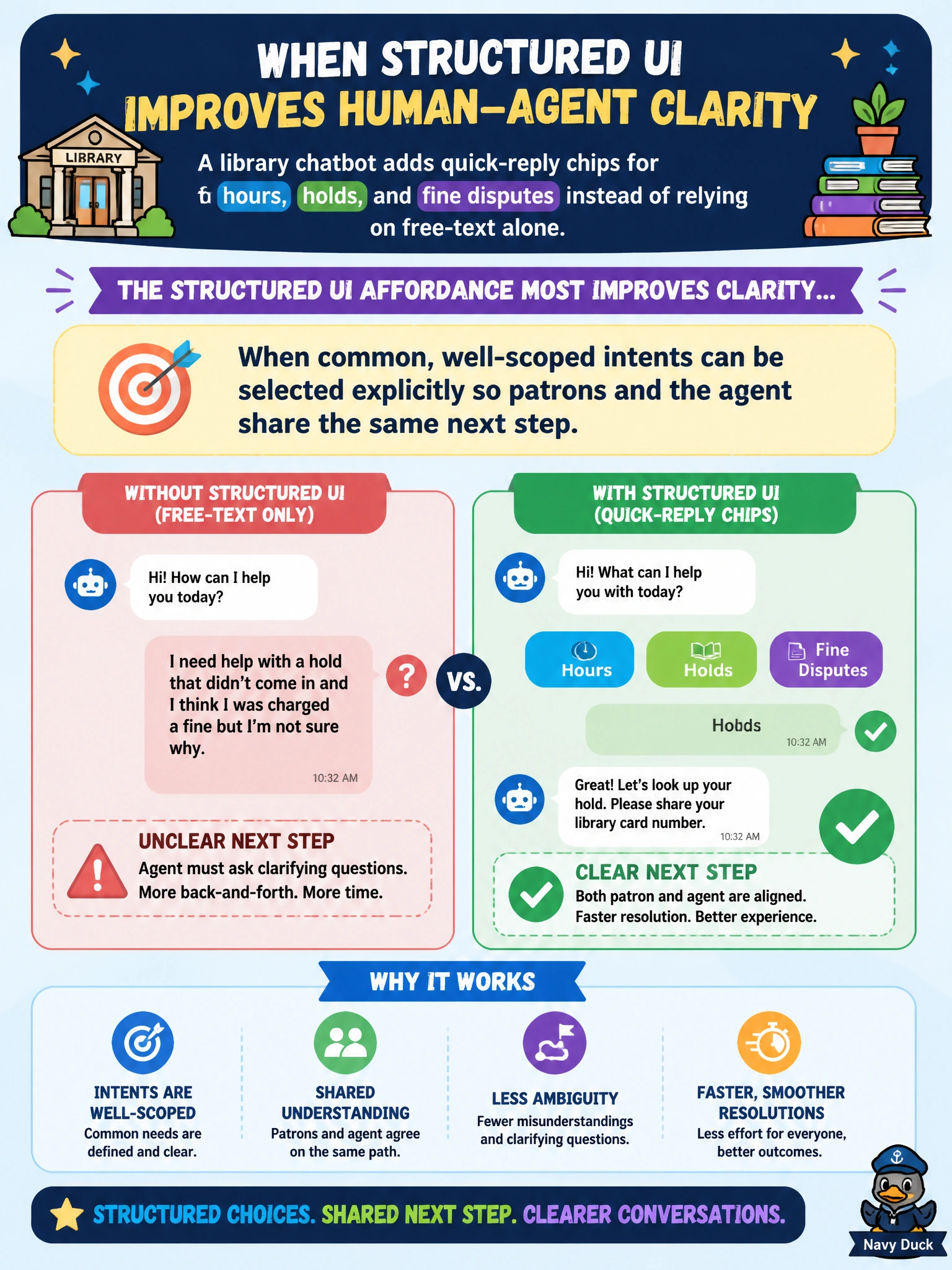
A library chatbot adds quick-reply chips for hours, holds, and fine disputes instead of relying on free-text alone. When does that structured UI affordance most improve human–agent clarity?
Select an answer to reveal the explanation.
Short Explanation
Chips are like those big buttons on a kiosk—Hours, Holds, Fines—so nobody has to guess the magic phrasing. When the ask is common and bounded, tapping the chip lines up human intent with the agent faster than typing a novel.
Full Explanation
Structured UI affordances such as quick-reply chips improve human–agent clarity when common, well-scoped intents can be selected explicitly so patrons and the agent share the same next step. In a library chatbot, chips for hours, holds, and fine disputes encode frequent municipal intents as mutually understood actions: the patron’s tap and the agent’s planned tool path converge without relying solely on free-text disambiguation. That is when chips most improve clarity—high-frequency, bounded civic tasks—not as a universal replacement for language understanding.
Retiring all NLU fails because chips complement free text; many patron utterances remain open-ended and still need language understanding. Limiting chips to staff-only admin consoles fails by concept: public patrons are exactly who benefit from reduced phrasing ambiguity on common asks. Waiting until every free-text conversation has already failed is a reactive misuse; clarity gains belong at the start of common paths, not only after breakdown.
Exam caveat: structured affordances are an interaction-design lever for intent alignment. They are not evidence that the model lacks NLU, nor a requirement to remove generative chat entirely.
Operational check: instrument chip versus free-text paths for holds and fine disputes; measure containment, tool-call accuracy, and clarification turns; confirm chips map to the intended tools and that free-text fallback still works for uncommon requests.