
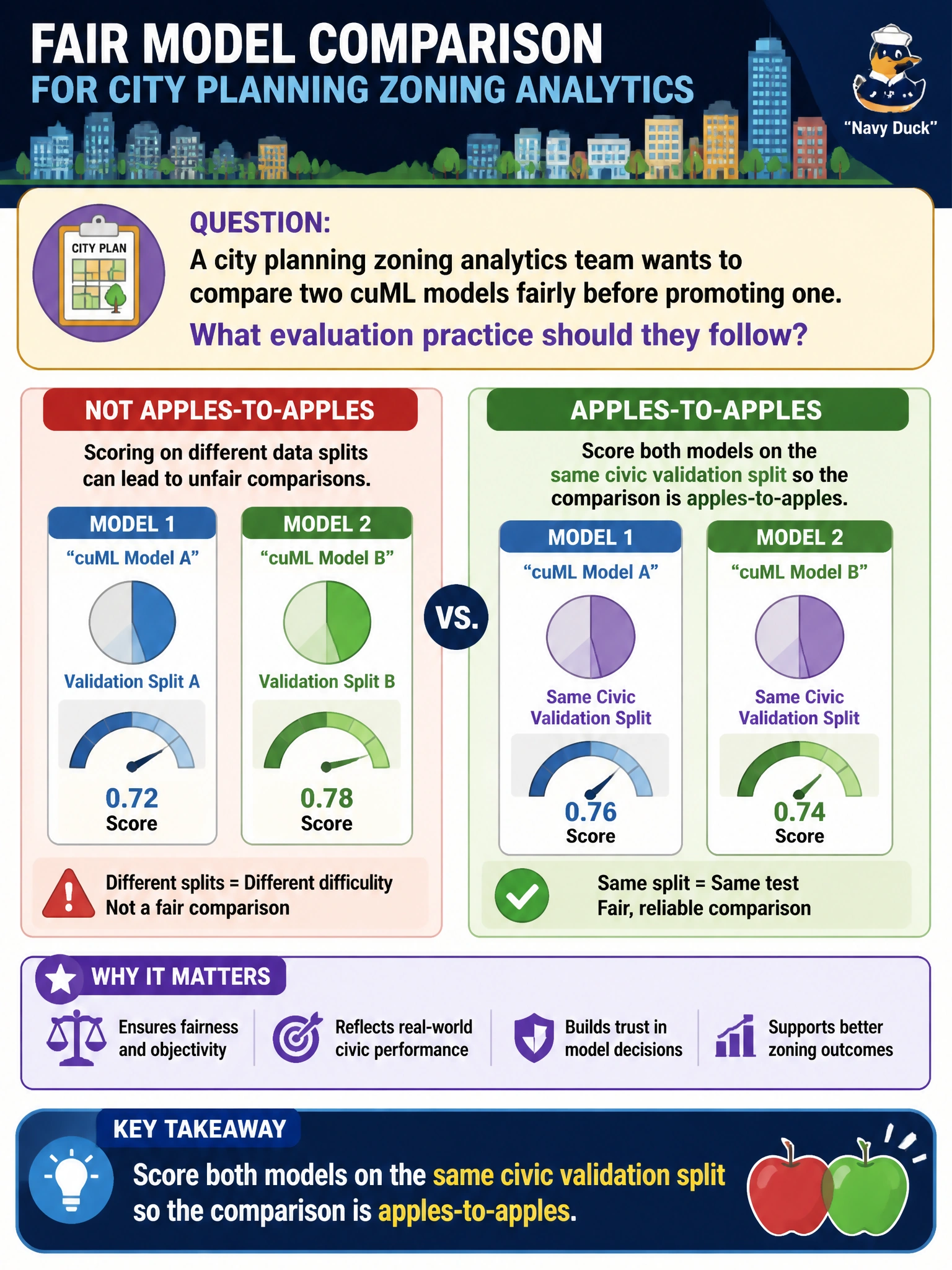
A city planning zoning analytics team wants to compare two cuML models fairly before promoting one. What evaluation practice should they follow?
Select an answer to reveal the explanation.
Short Explanation
Fair bake-offs use the same oven and the same recipe card—same validation split for both cuML models, no secret easier districts.
Full Explanation
A city planning zoning analytics team comparing two cuML models before promotion must keep the evaluation protocol identical. Scoring both models on the same civic validation split makes the comparison apples-to-apples: same rows, same labels, same metrics, so differences reflect estimators rather than uneven test difficulty. That discipline is what lets zoning analysts defend a promotion decision to planning leadership.
Giving model A the easy districts and model B the hardest districts only fails by concept—it confounds model quality with geographic difficulty and cannot support a fair bake-off. Changing feature definitions mid-comparison for only one model introduces an uncontrolled second variable, so you no longer isolate estimator differences. Picking the model whose filename sorts first alphabetically is unrelated to predictive quality and abandons evaluation entirely.
Exam caveat: same validation split is necessary for fairness but not sufficient—also lock preprocessing, random seeds where relevant, and metric definitions; otherwise “same split” still hides pipeline asymmetry. Operational check: materialize one zoning validation parquet, score both cuML candidates with the identical metric script, store both score files beside the split hash, and require a side-by-side report (overall plus district strata) before any model is marked promotion-ready.