
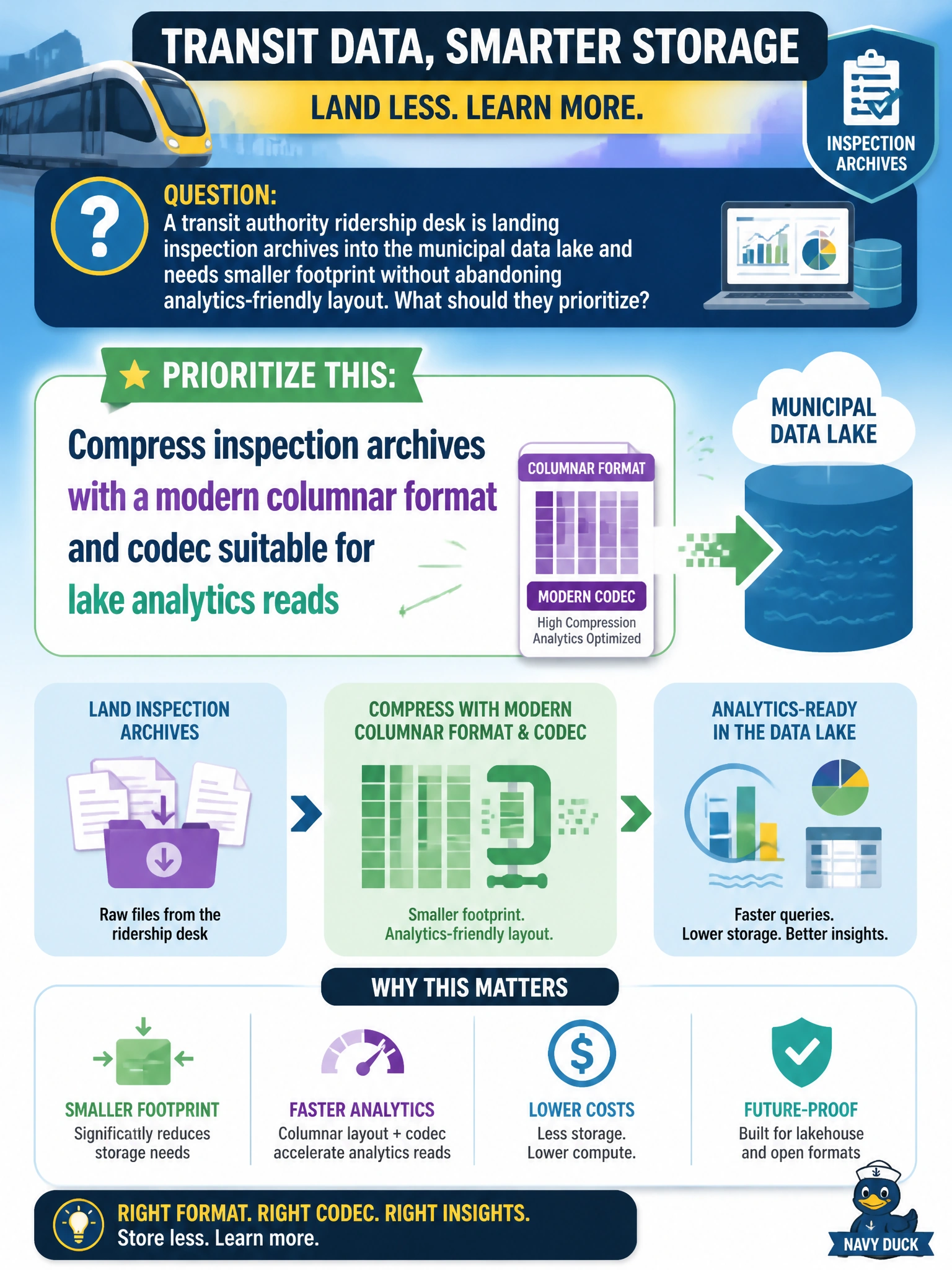
A transit authority ridership desk is landing inspection archives into the municipal data lake and needs smaller footprint without abandoning analytics-friendly layout. What should they prioritize?
Select an answer to reveal the explanation.
Short Explanation
Inspection archives should pack tight like buses at the depot—but still open lane-by-lane for analytics. A modern columnar format with a solid codec shrinks the lake footprint without forcing full-table text parses.
Full Explanation
A transit authority ridership desk landing inspection archives into the municipal data lake needs a smaller footprint without abandoning analytics-friendly layout. Compressing those archives with a modern columnar format and codec suitable for lake analytics reads shrinks storage while preserving selective column and row-group access for GPU jobs. That prioritizes both cost and usability: civic inspection history stays compact yet queryable, unlike opaque bulk dumps that force full reparse. Zipping entire directories of raw binary dumps fails by concept: analytics engines typically cannot column-prune inside opaque whole-directory zips the way they can with lake-native columnar files. Storing uncompressed text logs fails because every GPU job reparses strings and storage stays large. Duplicating archives in both CSV and Excel fails by maximizing storage use and still leaving weak analytics interchange for RAPIDS-scale reads. Exam caveat: compression codec and format choices must remain compatible with the lake’s query engines; an exotic codec that nothing in the GPU stack can read is not a win. Operational check: convert a sample inspection archive to compressed columnar Parquet (or equivalent), compare size versus text/CSV, run a selective RAPIDS column read, and confirm prune/filter behavior before migrating the transit authority’s full archive landing path.