
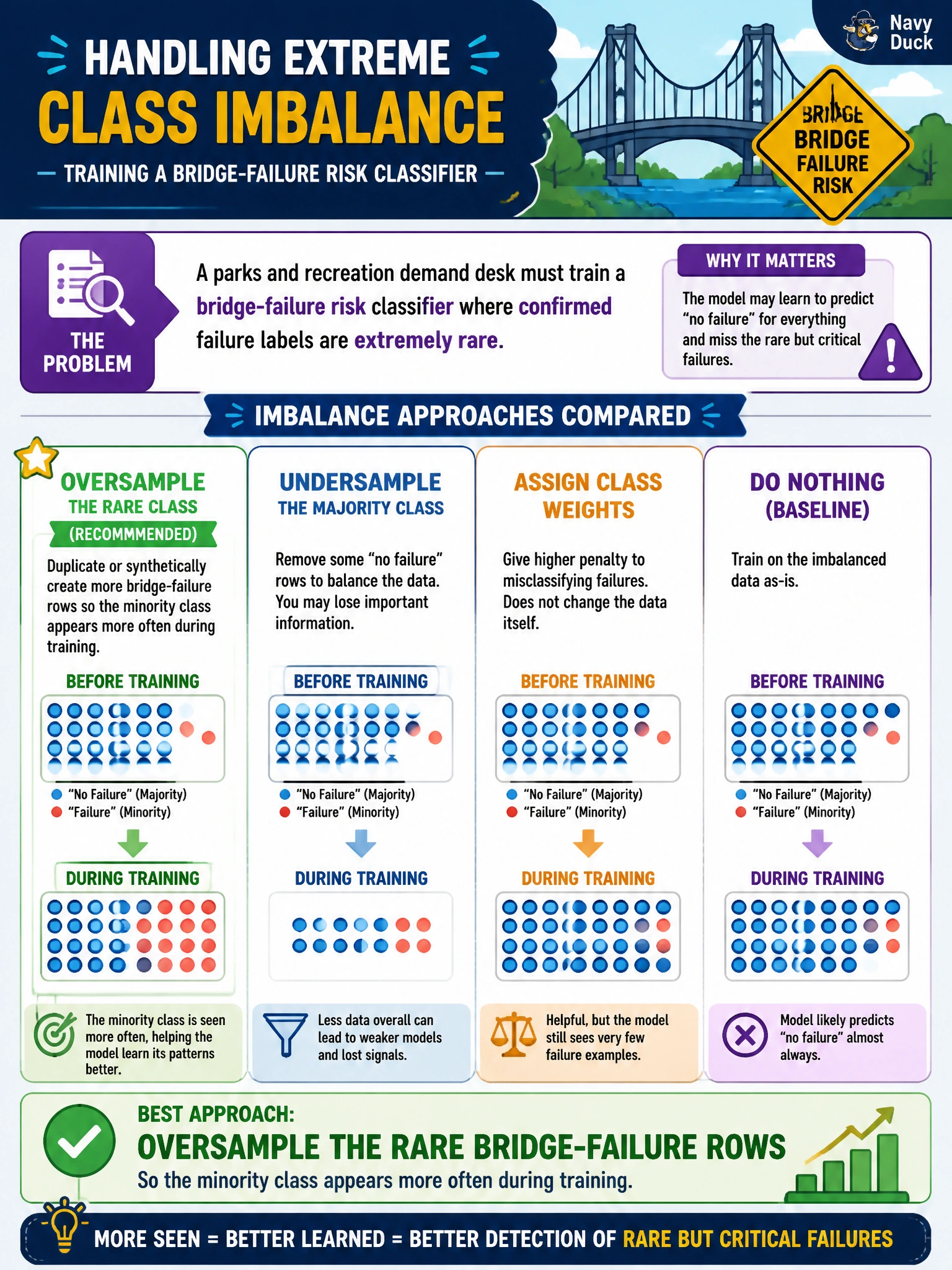
A parks and recreation demand desk must train a bridge-failure risk classifier where confirmed failure labels are extremely rare. Which imbalance approach best addresses that severe minority class?
Select an answer to reveal the explanation.
Short Explanation
Rare bridge failures are like finding a handful of cracked beams in a warehouse of good ones—accuracy can look great while missing every crack. Oversampling those rare failure rows gives the learner more chances to see the minority pattern.
Full Explanation
A parks and recreation demand desk training a bridge-failure risk classifier faces an extremely rare positive class. Oversampling the rare bridge-failure rows increases minority presence during training so the learner sees failure patterns often enough to form a useful decision boundary instead of collapsing to “always safe.” For severe civic imbalance, that directly addresses frequency skew while keeping failure labels in the supervised objective—critical when missed failures carry public-safety cost far beyond raw accuracy. Ignoring class counts and optimizing only overall accuracy fails by concept: with tiny failure rates, predicting the majority yields high accuracy while missing nearly every failed bridge. Deleting all failure rows fails because the model then cannot learn failure risk at all and becomes useless for the stated classifier. Converting the problem to unsupervised clustering and discarding failure labels fails by abandoning the rare supervised signal the desk already paid to confirm; clusters may group structures but do not optimize failure detection. Exam caveat: oversampling helps representation but can overfit duplicated failure idiosyncrasies if you do not validate on a held-out, non-duplicated minority set and watch for leakage across time or structure IDs. Operational check: record baseline minority recall on a held-out parks bridge set, oversample failures only inside the training fold, retrain, and compare minority recall, precision, and alert volume so operations staff see whether rare-risk detection improved without flooding inspectors.