
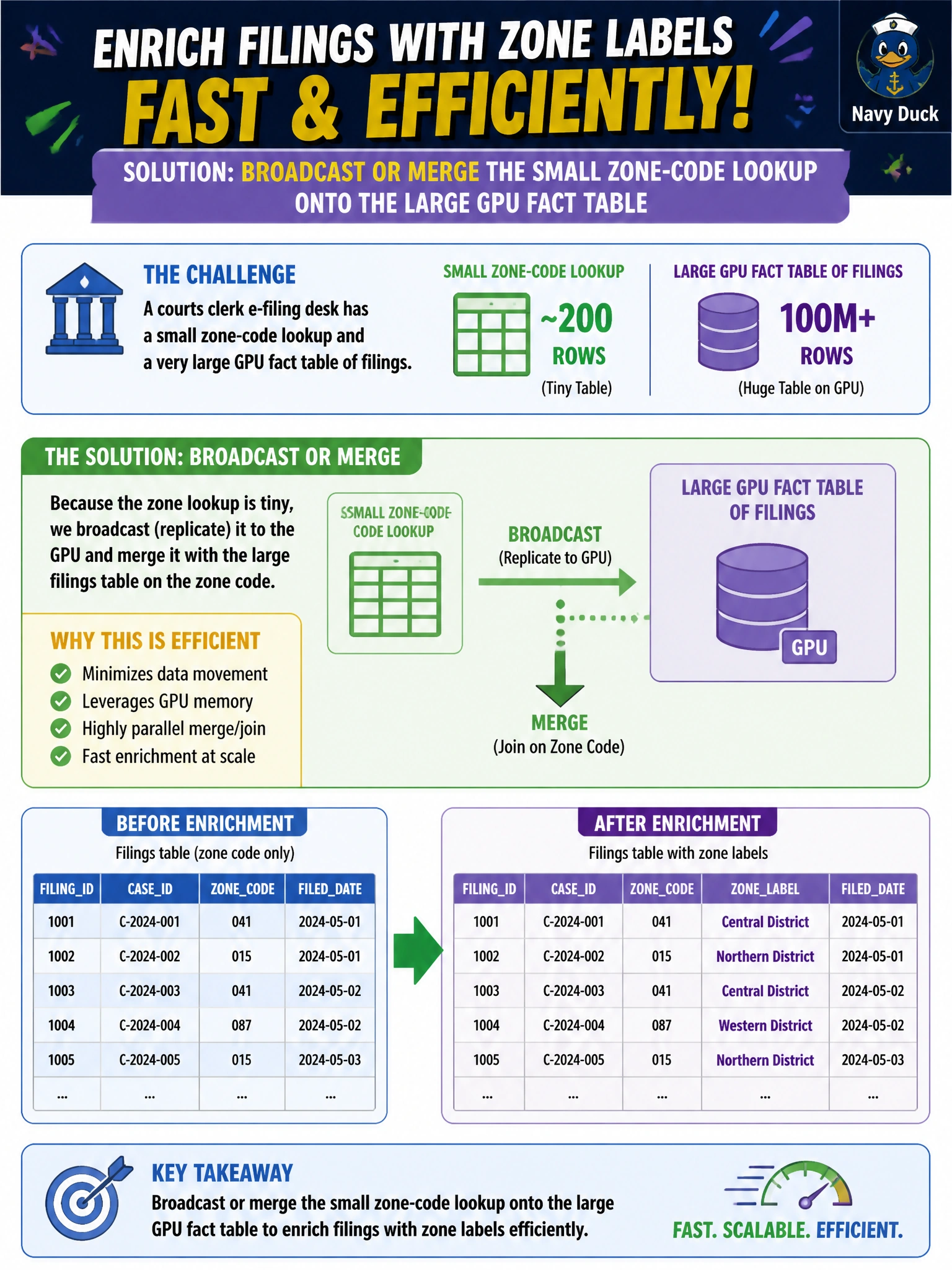
A courts clerk e-filing desk has a small zone-code lookup and a very large GPU fact table of filings. How should they enrich filings with zone labels efficiently?
Select an answer to reveal the explanation.
Short Explanation
A tiny zone codebook stuck onto a mountain of filings is like stamping a short legend onto every map sheet—you do not photocopy the mountain for each stamp. Broadcast or merge the small lookup onto the big GPU fact table. Rebuilding huge intermediates or spreadsheet VLOOKUPs waste the GPU path.
Full Explanation
Enriching a large GPU filings fact table with a small zone-code lookup is a classic broadcast-style or small-right merge pattern. Keeping the dimension compact and merging (or broadcasting) it onto the large fact table attaches zone labels without replicating the fact table per code and without leaving the RAPIDS path. Courts clerk e-filing analytics get deterministic zone attributes at GPU speed while the lookup remains a governed, reviewable codebook.
Replicating the entire fact table once per zone code before filtering materializes enormous intermediates and inverts the efficient small-dimension pattern. Exporting the fact table to CSV for nightly spreadsheet VLOOKUP abandons GPU acceleration, does not scale with filing volume, and creates fragile manual ops. Training a neural net to predict zone labels without using the lookup invents probabilistic substitutes for an authoritative dimension the desk already owns—unnecessary risk when a merge suffices.
Exam caveat: broadcast/merge still requires clean join keys and handling of unknown zone codes; unmatched filings should get an explicit unknown bucket rather than silent drops if analytics must retain all filings. Operational check: confirm lookup uniqueness on zone code, merge onto a sample of filings, measure unmatched rate, and verify that peak GPU memory stays far below the cost of any fact-table replication strategy.