
Imagine your boss walks in and asks why everyone is suddenly talking about Generative AI and why your team needs to spin up massive GPU clusters for it. Which two architectural and ecosystem developments are most responsible for this massive surge in generative model creation and adoption?
Select all correct answers, then click Submit.
Short Explanation and Infographic
Here's the deal—Generative AI didn't just happen overnight because people suddenly liked computers more. Two massive changes paved the way. First, we got transformer-based architectures. Before transformers, dealing with sequential data was a slow, painful slog using RNNs or LSTMs that couldn't parallelize well. Transformers changed everything with the self-attention mechanism, letting us train massive models on GPUs in parallel. Second, the community opened up. Instead of every company building an LLM from scratch—which costs millions—organizations can grab a pre-trained open-source base model and fine-tune it in an afternoon using open-source tools. Trust me, without these two breakthroughs, we’d still be in the AI slow lane.
Full explanation below image
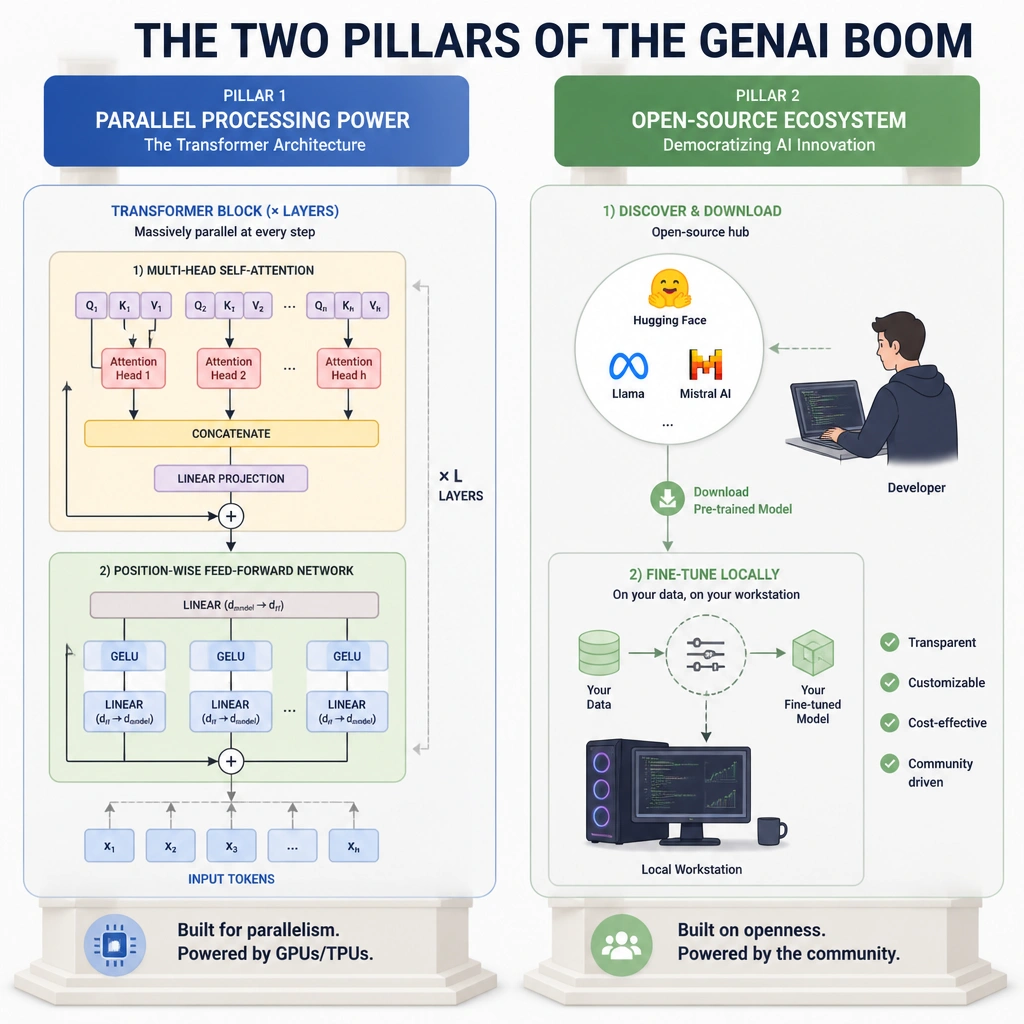
Full Explanation
The recent acceleration in Generative AI development and deployment is primarily driven by architectural innovations and open-source democratization. 1. Transformer Architectures: Introduced in 2017, the transformer architecture replaced recurrent structures (like LSTMs) with self-attention mechanisms. This architectural shift allowed neural networks to process tokens in parallel rather than sequentially, making it highly compatible GPU acceleration. As a result, training runs that previously took months could be completed in days or weeks, enabling the creation of extremely large parameter models. 2. Open-Source and Pre-trained Models: Historically, building a deep learning model required massive proprietary datasets and millions of dollars in compute infrastructure. The proliferation of open-source frameworks (like PyTorch and Hugging Face) and the release of pre-trained foundational models changed the landscape. Now, organizations of all sizes can download a base model and apply transfer learning or Parameter-Efficient Fine-Tuning (PEFT) on relatively small datasets using minimal compute, drastically lowering the barrier to entry.
Let's review the incorrect options: - Option A is incorrect because Recurrent Neural Networks (RNNs) suffer from vanishing gradients and sequential processing bottlenecks, making them unsuitable for large-scale generative AI compared to transformers. - Option B is incorrect because strict data privacy regulations generally restrict data collection and sharing, which is an operational hurdle rather than a driver of AI model growth. - Option D is incorrect because training and serving large generative models has dramatically increased data center energy consumption, not reduced it.
Therefore, transformers and open-source availability are the true catalyst drivers.