
When designing a low-latency, high-performance network for distributed AI training, engineers often select RDMA over Converged Ethernet (RoCE). Which three of the following characteristics describe the features and operational mechanisms of RoCE that make it suitable for high-performance networks? (Choose three)
Select all correct answers, then click Submit.
Short Explanation and Infographic
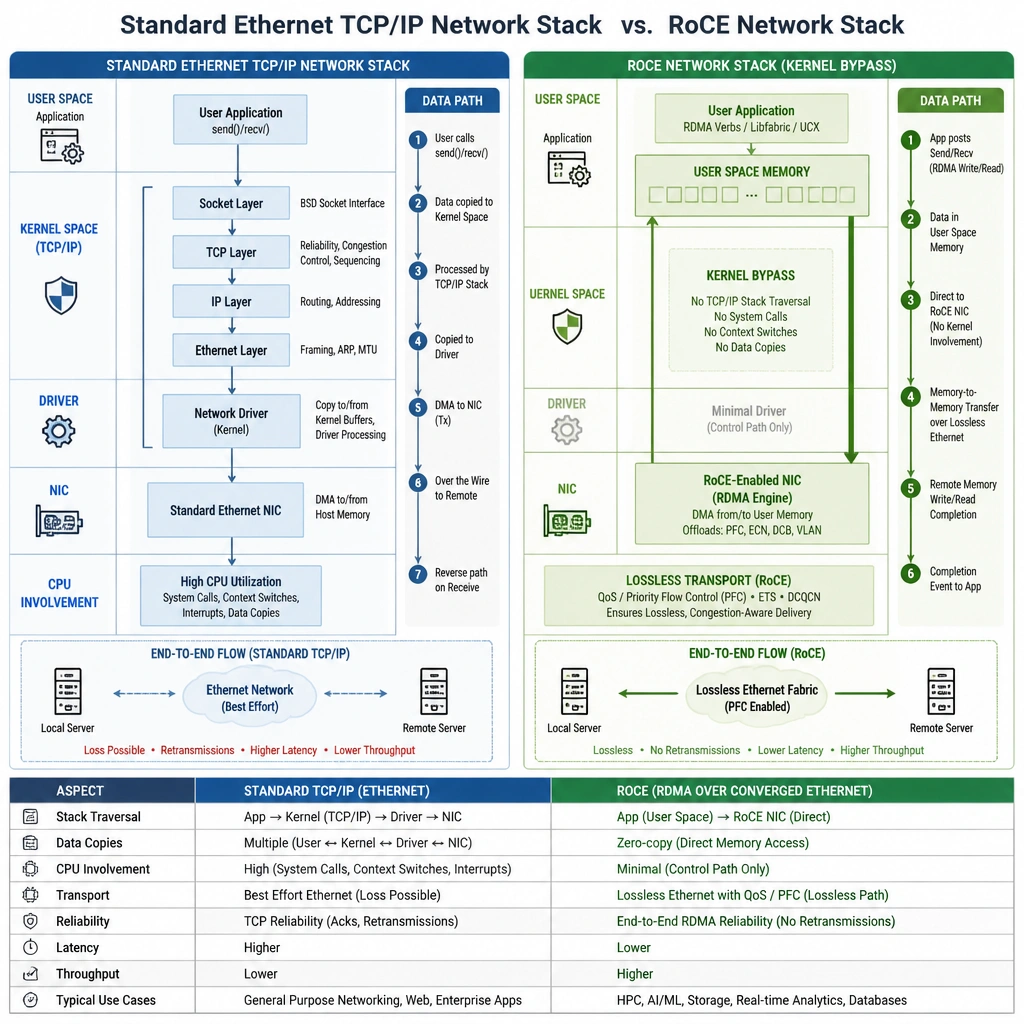
Okay, let's dive in. In high-performance AI clusters, the CPU is already super busy coordinating training tasks. The last thing you want is for the CPU to waste precious clock cycles wrapping and unwrapping network packets. That's why we love Remote Direct Memory Access (RDMA) over Ethernet, or RoCE. It does two amazing things: it bypasses the operating system's kernel entirely (kernel bypass), and it writes data directly from one server's memory to another's (memory-to-memory transfer) without bugging the CPU. But check this out: because Ethernet is naturally a lossy medium (it drops packets when busy), RoCE relies on Quality of Service features like Priority Flow Control (PFC) to make the network lossless. Trust me, these three are huge for the exam, so memorize them!
Full explanation below image
Full Explanation
RDMA over Converged Ethernet (RoCE) is a network protocol that enables Remote Direct Memory Access (RDMA) over Ethernet networks. It is highly valued in high-performance computing (HPC) and artificial intelligence workloads for three primary reasons. First, it features 'kernel bypass,' which allows the network interface card (NIC) to interact directly with application memory buffers, avoiding the overhead of copying data through the operating system kernel. Second, it enables direct memory-to-memory transfers between servers, meaning data is transferred directly from the memory of the source host to the memory of the destination host without CPU involvement, reducing CPU overhead and latency. Third, because RoCE requires a lossless Ethernet fabric to operate reliably, it supports advanced Quality of Service (QoS) mechanisms—specifically Priority Flow Control (PFC)—which pause traffic on a per-priority basis to prevent packet drops due to congestion. Option B is incorrect because RoCE (specifically RoCEv2) utilizes UDP/IP encapsulation, making it fully routable and scalable across large, multi-subnet enterprise networks. Option C is incorrect because RoCE is designed to offload data transfer tasks from the CPU to the network adapter. Option E is incorrect because RoCE bypasses the standard TCP/IP transport stack, relying instead on RoCE NIC hardware implementation and InfiniBand-based transport protocols or RoCE-specific congestion control (like ECN) over UDP.