
Generative AI has recently transitioned from academic labs into mainstream commercial applications. Which two of the following factors are most responsible for this rapid surge in the creation, deployment, and practical adoption of generative models? (Choose two)
Select all correct answers, then click Submit.
Short Explanation and Infographic
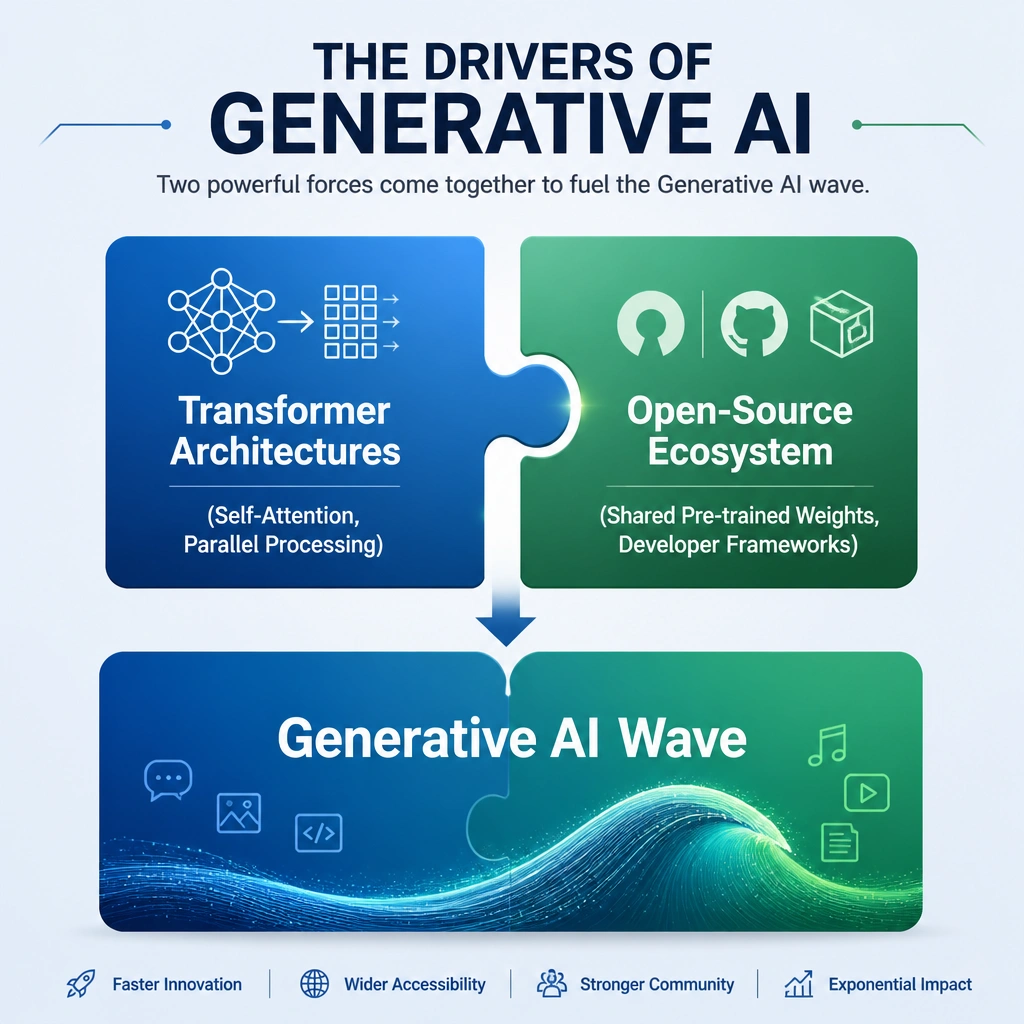
Here's the deal: Generative AI is taking over the world right now, but why? It comes down to two major things. First, the Transformer architecture. Before Transformers, AI couldn't handle complex, contextual relationships in data very well. The Transformer changed the game by allowing models to pay attention to different parts of an input simultaneously. Second, we have open-source access. Instead of starting from scratch and spending millions of dollars training a model, you can download pre-trained weights from places like Hugging Face and fine-tune them on a standard server. This accessibility has fueled the massive wave of innovation we're seeing today. Decreasing cloud interest or strict data blocks would kill this momentum, not help it!
Full explanation below image
Full Explanation
The current wave of Generative AI development and deployment is driven by a combination of algorithmic innovation and community-driven accessibility. The primary catalyst is the advancement in transformer-based neural network architectures. Transformers utilize self-attention mechanisms to capture long-range dependencies in data (such as text, images, or audio) far more effectively than previous sequential architectures, serving as the foundation for large language models (LLMs) and diffusion models. The second critical driver is the open-source ecosystem. Platforms like Hugging Face, PyTorch, and GitHub host pre-trained model checkpoints and developer tools, allowing organizations to adopt, fine-tune, and deploy state-of-the-art models without the immense cost of training them from scratch. Option A is incorrect because cloud computing is expanding, not declining, to support AI workloads. Option B is incorrect because strict regulations that block access to data would slow down AI development. Option D is incorrect because training and running large generative models have actually led to an increase, rather than a reduction, in data center energy usage.