
Which of the following statements regarding NVIDIA's NVLink high-speed interconnect technology is FALSE?
Select an answer to reveal the explanation.
Short Explanation and Infographic
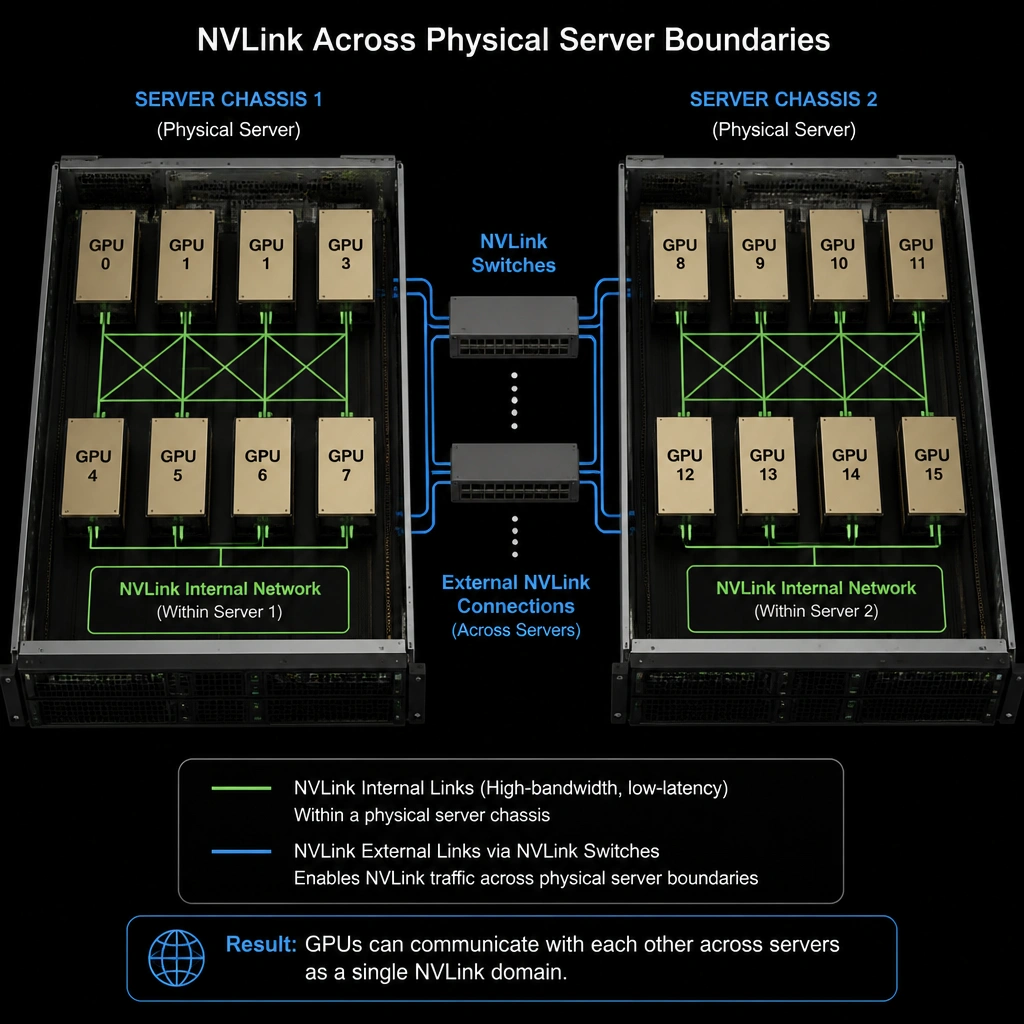
Let's clear up a huge misconception about NVLink. You probably know that NVLink is NVIDIA's super-fast, proprietary link that lets GPUs talk to each other directly, bypassing the slow PCIe bus. It's incredibly fast, and it lets GPUs share memory, creating a unified pool of VRAM. That's all true. But pay close attention here: people often think NVLink only works inside a single server box. That is false! With technologies like the NVIDIA NVLink Switch and NVLink Switch System, NVLink can actually be extended outside the chassis to connect GPUs across different physical servers in a cluster. This lets multiple servers act as one massive virtual GPU system. So, saying NVLink is exclusively for intra-server communication is incorrect—and that is exactly the kind of detail that shows up on the exam. Make sure you remember that!
Full explanation below image
Full Explanation
NVIDIA NVLink is a high-bandwidth, low-latency, proprietary interconnect designed for GPU-to-GPU communication. It was developed to overcome the bandwidth bottlenecks of the standard Peripheral Component Interconnect Express (PCIe) bus.
The statements correspond to NVLink characteristics as follows: - Proprietary Technology (Option A): NVLink is indeed a proprietary interface developed and owned by NVIDIA, requiring specialized physical connectors and controller logic on the GPU. - Memory Pooling (Option C): NVLink enables unified memory access (Direct Memory Access / DMA) between GPUs. This allows a GPU to read from and write to the memory of another GPU over the high-speed link with minimal latency, effectively creating a single, larger shared memory space. - Performance (Option D): NVLink offers vastly superior performance compared to PCIe. For example, NVLink on Hopper architecture (H100) provides up to 900 GB/s of bidirectional bandwidth, which is several times faster than PCIe Gen 5.
The incorrect statement is Option B. While NVLink was originally designed as an internal interconnect for GPUs within a single server chassis, NVIDIA extended this technology using NVLink Switch chips (and physical NVLink Switch systems). In architectures like the DGX SuperPOD, external NVLink cabling allows the NVLink network fabric to extend across multiple physical server nodes, enabling inter-server GPU-to-GPU communications at NVLink speeds. Therefore, it is false to state that NVLink is exclusively restricted to a single chassis.