
An enterprise is building an AI supercomputing cluster and plans to deploy RDMA over Converged Ethernet (RoCE) to interconnect GPU nodes. Which three characteristics of RoCE make it highly suited for the low-latency, high-throughput demands of distributed AI training?
Select all correct answers, then click Submit.
Short Explanation and Infographic
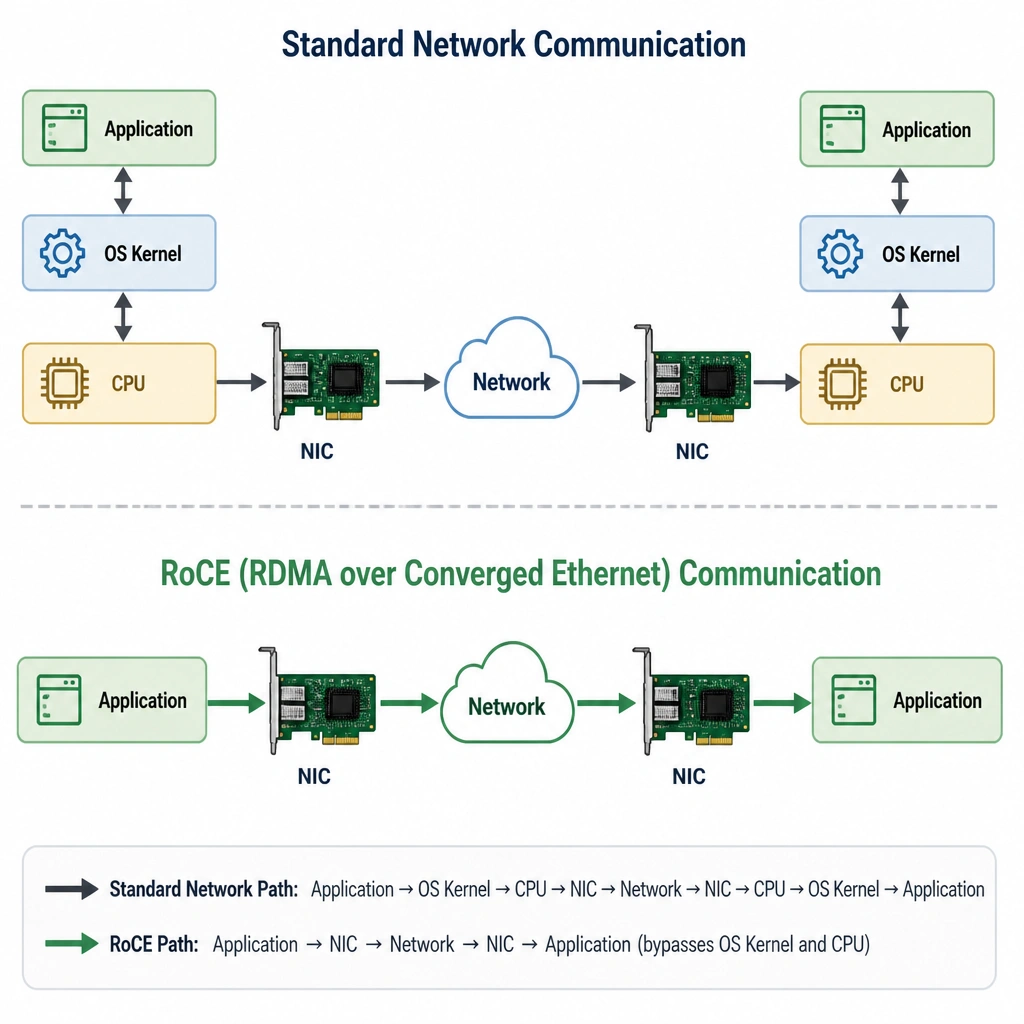
Think of RoCE as a VIP fast-pass for your data. In standard networking, when one server wants to send data to another, the CPU has to get involved, copy the data into the operating system's kernel space, wrap it in TCP/IP, and then send it out. That's a ton of CPU overhead and latency—definitely not what you want when training a multi-billion parameter model! RoCE changes the game. First, it uses kernel bypass, meaning the application talks directly to the network interface card (NIC), skipping the OS kernel entirely. Second, it does direct memory-to-memory transfers—zero-copy—meaning data goes from Server A's memory straight to Server B's memory without bugging either CPU. Finally, because standard Ethernet can drop packets under heavy load, RoCE relies on Quality of Service (QoS) features like Priority Flow Control (PFC) to make the network lossless. Trust me, these three features are why RoCE is a powerhouse in AI networks. The TCP stack, high CPU usage, and bad scaling are exactly what we're trying to avoid!
Full explanation below image
Full Explanation
Remote Direct Memory Access over Converged Ethernet (RoCE) is a critical networking technology in high-performance computing (HPC) and distributed AI workloads. Distributed training requires constant synchronization of model gradients and weights across hundreds or thousands of GPUs, making networking performance a primary bottleneck. RoCE addresses this through three key mechanisms:
1. Kernel Bypass (Option A): Traditional network communication requires transitioning data between user space and kernel space within the operating system. This context switching and protocol processing introduce significant latency and CPU overhead. RoCE allows applications to write directly to the network adapter's hardware registers, bypassing the operating system kernel entirely, which reduces latency to the microsecond level.
2. Zero-Copy / CPU Offloading (Option B): RoCE enables direct memory-to-memory data transfers between remote host systems. The network interface card (NIC) handles the data transfer directly from the source system's RAM or GPU memory (e.g., GPUDirect RDMA) to the destination system's memory. This occurs without copying data into intermediate CPU buffers or requiring host CPU processing, freeing up CPU resources for other tasks.
3. Lossless Ethernet / Quality of Service (Option C): Because RoCE typically runs over Ethernet, it requires a lossless fabric to prevent packet drops, which would trigger retransmissions and destroy performance. RoCE relies on Converged Ethernet features, specifically Quality of Service (QoS) protocols like Priority Flow Control (PFC) (IEEE 802.1Qbb). PFC operates at the data link layer to pause traffic on a per-priority basis, preventing buffer overflows and ensuring lossless delivery.
In contrast: - RoCE v2 utilizes UDP/IP encapsulation rather than TCP/IP (Option D) to route packets across subnets while avoiding TCP's connection management and congestion control overhead. - It reduces CPU utilization rather than increasing it (Option E). - It is highly scalable across large modern data center networks (Option F) when combined with appropriate routing and congestion management.