
When setting up a high-performance AI cluster that uses RDMA over Converged Ethernet (RoCE) for inter-node communication, which protocol performs the critical task of discovering neighboring RDMA-capable devices and exchanging address mapping information?
Select an answer to reveal the explanation.
Short Explanation and Infographic
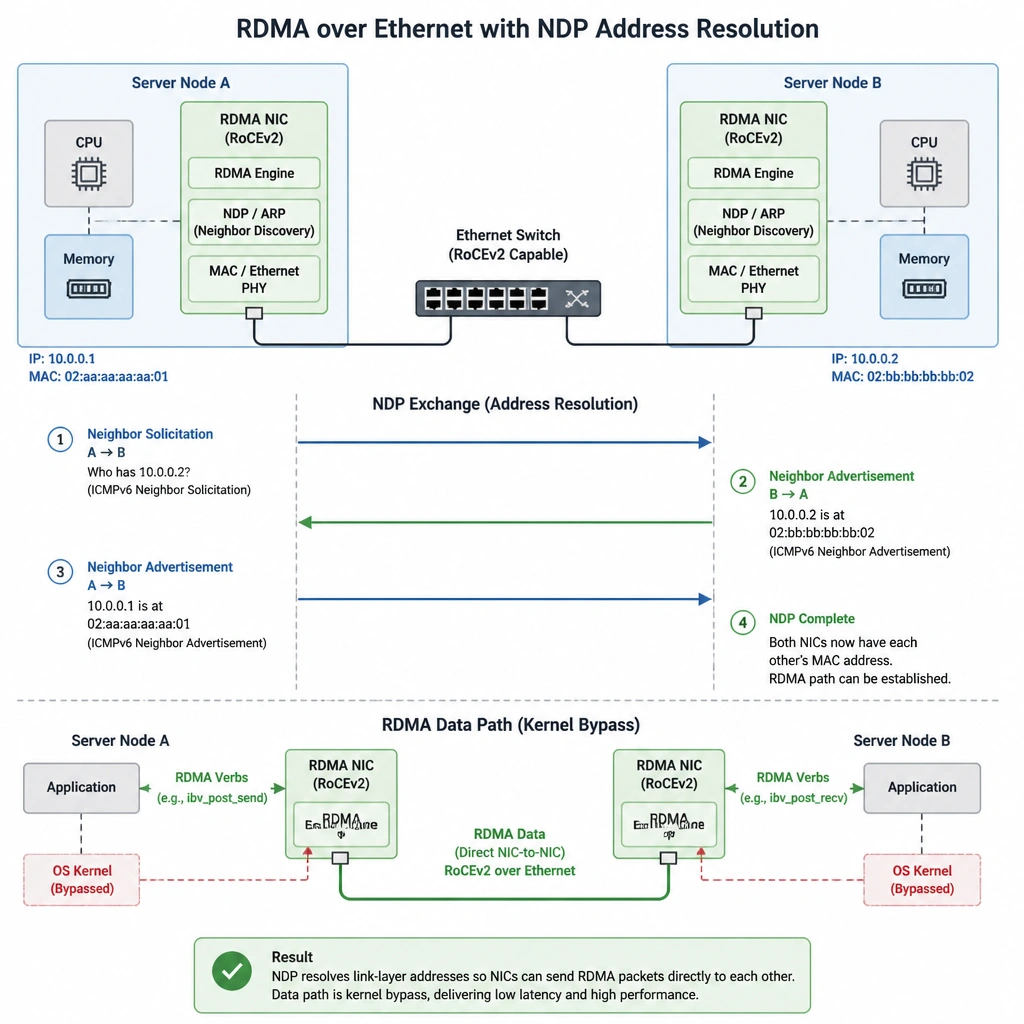
Here's the deal: if you want your GPUs to talk to each other across different nodes without burning CPU cycles, you're going to use RDMA over Converged Ethernet, or RoCE. But how do these RDMA adapters find each other and swap their addressing info? They use the Neighbor Discovery Protocol, or NDP. Think of NDP as the ultimate local guide—it replaces the old-school ARP we used in IPv4, handling address resolution and neighbor discovery in IPv6 environments. Pay close attention here: Cisco's CDP is proprietary and won't help you discover third-party RDMA nodes. ARP is strictly IPv4 and doesn't support the RDMA extension metadata needed here, and while LLDP is great for showing you physical switch port connections, it doesn't exchange the node-to-node RDMA addressing info needed to establish your RDMA path. Get NDP running, and your cluster will be humming in no time.
Full explanation below image
Full Explanation
Neighbor Discovery Protocol (NDP) is a core component of the IPv6 protocol suite and is critical in RoCE (RDMA over Converged Ethernet) deployments. In a RoCE network, NDP is utilized to discover neighboring devices, verify host reachability, and exchange the address and capability information necessary to bootstrap RDMA connections between nodes. - Neighbor Discovery Protocol (NDP) (the correct answer) is responsible for resolving network-layer addresses to link-layer addresses (replacing ARP in IPv6) and discovering neighboring RDMA-enabled hosts. - Address Resolution Protocol (ARP) (Option C) is used in IPv4 networks for mapping IP addresses to MAC addresses. While RoCE v2 can run over IPv4, standard ARP lacks the built-in capability extensions needed for RDMA-specific discovery and state tracking that NDP handles in modern IPv6-based converged Ethernet fabrics. - Cisco Discovery Protocol (CDP) (Option A) is a proprietary Layer 2 protocol used by Cisco devices to share information about other directly connected Cisco equipment. It is not used for end-host RDMA device discovery or address resolution. - Link Layer Discovery Protocol (LLDP) (Option D) is a vendor-neutral Layer 2 protocol used by network devices to advertise their identity and capabilities to neighbors, but it is not used by the operating system or RoCE stack to dynamically resolve IP/MAC mappings for active RDMA traffic streams.