
An enterprise is migrating multi-petabyte datasets to a public cloud environment. To guarantee that no files are corrupted, truncated, or lost during the transit phase, which data integrity strategy should the migration team implement?
Select an answer to reveal the explanation.
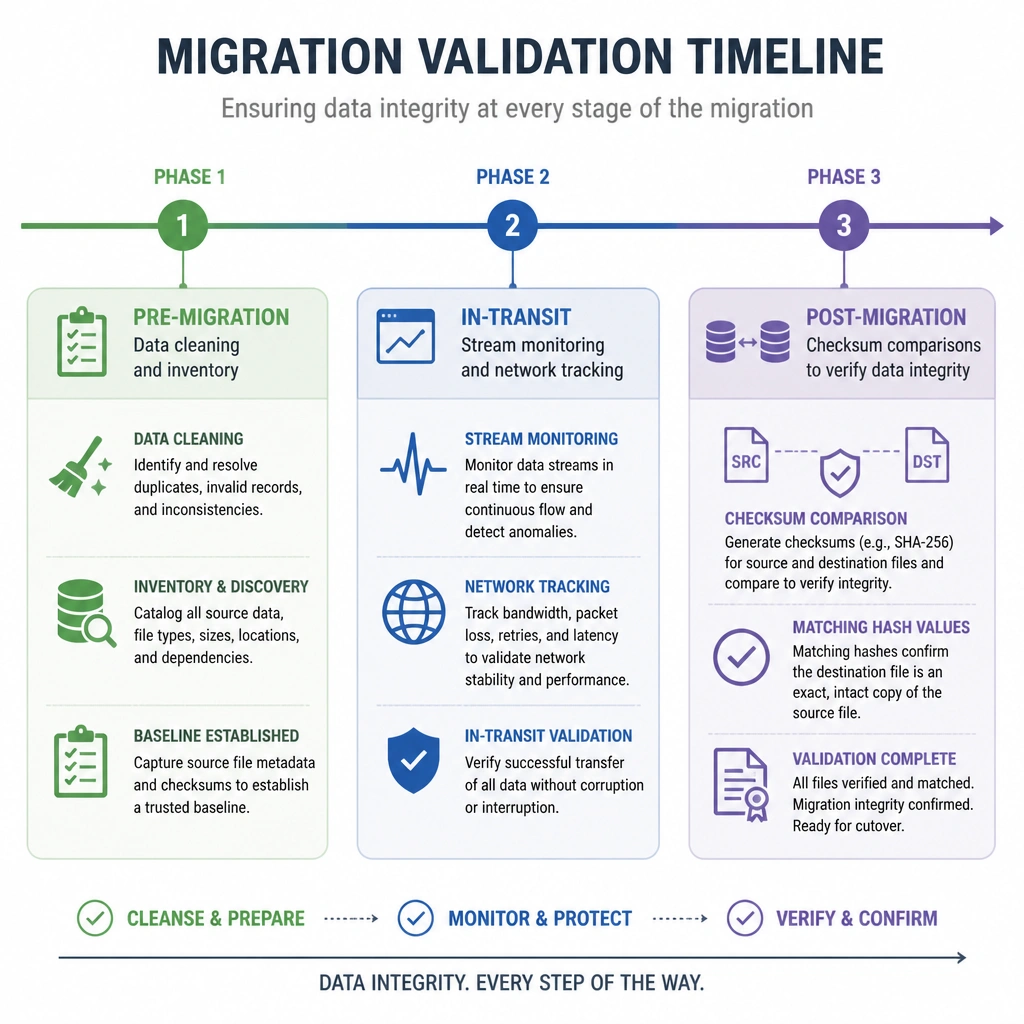
Short Explanation and Infographic
Think of it like moving your entire house to a new state. If you only count your boxes before the truck leaves, you have no idea if a box fell off the truck during the drive or if it got damaged on the way. You need a multi-layered plan. First, catalog everything before it goes (pre-migration). Next, track the truck along the route (in-transit monitoring). Finally, count and inspect every box when it arrives using checksums (post-migration verification). If you only do one of these, you're leaving data integrity to luck. Trust me, you need all three phases to make sure your data arrives in perfect shape.
Full explanation below image
Full Explanation
Ensuring data integrity during large-scale enterprise migrations requires mitigating risks at every stage of the data transfer lifecycle. A single validation method is insufficient because corruption can occur during read operations, transit over the network, or write operations on the destination filesystem.
A comprehensive data integrity strategy must be multi-layered: 1. Pre-migration: Scanning and validating source data to identify corrupted files, duplicates, or incompatible schemas. 2. In-transit: Monitoring the transfer streams in real-time to detect network interruptions or packet loss. 3. Post-migration: Generating cryptographic checksums (e.g., MD5 or SHA-256) on both source and destination files to verify that every byte was copied accurately.
Let's analyze the other choices: - Delta migration is an optimization technique that syncs changes made after the bulk transfer, but it does not validate the integrity of the transferred data. - Backups created after migration are useless if the data was already corrupted during the migration process. - Pre-migration validation alone cannot detect corruption or packet loss that occurs while the data is in transit over the network.