
You are designing a next-generation data center partition specifically optimized for training trillion-parameter Large Language Models (LLMs). Which GPU architecture will deliver the highest computational throughput and memory efficiency for these massive transformer models?
Select an answer to reveal the explanation.
Short Explanation and Infographic
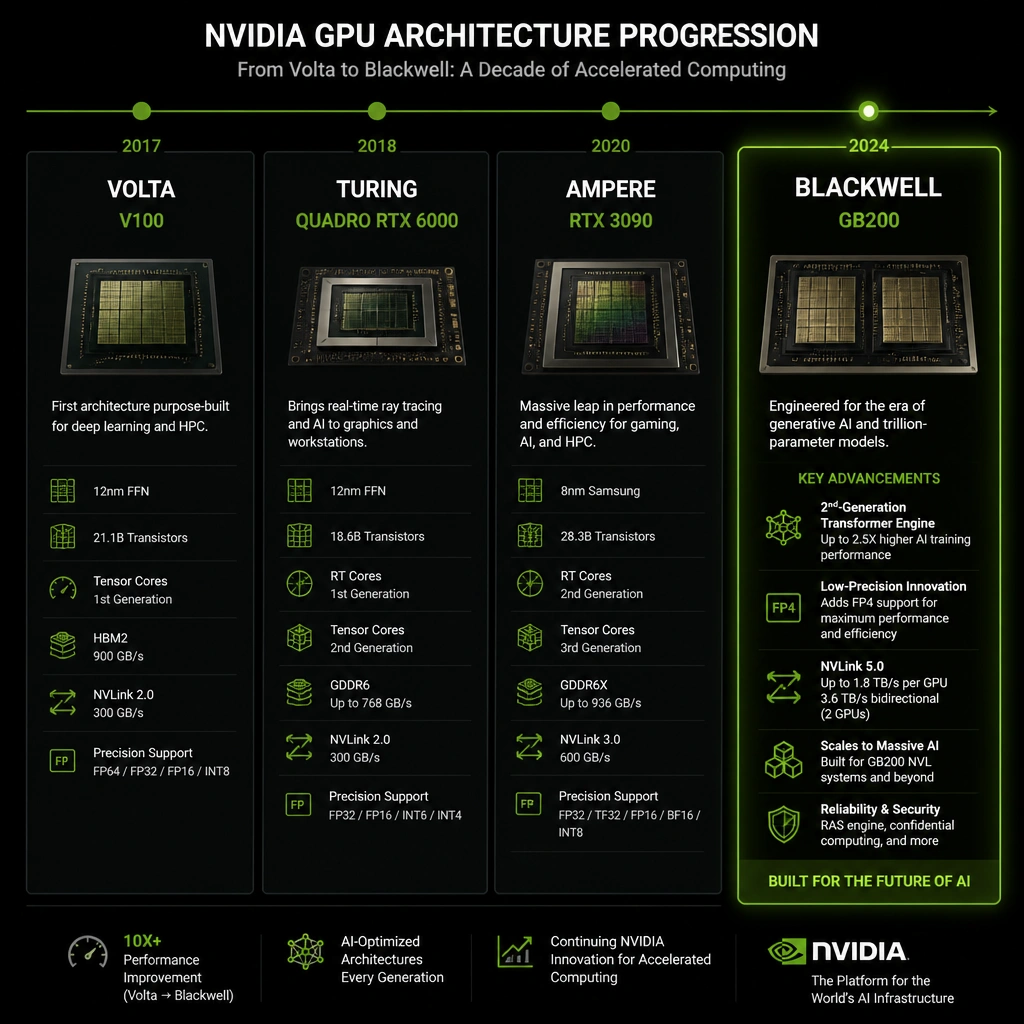
Here's the deal: training LLMs with hundreds of billions or trillions of parameters is one of the most demanding workloads on earth. If you look at the architecture list, the Blackwell-based NVIDIA GB200 is the clear king of the hill. It features a second-generation Transformer Engine and high-speed NVLink interconnects that are purpose-built to handle massive model scaling. Workstation GPUs like the Quadro RTX 6000, consumer cards like the RTX 3090, and even older data center workhorses like the Volta V100 simply cannot compete with the sheer memory bandwidth, throughput, and numeric precision support (like FP4) of Blackwell. Trust me, Blackwell is the architecture designed to break through the LLM scaling wall.
Full explanation below image
Full Explanation
Training large language models (LLMs) requires extreme compute density, massive memory capacity with high bandwidth, and ultra-fast interconnects to scale across thousands of GPUs. The NVIDIA GB200 (Grace Blackwell Superchip), based on the Blackwell architecture, is designed specifically to address these challenges. It integrates Grace CPUs and Blackwell GPUs, featuring a second-generation Transformer Engine that supports micro-scaling formats (including FP4 and FP8) to maximize throughput and memory efficiency for transformer-based models.
Let's contrast this with the other options: - The NVIDIA Quadro RTX 6000 is a workstation-class Turing GPU designed for professional rendering and CAD applications, completely lacking the memory architecture or NVLink scaling required for LLM training. - The GeForce RTX 3090 is a consumer Ampere GPU that lacks enterprise-level driver support, high-speed interconnect scaling, and data center thermal design. - The NVIDIA Tesla V100 (Volta architecture), released in 2017, was a pioneer in Tensor Core technology, but its memory bandwidth, FP16 throughput, and lack of modern Transformer Engines make it highly inefficient for today's LLM workloads compared to Blackwell.