
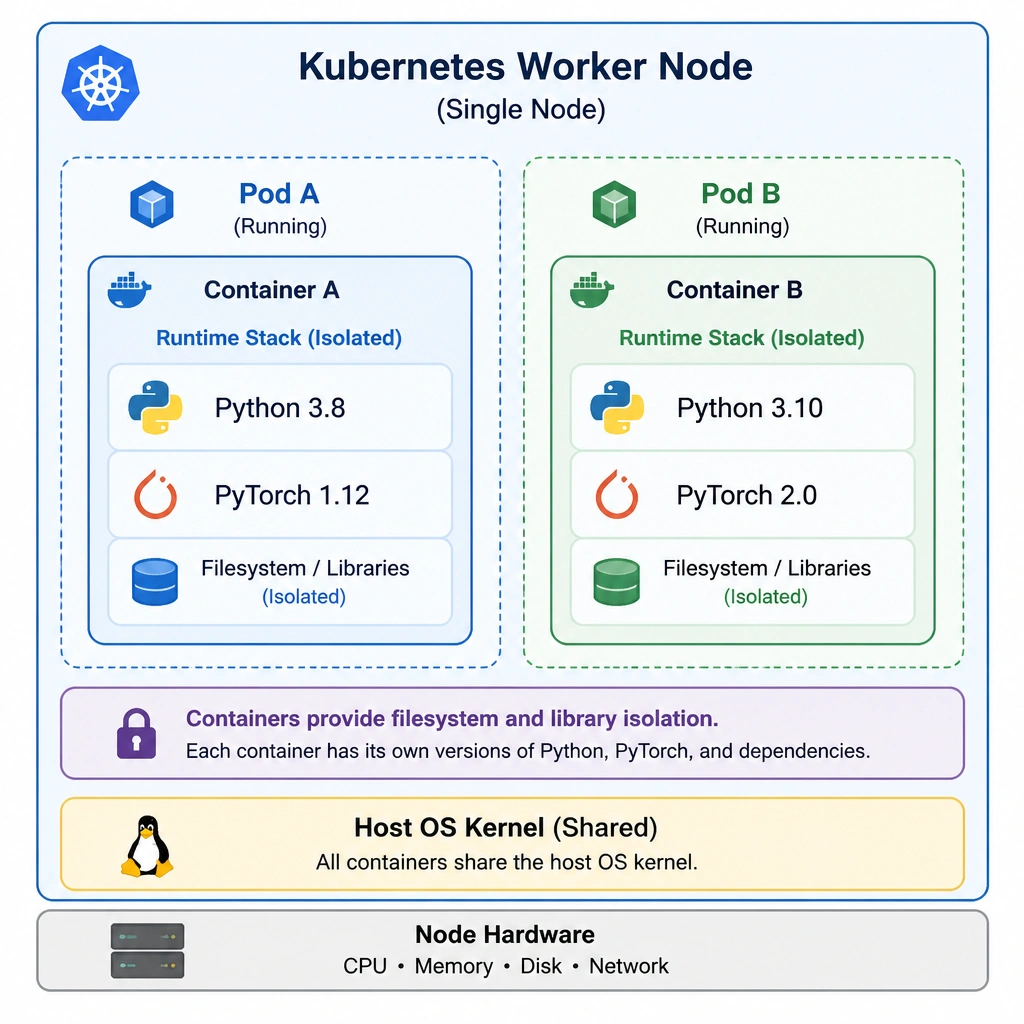
You need to deploy two different AI models on the same physical Kubernetes cluster. Model A requires Python 3.8 and PyTorch 1.12, while Model B requires Python 3.10 and PyTorch 2.0. Which technology should you use to ensure these conflicting runtime environments and libraries do not interfere with each other on the host nodes?
Select an answer to reveal the explanation.
Short Explanation and Infographic
Here's the deal: in the AI world, dependency hell is very real. You've got one model that needs PyTorch 1.12 and another that won't run on anything older than PyTorch 2.0. If you try to install both directly on the host operating system, things are going to break fast. Trust me on this. The solution is containers. Think of a container like a self-contained apartment. It packages up the model, the exact Python version, and all the libraries it needs into one neat little bundle. It doesn't care what the apartment next door is running because the walls are solid. Namespaces might sound like they do this, but they only organize Kubernetes objects—they don't isolate your library runtimes!
Full explanation below image
Full Explanation
Containers are the fundamental packaging and isolation technology used in modern cloud-native environments like Kubernetes. They allow developers to bundle an application or model along with all of its specific dependencies, libraries, binaries, and environment variables into a single image. This container image runs in an isolated user space on the host operating system, sharing the host kernel but maintaining its own isolated file system and library path. This isolation prevents conflicts between different applications or models running on the same cluster, enabling Model A and Model B to run side-by-side without library path collisions or version conflicts.
Let's look at why the other options are incorrect: Option A is incorrect because Kubernetes Namespaces provide logical partition boundaries within a cluster for resource quota management, access control (RBAC), and naming scope. They do not isolate the execution environments or prevent system-level file conflicts on the underlying worker nodes. Option B is incorrect because ConfigMaps are designed to store non-confidential configuration data in key-value pairs, which pods can consume as environment variables, command-line arguments, or configuration files in a volume. They do not provide application execution isolation. Option D is incorrect because the Horizontal Pod Autoscaler (HPA) is a controller that automatically adjusts the number of replica pods in a deployment or stateful set based on observed CPU utilization or custom metrics. It is a scaling mechanism, not an isolation mechanism.