
A machine learning engineer is deploying a large language model (LLM) into production using NVIDIA NIM (NVIDIA Inference Microservice). Compared to a standard, unoptimized open-source container deployment of the same model on the same GPU infrastructure, what is the primary performance benefit that NIM provides?
Select an answer to reveal the explanation.
Short Explanation and Infographic
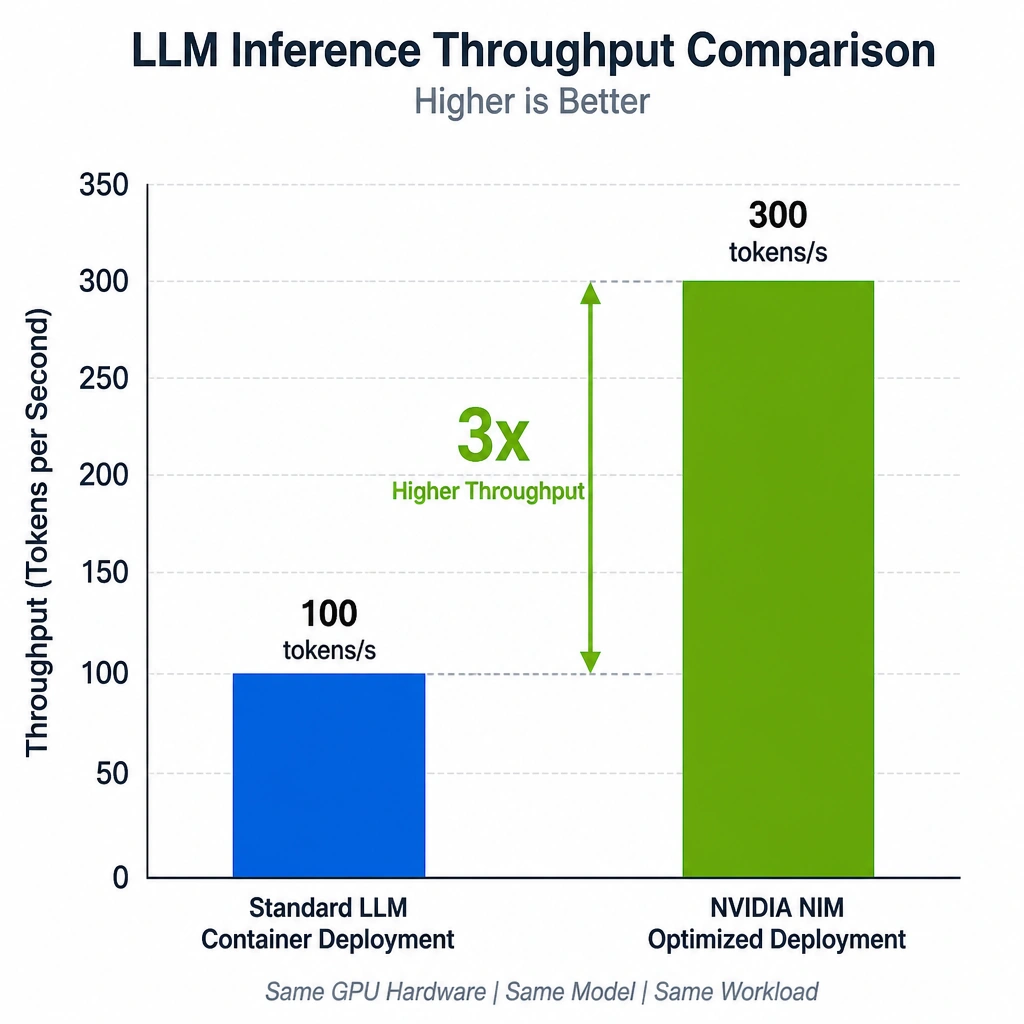
Here's the deal—running large language models in production can be incredibly expensive and slow if you're just using a default container setup. When you use NVIDIA NIM, the cool thing is that it comes pre-packaged with highly optimized inference engines like TensorRT-LLM that are specifically tuned for your exact GPU architecture. In the real world, this means you can get up to three times more tokens per second out of the exact same hardware compared to a basic, off-the-shelf container. And the best part? It doesn't sacrifice your model's accuracy to get that speed, and it's definitely not running on slow CPUs. It's pure, optimized GPU performance. Trust me, getting a 3x boost without upgrading your hardware is a massive win!
Full explanation below image
Full Explanation
NVIDIA NIM (NVIDIA Inference Microservice) is a set of optimized cloud-native microservices designed to accelerate the deployment of generative AI models across enterprise environments. It is part of the NVIDIA AI Enterprise suite. The primary performance improvement offered by NIM is its ability to deliver up to a 3x increase in inference throughput (measured in tokens per second for LLMs) on the same underlying GPU hardware compared to standard, unoptimized open-source model deployments.
NIM achieves this boost through hardware-specific compilation and deep software-level optimization. The containers include runtime engines like TensorRT and TensorRT-LLM, which are fine-tuned for NVIDIA architectures to optimize key-value (KV) caching, batching, and tensor operations.
Let's evaluate the incorrect options: - A is incorrect because NIM does not dynamically compress and decompress model weights during runtime to save memory. While quantization (like FP8 or INT4) can be used to fit models into smaller memory footprints, this is a pre-compilation step, not a dynamic runtime compression process. - B is incorrect because NIM does not trade off model accuracy or precision to achieve high speed. The throughput improvements are achieved through structural engine efficiency and optimal resource utilization, not by degrading the model's accuracy. - D is incorrect because NIM is engineered specifically to maximize performance on NVIDIA GPU-accelerated computing platforms, rather than converting workloads to run on CPU-only architectures.