
A local broadcasting studio is building a set of physical editing suites to handle real-time rendering, color grading, and video editing of raw 8K camera feeds. Which GPU configuration will provide the necessary local VRAM capacity and specialized media acceleration hardware for this professional workstation setup?
Select an answer to reveal the explanation.
Short Explanation and Infographic
If you're dealing with raw 8K video editing, you're talking about massive amounts of data flowing in real time. Your editors will scream if their timeline stutters. You need a GPU that has two things: a huge chunk of fast memory (VRAM) to hold those high-res frames, and dedicated hardware chips (like NVENC and NVDEC) to handle video encoding and decoding without breaking a sweat. The NVIDIA GeForce RTX 4090 is absolute gold here with 24GB of VRAM and dual encoders. An older GTX card is way too slow and lacks modern features, integrated graphics will just freeze up, and a server-side Tesla T4 is too weak for raw local 8K editing. Keep it local, keep it fast—RTX 4090 is the clear choice here. Got it? Sweet. Let's keep rolling.
Full explanation below image
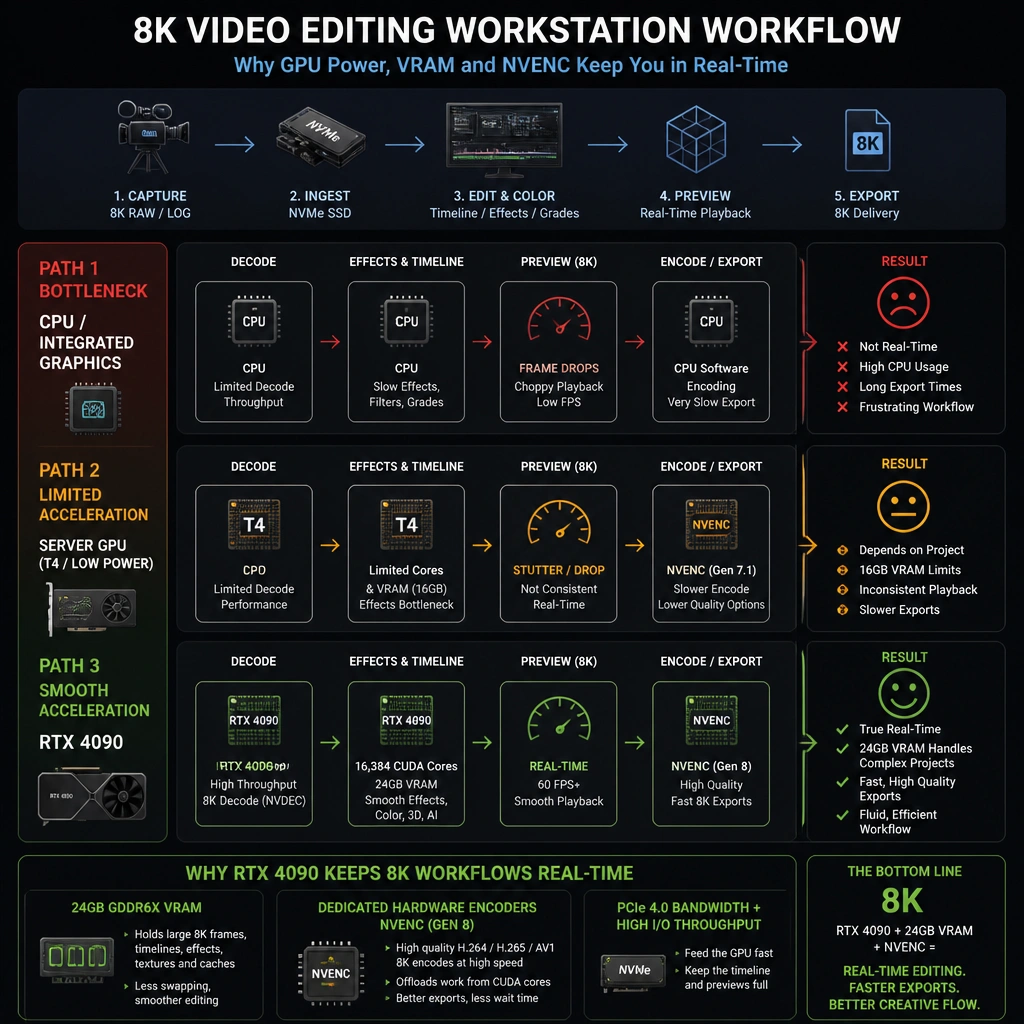
Full Explanation
Processing raw 4K and 8K video feeds in real-time requires high memory bandwidth, massive compute capability, and dedicated hardware acceleration. - Why Option B is correct: The NVIDIA GeForce RTX 4090 provides 24GB of high-speed GDDR6X VRAM, which is essential for loading large 8K video frames into memory during editing and color grading. Additionally, it features eighth-generation NVIDIA Encoders (NVENC) with dual AV1 encoders, enabling extremely fast video exporting and real-time timeline scrubbing with heavy effects. - Why Option A is incorrect: Legacy GeForce GTX GPUs lack the necessary VRAM capacity, tensor cores, and modern hardware video encoders (like AV1 support). SLI configuration is also deprecated and not supported or optimized by modern video editing suites. - Why Option C is incorrect: Integrated graphics processors (iGPUs) share system memory, which is significantly slower than dedicated VRAM. Relying on CPU-based software encoding for 8K rendering is extremely slow and will cause severe timeline lag. - Why Option D is incorrect: The NVIDIA Tesla T4 is a low-power (70W) enterprise GPU designed primarily for inference workloads in servers. It only has 16GB of slower GDDR6 memory and lacks the raw compute power and display interfaces needed for local, high-fidelity real-time 8K editing workstations. Memory Aid: Local high-end video editing needs high local VRAM (24GB+) and heavy-duty media engines. The RTX 4090 is the flagship workstation/enthusiast option that fits this perfectly.