
You are designing a multi-node GPU cluster to train massive deep learning models. Scaling performance horizontally across multiple nodes is notoriously difficult due to communication bottlenecks. Which of the following strategies and technologies are most critical to implement or configure to maximize training efficiency and scaling? (Choose three)
Select all correct answers, then click Submit.
Short Explanation and Infographic
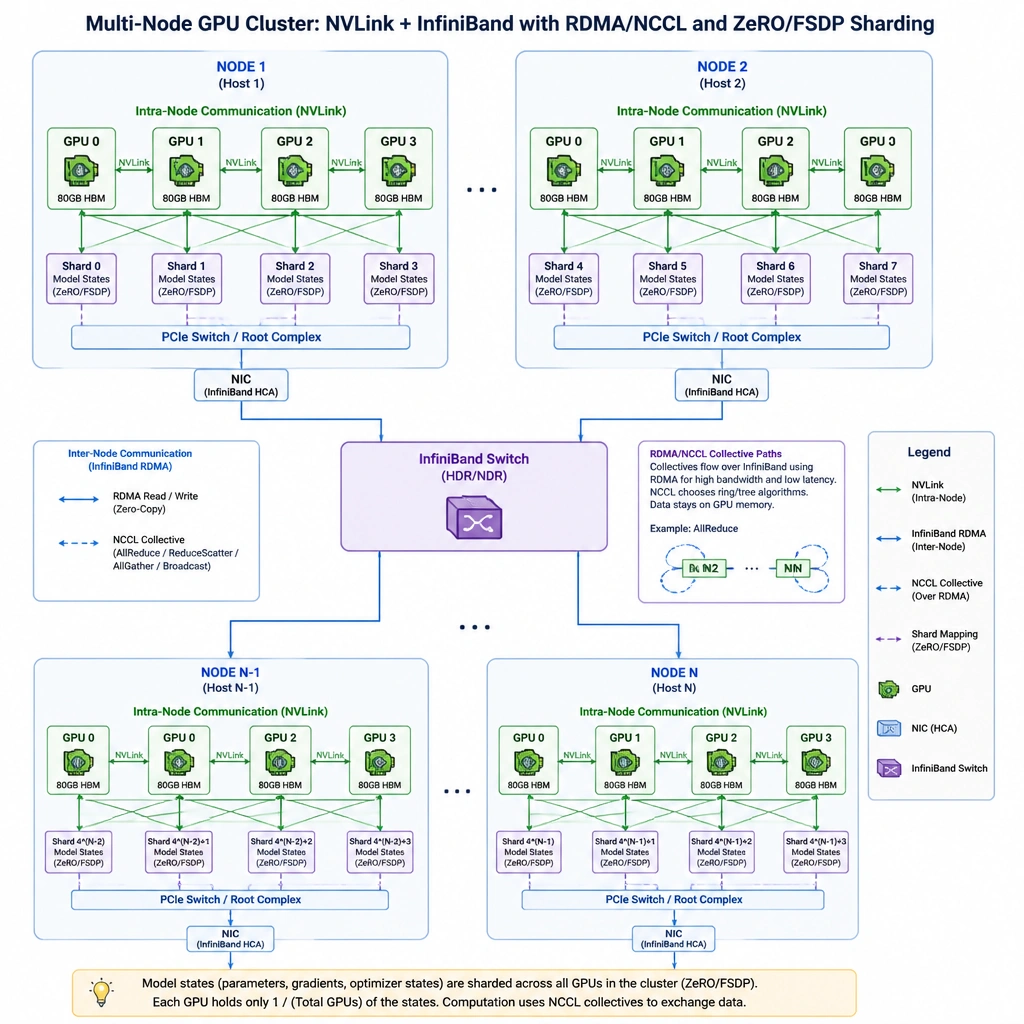
Here's the deal: training massive AI models across a bunch of nodes isn't just about throwing more GPUs at the problem. If your network is slow, your expensive GPUs are going to sit around twiddling their thumbs waiting for data. That's why you absolutely need a screaming-fast, low-latency interconnect like InfiniBand or RoCE v2—we're talking sub-microsecond latency. But the hardware is only half the battle. You've also got to run smart software strategies like DeepSpeed ZeRO or FSDP to split up the model parameters, and leverage libraries like NCCL to optimize how those GPUs talk to each other during gradient sync. Trust me on this, if you ignore communication overhead, your multi-node cluster will crawl.
Full explanation below image
Full Explanation
Distributed training of large language models (LLMs) across multiple GPU nodes is highly sensitive to communication bottlenecks. When scaling out, the primary performance inhibitor is the time GPUs spend waiting to synchronize gradients and model states. To address this, three technical pillars are essential:
First, high-bandwidth and ultra-low-latency network interconnects (such as InfiniBand or RDMA over Converged Ethernet - RoCE v2) are required. These technologies allow GPUs to bypass the host CPU and OS network stack (using GPUDirect RDMA) to transfer data directly between node memories, keeping latency under a microsecond.
Second, distributed training frameworks must be implemented to manage model parameters and gradients across nodes. Strategies like Distributed Data Parallel (DDP) replicate the model but partition the data, while Fully Sharded Data Parallel (FSDP) and DeepSpeed ZeRO shard model states, gradients, and optimizer states across the cluster, preventing out-of-memory (OOM) errors and optimizing resource utilization.
Third, the underlying communication library (such as NVIDIA Collective Communications Library, or NCCL) must be optimized. NCCL implements highly tuned collective communication primitives (like AllReduce and AllGather) that maximize throughput across both PCIe/NVLink (intra-node) and InfiniBand (inter-node) connections, minimizing gradient synchronization overhead.
While power distribution, cooling, and data preprocessing are critical for overall operations and data quality, they do not directly optimize the network and computational scaling efficiency during the training loop itself.