
An infrastructure architect is analyzing hardware requirements for training a trillion-parameter Large Language Model (LLM). Why does the architect specify high-end GPUs over high-core-count server CPUs regarding memory subsystem performance?
Select an answer to reveal the explanation.
Short Explanation and Infographic
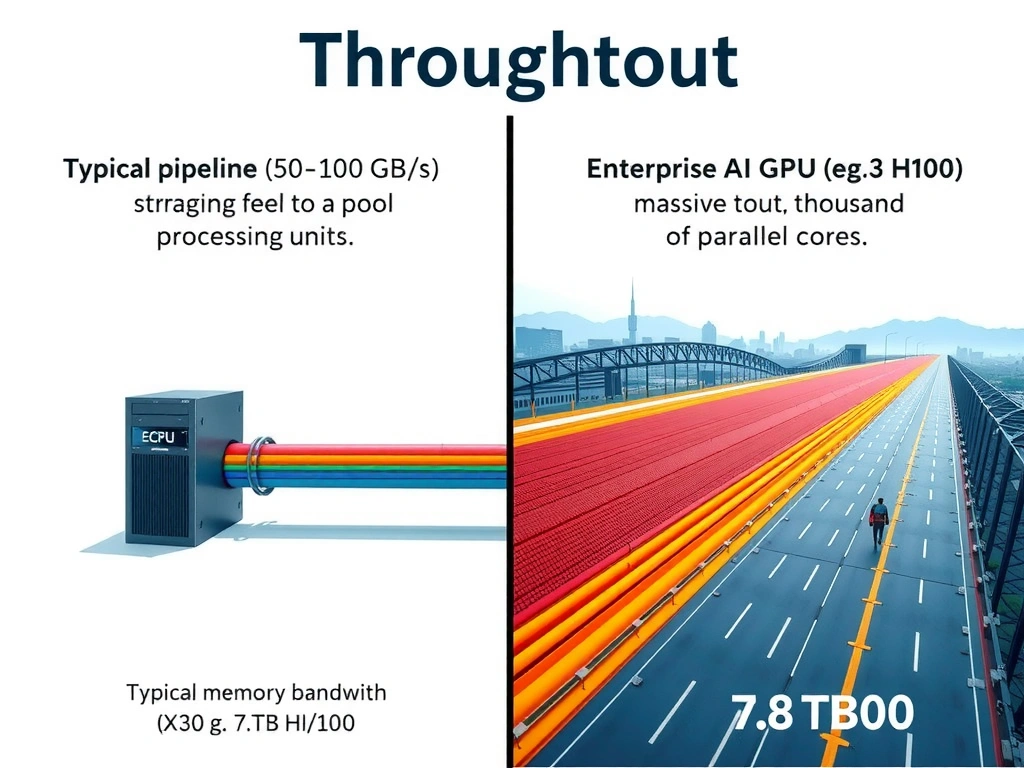
Here's the deal: deep learning is incredibly hungry for data. It's not just about how fast your cores can crunch numbers—it's about how fast you can feed those numbers to the cores. If you have a Ferrari engine but feed it fuel through a coffee straw, you aren't going anywhere fast! That coffee straw is the CPU's memory bandwidth, sitting at a modest 50 to 100 gigabytes per second. The GPU? It's feeding that engine with a high-pressure fire hose, delivering up to 7.8 terabytes per second of throughput. Think about it: that's over a hundred times more data moving per second! When you are training large language models with billions or trillions of parameters, those parameters have to be loaded and updated constantly. If you tried to run this on a CPU, the execution units would spend most of their time waiting around for data. GPUs solve this hardware bottleneck. Trust me, memory bandwidth is one of the most critical factors in AI performance, and the GPU wins this battle by a landslide.
Full explanation below image
Full Explanation
Deep learning training workloads are highly memory-bound due to the massive volume of weights, activations, and gradient data that must be constantly transferred between processor registers and memory. A standard server CPU, even with multi-channel DDR5 memory, typically provides around 50 GB/s to 100 GB/s of bandwidth per socket. High-end AI accelerators like the NVIDIA H100 or H200 utilize advanced High Bandwidth Memory (HBM3/HBM3e) which stacks memory dies vertically and connects them via a wide silicon interposer. This design achieves memory bandwidths of up to 3.35 TB/s to 7.8 TB/s. This immense bandwidth delta is critical for preventing compute elements from stalling, making GPUs vastly superior for high-throughput, data-intensive deep learning tasks. Let's analyze the incorrect options: - Option A is incorrect because memory bandwidth is a primary performance bottleneck in AI workloads. High compute capacity is useless if data cannot be loaded into the compute units quickly enough. - Option C is incorrect because the performance gap is a fundamental hardware architectural difference (DDR memory channels vs. stacked High Bandwidth Memory interfaces), not a software optimization issue. - Option D is incorrect because CPUs do not supply greater memory bandwidth. While system RAM (DDR5) has high capacity, it has significantly lower bandwidth compared to the specialized on-package HBM used in high-end GPUs.