
Which of the following statements accurately contrasts the computational operations and data processing workflows between the AI model training phase and the inference phase?
Select an answer to reveal the explanation.
Short Explanation and Infographic
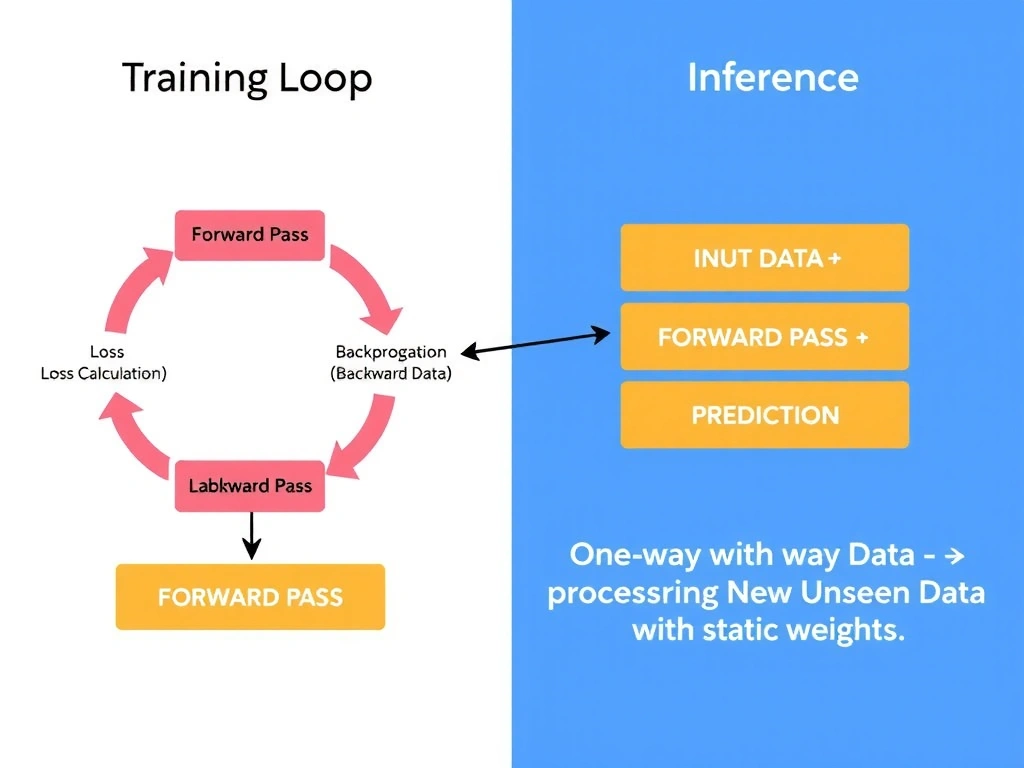
Let's talk about the difference between school and the real world. Model training is like studying for a massive exam. You read the textbook, take a practice test (forward pass), check the answer key to see where you messed up (calculating loss), and then study what you got wrong so you do better next time (that's backpropagation and updating weights). You do this over and over again—which takes huge amount of brainpower (and GPU compute). Inference is the actual exam day. You get a question (new data), you write down your answer based on what you already know (forward pass), and you move on. You don't update your knowledge during the exam itself. That's why inference is much lighter and faster—it's just a one-way street (forward pass) to get a prediction. Keep this analogy in mind because the exam will definitely test you on these differences!
Full explanation below image
Full Explanation
The lifecycle of a machine learning model is divided into two distinct computational phases: training and inference. 1. Training Phase: This is the phase where the model learns the relationship between inputs and outputs. It requires feeding a massive dataset (often labeled historical data) through the model. Each iteration consists of a forward pass, loss computation, and a backward pass (backpropagation) to calculate gradients and update internal weights via an optimizer. This cycle is repeated over many epochs, demanding immense computational power, high memory bandwidth, and high-speed inter-GPU communications. 2. Inference Phase: Once the model is trained, it is deployed to production to make predictions on new, unseen data. During inference, input data goes through a single forward pass to produce the output. No backward pass is performed, and the model's weights remain fixed. Because there is no backpropagation, inference requires significantly less memory and computational overhead per query than training, allowing it to be deployed on smaller hardware profiles or edge devices while focusing on minimizing response latency. Let's examine the incorrect options: Option A reverses the characteristics. Option B reverses the math. Option D is incorrect because training is almost always accelerated by GPUs due to its intense computational demands, while inference can sometimes be run on CPUs if latency requirements are lenient.